

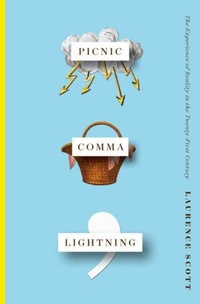
Picnic Comma Lightning
The Experience of Reality in the Twenty-First Century
Published on 28. May 2019
Book
Hardback
256 pages
978-0-393-60997-4 (ISBN)
Description
In Vladimir Nabokov's Lolita, Humbert Humbert offers a memorably brief account of his parents' death: "picnic, lightning." Picnic Comma Lightning, too, opens with death-that of Laurence Scott's mother-because, for a philosopher, death raises a profound existential question: How do we know what is real, especially when we have come to question the reality of so many of our day-to-day experiences? Writing from the intersection of philosophy, politics, and memoir, Scott transforms his personal meditation on loss into a beguiling exploration of what it means to exist in the world today.
It used to be that our lives were rooted in reasonably solid things: to people, places and memories. Now, in an age of online personas, alternative truths, constant surveillance and an increasingly hysterical news cycle, our realities are becoming flimsier and more vulnerable than ever before. Scott's far-ranging examination charts the ways our traditional mental models of the world have started to fray. He ponders how ubiquitous cameras reframe our private lives (an event only exists once someone posts the video), how mysterious algorithms undermine our attempts at self-definition through their own data-driven portraits, and what happens in those moments when our illusions about reality are ruptured by incontrovertible facts (like the death of a parent or a bolt of lightning). "A report from the front line of the online generation" (Sunday Times), Picnic Comma Lightning is an essential account of how we've started to make sense of our strange new world.
It used to be that our lives were rooted in reasonably solid things: to people, places and memories. Now, in an age of online personas, alternative truths, constant surveillance and an increasingly hysterical news cycle, our realities are becoming flimsier and more vulnerable than ever before. Scott's far-ranging examination charts the ways our traditional mental models of the world have started to fray. He ponders how ubiquitous cameras reframe our private lives (an event only exists once someone posts the video), how mysterious algorithms undermine our attempts at self-definition through their own data-driven portraits, and what happens in those moments when our illusions about reality are ruptured by incontrovertible facts (like the death of a parent or a bolt of lightning). "A report from the front line of the online generation" (Sunday Times), Picnic Comma Lightning is an essential account of how we've started to make sense of our strange new world.
Reviews / Votes
"[I]nsightful, in part for its academic nuance but also for its humane, personal style....A moving meditation of reality in the 21st century." -- Wired UK "[A] touching exploration of identity in the twenty-first century." -- Everything Else, culture podcast from the Financial Times "In its willingness to dig deeper, Picnic Comma Lightning provides a bravura investigation of our turbulent times." -- New Scientist "Clever, funny and deeply moving...an engaging and thought-provoking journey through the fakery of modern life." -- Mail on Sunday "A brave exploration of life after loss and how it alters our reality." -- Evening Standard "[A]cutely perceptive...delivers a thoughtful message about finding an authentic way to live at a time when reality itself can seem built on shifting sands." -- Publishers Weekly "A lucid...brilliant critique of a fragmented culture in a peculiar time." -- Kirkus Reviews (starred review)More details
Language
English
Place of publication
New York
United States
Dimensions
Height: 243 mm
Width: 167 mm
Thickness: 33 mm
Weight
531 gr
ISBN-13
978-0-393-60997-4 (9780393609974)
Copyright in bibliographic data and cover images is held by Nielsen Book Services Limited or by the publishers or by their respective licensors: all rights reserved.
Schweitzer Classification
Person
Laurence Scott's essays and criticism have appeared on NewYorker.com and in the Guardian, the Financial Times, and the London Review of Books, among other publications. He is a lecturer in writing at New York University in London and lives in London.