

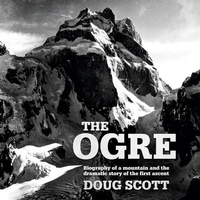
The Ogre
Biography of a mountain and the dramatic story of the first ascent
Published on 5. December 2019
Book
Paperback/Softback
192 pages
978-1-912560-92-9 (ISBN)
Description
'One of the greatest mountaineering survival stories never told.' - The Sunday Times
Some mountains are high; some mountains are hard. Few are both.
On the afternoon of 13 July 1977, having become the first climbers to reach the summit of the Ogre, Doug Scott and Chris Bonington began their long descent. In the minutes that followed, any feeling of success from their achievement would be overwhelmed by the start of a desperate fight for survival. And things would only get worse.
Rising to over 7,000 metres in the centre of the Karakoram, the Ogre - Baintha Brakk - is notorious in mountaineering circles as one of the most difficult mountains to climb. First summited by Scott and Bonington in 1977 - on expedition with Paul 'Tut' Braithwaite, Nick Estcourt, Clive Rowland and Mo Anthoine - it waited almost twenty-four years for a second ascent, and a further eleven years for a third.
The Ogre, by legendary mountaineer Doug Scott, is a two-part biography of this enigmatic peak: in the first part, Scott has painstakingly researched the geography and history of the mountain; part two is the long overdue and very personal account of his and Bonington's first ascent and their dramatic week-long descent on which Scott suffered two broken legs and Bonington smashed ribs. Using newly discovered diaries, letters and audio tapes, it tells of the heroic and selfless roles played by Clive Rowland and Mo Anthoine. When the desperate climbers finally made it back to base camp, they were to find it abandoned - and themselves still a long way from safety.
The Ogre is undoubtedly one of the greatest adventure stories of all time.
Some mountains are high; some mountains are hard. Few are both.
On the afternoon of 13 July 1977, having become the first climbers to reach the summit of the Ogre, Doug Scott and Chris Bonington began their long descent. In the minutes that followed, any feeling of success from their achievement would be overwhelmed by the start of a desperate fight for survival. And things would only get worse.
Rising to over 7,000 metres in the centre of the Karakoram, the Ogre - Baintha Brakk - is notorious in mountaineering circles as one of the most difficult mountains to climb. First summited by Scott and Bonington in 1977 - on expedition with Paul 'Tut' Braithwaite, Nick Estcourt, Clive Rowland and Mo Anthoine - it waited almost twenty-four years for a second ascent, and a further eleven years for a third.
The Ogre, by legendary mountaineer Doug Scott, is a two-part biography of this enigmatic peak: in the first part, Scott has painstakingly researched the geography and history of the mountain; part two is the long overdue and very personal account of his and Bonington's first ascent and their dramatic week-long descent on which Scott suffered two broken legs and Bonington smashed ribs. Using newly discovered diaries, letters and audio tapes, it tells of the heroic and selfless roles played by Clive Rowland and Mo Anthoine. When the desperate climbers finally made it back to base camp, they were to find it abandoned - and themselves still a long way from safety.
The Ogre is undoubtedly one of the greatest adventure stories of all time.
Reviews / Votes
'One of the greatest mountaineering survival stories never told.' - The Sunday Times.More details
Language
English
Place of publication
United Kingdom
Product notice
Paperback (UK-trade)
With flaps
Illustrations
Colour photographs; Black and white photographs
Dimensions
Height: 233 mm
Width: 161 mm
Thickness: 17 mm
Weight
496 gr
ISBN-13
978-1-912560-92-9 (9781912560929)
Copyright in bibliographic data and cover images is held by Nielsen Book Services Limited or by the publishers or by their respective licensors: all rights reserved.
Schweitzer Classification
Person
Born in Nottingham in 1941, Doug Scott began climbing
in Derbyshire when he was thirteen and without any obvious plan in it was soon
discovering the cliffs of Snowdonia, Scotland, the Alps and the Dolomites. He
completed his first Alpine season at the age of eighteen. In 1965, aged
twenty-three, he went on his first organised expedition, to the Tibesti
Mountains of Chad. It was to be the first of many trips to the high mountains
of the world. On 24 September 1975, he and his climbing partner Dougal Haston
became the first Britons to reach the summit of Mount Everest, via the
formidable South-West Face, and they became national heroes. In total, Scott made forty-two expeditions to the high mountains of Asia, reaching the
summits of forty peaks. With the exception of his ascent of Everest, he made all his climbs in lightweight or alpine style and without the use of
supplementary oxygen. Scott was made a CBE in 1994. He was a president of
the Alpine Club, and in 1999 he received the Royal Geographical Society
Patron's Gold Medal. In 2011 he was awarded the Lifetime Achievement Award by
the Piolets d'Or, during the presentation of which his mountaineering style was
described as 'visionary'. In 1995 he founded Community Action Nepal (CAN), a
UK-based registered charity whose aim is to help mountaineers to support the
mountain people of Nepal. Up until his death in December 2020, Scott continued
to climb, write and lecture, avidly supporting the work of CAN. He is the
author of six books, including Up and About and The Ogre. Kangchenjunga
is his final book.
in Derbyshire when he was thirteen and without any obvious plan in it was soon
discovering the cliffs of Snowdonia, Scotland, the Alps and the Dolomites. He
completed his first Alpine season at the age of eighteen. In 1965, aged
twenty-three, he went on his first organised expedition, to the Tibesti
Mountains of Chad. It was to be the first of many trips to the high mountains
of the world. On 24 September 1975, he and his climbing partner Dougal Haston
became the first Britons to reach the summit of Mount Everest, via the
formidable South-West Face, and they became national heroes. In total, Scott made forty-two expeditions to the high mountains of Asia, reaching the
summits of forty peaks. With the exception of his ascent of Everest, he made all his climbs in lightweight or alpine style and without the use of
supplementary oxygen. Scott was made a CBE in 1994. He was a president of
the Alpine Club, and in 1999 he received the Royal Geographical Society
Patron's Gold Medal. In 2011 he was awarded the Lifetime Achievement Award by
the Piolets d'Or, during the presentation of which his mountaineering style was
described as 'visionary'. In 1995 he founded Community Action Nepal (CAN), a
UK-based registered charity whose aim is to help mountaineers to support the
mountain people of Nepal. Up until his death in December 2020, Scott continued
to climb, write and lecture, avidly supporting the work of CAN. He is the
author of six books, including Up and About and The Ogre. Kangchenjunga
is his final book.
Content
Preface
Introduction
PART I
1. The Mountain
2. Ancient History of Exploration
3. European Interest in the Region
4. The East India Company
5. Scottish Contribution to Empire
6. The Blanks on the Map
7. Early Mountaineering
PART II
8. The Climbers
9. March to Base Camp
10. Climbing the Ogre
11. The Epic Descent
12. The Final Stretch
Afterword
Acknowledgements
Further Reading
The Author
Introduction
PART I
1. The Mountain
2. Ancient History of Exploration
3. European Interest in the Region
4. The East India Company
5. Scottish Contribution to Empire
6. The Blanks on the Map
7. Early Mountaineering
PART II
8. The Climbers
9. March to Base Camp
10. Climbing the Ogre
11. The Epic Descent
12. The Final Stretch
Afterword
Acknowledgements
Further Reading
The Author