

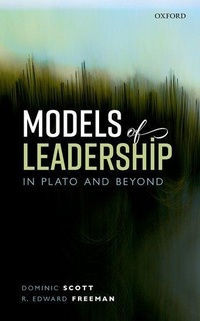
Models of Leadership in Plato and Beyond
Published on 15. July 2021
Book
Hardback
234 pages
978-0-19-883735-0 (ISBN)
Description
Leadership has become a prevalent concept across a variety of disciplines, among them history, politics, management studies, economics, and psychology. An array of definitions and theories have been proposed both by those who study leadership, and by those in leadership positions themselves. Here, Dominic Scott and R. Edward Freeman adopt a highly innovative approach by going back to one of the greatest thought leaders of all time, the Greek philosopher Plato.
Plato brought a richness and complexity to common ideas about the nature and purpose of leadership. Rather than attempting to give a single 'one-size-fits-all' definition, his strategy was to break it into its different strands. He presents several 'models' of leadership, mostly through images or analogies: the leader as doctor, navigator, artist, teacher, shepherd, weaver, or sower. Each model points to features of leadership that we intuitively recognize to be important, and which still carry significant weight today, such as curing a social malaise or charting a new course. Scott and Freeman set out the essentials of Plato's thought and illustrate each model through modern case studies, including presidents, CEOs, and Nobel laureates. They also measure Plato's models against more recent concepts, using his insights to throw light on contemporary theory and practice. With a principal focus on leadership, and an assumption of no prior knowledge of Plato's works, this book takes a multi-faceted approach to a complex phenomenon.
Plato brought a richness and complexity to common ideas about the nature and purpose of leadership. Rather than attempting to give a single 'one-size-fits-all' definition, his strategy was to break it into its different strands. He presents several 'models' of leadership, mostly through images or analogies: the leader as doctor, navigator, artist, teacher, shepherd, weaver, or sower. Each model points to features of leadership that we intuitively recognize to be important, and which still carry significant weight today, such as curing a social malaise or charting a new course. Scott and Freeman set out the essentials of Plato's thought and illustrate each model through modern case studies, including presidents, CEOs, and Nobel laureates. They also measure Plato's models against more recent concepts, using his insights to throw light on contemporary theory and practice. With a principal focus on leadership, and an assumption of no prior knowledge of Plato's works, this book takes a multi-faceted approach to a complex phenomenon.
Reviews / Votes
Overall, the book offers a practical and accessible account of how Plato's ancient leadership models can inform and guide today's leaders. * David C. Bauman, Regis University, Denver, Colorado, THE REVIEW OF POLITICS *More details
Language
English
Place of publication
Oxford
United Kingdom
Target group
College/higher education
Product notice
sewn/stitched
Cloth over boards
Dimensions
Height: 218 mm
Width: 145 mm
Thickness: 23 mm
Weight
431 gr
ISBN-13
978-0-19-883735-0 (9780198837350)
Copyright in bibliographic data and cover images is held by Nielsen Book Services Limited or by the publishers or by their respective licensors: all rights reserved.
Schweitzer Classification
Other editions
Additional editions
Dominic Scott | R. Edward Freeman
Models of Leadership in Plato and Beyond
E-Book
07/2021
1st Edition
OUP eBook
€26.49
Available for download
Dominic Scott | R. Edward Freeman
Models of Leadership in Plato and Beyond
E-Book
07/2021
1st Edition
OUP eBook
€26.49
Available for download
Persons
Dominic Scott is a professor of philosophy at the University of Oxford. He has previously held positions at Cambridge and the University of Virginia, as well as visiting positions at Princeton, Harvard, and the Center for Hellenic Studies, Washington DC. In 2001-3 he was a British Academy Research Reader and in 2016 a Humboldt Fellow based in Munich. He has written numerous books on ancient philosophy, as well as co-authoring The Humanities World Report 2015.
R. Edward Freeman is University Professor, Olsson Professor, and Academic Director of the Institute for Business in Society at the University of Virginia. He is best known for his award-winning book Strategic Management: A Stakeholder Approach (Pitman, 1984; reprinted by Cambridge University Press in 2010). He has received six honorary doctorates (Doctor Honoris Causa) for his work on stakeholder theory and business ethics. He is the host of The Stakeholder Podcast, sponsored by Stakeholder Media, LLC.
R. Edward Freeman is University Professor, Olsson Professor, and Academic Director of the Institute for Business in Society at the University of Virginia. He is best known for his award-winning book Strategic Management: A Stakeholder Approach (Pitman, 1984; reprinted by Cambridge University Press in 2010). He has received six honorary doctorates (Doctor Honoris Causa) for his work on stakeholder theory and business ethics. He is the host of The Stakeholder Podcast, sponsored by Stakeholder Media, LLC.
Content
Introduction
1: Setting the Scene
2: The Doctor
3: Captains and Navigators
4: The Artist
5: The Teacher
6: Doctors and Teachers
7: The Shepherd
8: The Weaver
9: The Sower
10: Teachers and Sowers
11: Plato and Modern Leadership Models
Conclusion
Appendix 1. Plato's Use of the Ship of State Image in the Republic
Appendix 2. Interpreting the Cave Allegory
Appendix 3. Extracts from Plato's Works
1: Setting the Scene
2: The Doctor
3: Captains and Navigators
4: The Artist
5: The Teacher
6: Doctors and Teachers
7: The Shepherd
8: The Weaver
9: The Sower
10: Teachers and Sowers
11: Plato and Modern Leadership Models
Conclusion
Appendix 1. Plato's Use of the Ship of State Image in the Republic
Appendix 2. Interpreting the Cave Allegory
Appendix 3. Extracts from Plato's Works