

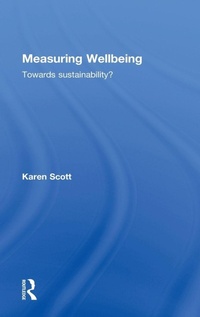
Measuring Wellbeing: Towards Sustainability?
Towards Sustainability?
1st Edition
Published on 18. May 2012
Book
Hardback
222 pages
978-1-84971-462-4 (ISBN)
Description
Improving wellbeing and sustainability are central goals of government, but are they in conflict? This engaging new book reviews that question and its implications for public policy through a focus on indicators.
It highlights tensions on the one hand between various constructs of wellbeing and sustainable development, and on the other between current individual and societal notions of wellbeing. It recommends a clearer conceptual framework for policy makers regarding different wellbeing constructs which would facilitate more transparent discussions. Arguing against a win-win scenario of wellbeing and sustainability, it advocates an approach based on recognising and valuing conflicting views where notions of participation and power are central to discussions.
Measuring Wellbeing is divided into two parts. The first part provides a critical review of the field, drawing widely on international research but contextualised within recent UK wellbeing policy discourses. The second part embeds the theory in a case study based on the author's own experience of trying to develop quality of life indicators within a local authority, against the backdrop of increasing national policy interest in measuring 'happiness'.
This accessible and informative book, covering uniquely both practice and theory, will be of great appeal to students, academics and policy makers interested in wellbeing, sustainable development, indicators, public policy, community participation, power and discourse.
It highlights tensions on the one hand between various constructs of wellbeing and sustainable development, and on the other between current individual and societal notions of wellbeing. It recommends a clearer conceptual framework for policy makers regarding different wellbeing constructs which would facilitate more transparent discussions. Arguing against a win-win scenario of wellbeing and sustainability, it advocates an approach based on recognising and valuing conflicting views where notions of participation and power are central to discussions.
Measuring Wellbeing is divided into two parts. The first part provides a critical review of the field, drawing widely on international research but contextualised within recent UK wellbeing policy discourses. The second part embeds the theory in a case study based on the author's own experience of trying to develop quality of life indicators within a local authority, against the backdrop of increasing national policy interest in measuring 'happiness'.
This accessible and informative book, covering uniquely both practice and theory, will be of great appeal to students, academics and policy makers interested in wellbeing, sustainable development, indicators, public policy, community participation, power and discourse.
More details
Language
English
Place of publication
London
United Kingdom
Publishing group
Taylor & Francis Ltd
Target group
College/higher education
Illustrations
12 s/w Abbildungen
12 Illustrations, black and white
Dimensions
Height: 240 mm
Width: 161 mm
Thickness: 17 mm
Weight
505 gr
ISBN-13
978-1-84971-462-4 (9781849714624)
Copyright in bibliographic data and cover images is held by Nielsen Book Services Limited or by the publishers or by their respective licensors: all rights reserved.
Schweitzer Classification
Other editions
Additional editions
Karen Scott
Measuring Wellbeing: Towards Sustainability?
E-Book
07/2012
1st Edition
Routledge
€59.49
Available for download
Karen Scott
Measuring Wellbeing: Towards Sustainability?
E-Book
07/2012
1st Edition
Routledge
€59.49
Available for download
Book
05/2012
1st Edition
Earthscan Ltd
€65.20
Shipment within 3-4 weeks
Person
Karen Scott is a research fellow at The Centre for Rural Economy at Newcastle University, UK. Her professional experience in social care, community planning and environmental fields underpins her academic research interest in the politics of human wellbeing and sustainable development at the local level.
Content
Part 1: Reviewing Wellbeing Concepts and Measurement 1.Introduction 2. Human Wellbeing and Quality of Life 3. Sustainable Wellbeing: An Oxymoron? 4. Leave it to the People? Power and Participation 5.The role of Indicators: Knowledge, Rationality and Public Policy Part 2 : Measuring Wellbeing in Practice 6. Case study in Blyth Valley District Council - Background and Context 7. Defining 'Local' Wellbeing: Discourse and Debate 8. Towards a Common Measure: Developing a Wellbeing Framework 9.Conclusion