

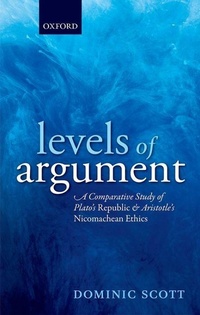
Levels of Argument
A Comparative Study of Plato's Republic and Aristotle's Nicomachean Ethics
Published on 5. March 2015
Book
Hardback
244 pages
978-0-19-924964-0 (ISBN)
Description
In Levels of Argument, Dominic Scott compares the Republic and Nicomachean Ethics from a methodological perspective. In the first half he argues that the Republic distinguishes between two levels of argument in the defence of justice, the 'longer' and 'shorter' routes. The longer is the ideal and aims at maximum precision, requiring knowledge of the Forms and a definition of the Good. The shorter route is less precise, employing hypotheses, analogies and empirical observation. This is the route that Socrates actually follows in the Republic, because it is appropriate to the level of his audience and can stand on its own feet as a plausible defence of justice. In the second half of the book, Scott turns to the Nicomachean Ethics. Scott argues that, even though Aristotle rejects a universal Form of the Good, he implicitly recognises the existence of longer and shorter routes, analogous to those distinguished in the Republic. The longer route would require a comprehensive theoretical worldview, incorporating elements from Aristotle's metaphysics, physics, psychology, and biology. But Aristotle steers his audience away from such an approach as being a distraction from the essentially practical goals of political science. Unnecessary for good decision-making, it is not even an ideal. In sum, Platonic and Aristotelian methodologies both converge and diverge. Both distinguish analogously similar levels of argument, and it is the shorter route that both philosophers actually follow--Plato because he thinks it will have to suffice, Aristotle because he thinks that there is no need to go beyond it.
Reviews / Votes
Scott's analysis helps bring important questions about Aristotle's method into sharp focus; he assesses the evidence judiciously, and defends plausible positions in a way that allows the reader to make up her own mind. In terms of style, Dominic Scott is perhaps the most elegant writer working on ancient philosophy today.Levels of Argumentsets a new benchmark for scholarship. It is one of the most original and thought-provoking works of ancient philosophy to appear in recent years. Like the works it studies, it rewards reading and re-reading, and will become a standard critical work for any serious student of ancient philosophy. * Karen Margrethe Nielsen, Mind * This book is without question a valuable contribution to our study of the Republic and Nicomachean Ethics. The carefulness and reasonableness with which Scott approaches the text inspire much confidence ... this methodologically innovative study on a well-chosen topic really does manage to let fresh air into our perennial reading of the Republic and Nicomachean Ethics. * Samuel H. Baker, Notre Dame Philosophical Reviews Online *More details
Language
English
Place of publication
Oxford
United Kingdom
Target group
College/higher education
Dimensions
Height: 222 mm
Width: 145 mm
Thickness: 17 mm
Weight
443 gr
ISBN-13
978-0-19-924964-0 (9780199249640)
Copyright in bibliographic data and cover images is held by Nielsen Book Services Limited or by the publishers or by their respective licensors: all rights reserved.
Schweitzer Classification
Other editions
Additional editions
Dominic Scott
Levels of Argument
A Comparative Study of Plato's Republic and Aristotle's Nicomachean Ethics
Book
03/2018
Oxford University Press
€37.19
Shipment within 15-20 days
Dominic Scott
Levels of Argument
A Comparative Study of Plato's Republic and Aristotle's Nicomachean Ethics
E-Book
03/2015
1st Edition
OUP eBook
€18.99
Available for download
Person
Dominic Scott was awarded a PhD in Classics from the University of Cambridge in 1988 and taught there in the Faculty of Philosophy and Clare College until 2007. Since then has been at the University of Virginia, and has now returned to the UK, teaching ethics and politics at the University of Kent. He has also held visiting positions at Oxford, Princeton and Harvard. From 2001 to 2003 he was a British Academy Research Reader. He has lectured extensively: in Europe, North and South America, and Asia. He has also done a great deal of work bringing philosophy into the public arena, working with government, civil service and business, and has co-authored a report on the worldwide state of the humanities.
Content
PART ONE; PART TWO