

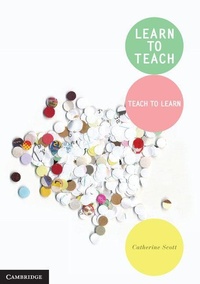
Learn to Teach
Teach to Learn
Published on 10. September 2014
Book
Paperback/Softback
250 pages
978-1-107-64719-0 (ISBN)
Description
Learn to Teach explores the most up-to-date findings on how children learn, to help teachers create effective learning environments and plan for teaching. Drawing on a neo-Vygotskian approach to learning, it covers the purpose of education; socio-cultural approaches to human cognition; attention and intelligence as cognitive tools; and the role of mindsets, memory and language in learning. It promotes the idea that the mind is a cultural product and that education is best understood as fostering the development of valued cognitive tools appropriate for the twenty-first century. To provide readers with a holistic understanding of learning, the book explores the significant contributions to the study of learning and teaching from psychologists, sociologists and cultural theorists. Readers are encouraged to critically engage with - and challenge - some of the prevailing learning theories in order to better understand their students. Each chapter features classroom observation exercises, discussion questions and links to further reading.
More details
Language
English
Place of publication
Cambridge
United Kingdom
Target group
College/higher education
Professional and scholarly
Product notice
Paperback (trade)
Dimensions
Height: 250 mm
Width: 174 mm
Thickness: 15 mm
Weight
401 gr
ISBN-13
978-1-107-64719-0 (9781107647190)
Copyright in bibliographic data and cover images is held by Nielsen Book Services Limited or by the publishers or by their respective licensors: all rights reserved.
Schweitzer Classification
Other editions
Additional editions
E-Book
09/2014
1st Edition
Cambridge University Press
€67.99
Available for download
E-Book
09/2014
Cambridge University Press
€56.49
Available for download
Person
Catherine Scott is a Senior Lecturer at the Melbourne Graduate School of Education, University of Melbourne.
Content
Introduction; 1. Ideas that shape thinking about learning and teaching; 2. Culture and education; 3. Natural pedagogy; 4. Intelligence; 5. Cognitive processes in the classroom; 6. Memory processes: making it stick; 7. Non-cognitive factors in school success; 8. Experts and novices; 9. Teaching unplugged: talk for learning; 10. Assessment and feedback: teaching's engine room.