

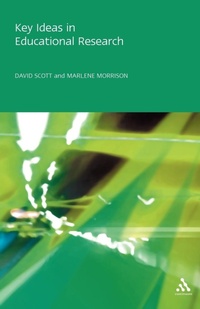
Key Ideas in Educational Research
Published on 15. May 2007
Book
Paperback/Softback
316 pages
978-0-8264-9569-3 (ISBN)
Description
It is easy for newcomers to educational research to be confused by the wide range of terms used in the field and consequently for them to find it challenging to relate such terms to their own research and practice. This comprehensive guide consists of 120 concise but illuminative essays providing: - an explanation and definition of the term - alternative explanations and definitions of the term - the context in which it is used by educational researchers - exemplars as to how the term is used and used be used in practice - references to further literature - cross-references to other terms in the book.
Reviews / Votes
"Students, instructors, and beginning researchers interestedin foundations of educational research, educational psychology, assessment, statistics, research design, anthropology and sociology of education, and philosophy of education will find this work of interest. Summing up: Highly recommended. All readership levels." -CHOICE * Choice *More details
Language
English
Place of publication
London
United Kingdom
Publishing group
Bloomsbury Publishing PLC
Target group
College/higher education
Professional and scholarly
Dimensions
Height: 216 mm
Width: 140 mm
Thickness: 17 mm
Weight
400 gr
ISBN-13
978-0-8264-9569-3 (9780826495693)
Copyright in bibliographic data and cover images is held by Nielsen Book Services Limited or by the publishers or by their respective licensors: all rights reserved.
Schweitzer Classification
Other editions
Additional editions
David Scott | Marlene Morrison
Key Ideas in Educational Research
E-Book
11/2005
1st Edition
Continuum International Publishing Group Ltd.
€83.49
Available for download
Persons
David Scott is Professor of Educational Leadership and Learning at the University of Lincoln. Dr. Marlene Morrison is Reader at the University of Lincoln.
Content
Complete list of headwords:; abduction; access; action research; agency; alignment; anti-racism; assessment; biography / autobigraphy; case study; categorisation. causation; childhood research; closed and open systems; coding; comparative research; content analysis; conversation analysis; correlational research; critical discourse analysis; critical incidents; critical realism; critical theory; culture; data display; data reduction; deconstruction; deduction; design; determinism; diaries; discourse; dissemination; distribution; documentary analysis; downward conflation; emotionalism; empiricism; empowerment; epistemology / ontolgy; ethics; ethnography; ethnomethodology; evaluation; evidence-based practice; experiment; fallacies; fallibility; feminist research; focus groups; gender; generalisation; grounded theory; hemeneutics; historical research; ideal speech situation; induction; interpretativism; interview; life history; linguistic discourse analysis; literture review; longitudinal observation studies; mathematical modelling; media; method; methodology; mixed methods; narrative; naturalistic observation; nomothetic statements; objectivity; observation; paradigm; phenomenology; plagiarism; positivism; postmodernism; power; prediction; publishing; qualitative research; quantitative research; questionnaire; realism; reductionism; refereeing; reflexivity; referencing systems; regression analysis; relativism; relevance; reliability; replication; representativeness; research assessment exercise; research community; respondent validation; retroduction; sampling; social constructionism; statistics; strategy; structuralism / post-structuralism; structure; subjectivity; survey; symbolic interactionism; systematic observation; telephone interviews; tests; textuality; transferability; triangulation; validity; value-added; values; variable analysis; virtual research; writing; writing for academic purposes; writing as representation.; Author index; Subject index.