

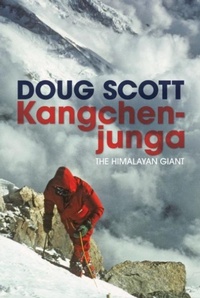
Kangchenjunga
The Himalayan giant
Published on 1. July 2021
Book
Hardback
288 pages
978-1-912560-19-6 (ISBN)
Description
Kangchenjunga is the third highest mountain in the world and a notoriously difficult and dangerous mountain to climb. First climbed from the west in 1955 by a British team comprising Joe Brown, George Band, Tony Streather and Norman Hardie, it waited over twenty years for a second ascent. The third ascent, from the north, was made in 1979 by a four-man team including the visionary British alpinist Doug Scott.
Completed before his death in 2020, and edited by Catherine Moorehead, Kangchenjunga is Doug Scott's final book. Scott explores the mountain and its varied people - the mountain sits on the border between Nepal and Sikkim in north-east India - before going on to look at Western approaches and early climbing attempts on the mountain. Kangchenjunga was in fact long believed to be the highest mountain in the world, until in the nineteenth century it was demonstrated that Peak XV - Everest - was taller. Out of respect for the beliefs of the Sikkimese, no climber has ever set foot on the very top of Kangchenjunga, the sacred summit.
Scott's own relationship with the mountain began in 1978, three years after his first British ascent of Everest with Dougal Haston. The assembled team featured some of the greatest mountaineers in history: Scott, Joe Tasker, Peter Boardman and Georges Bettembourg. The plan was for a stripped-down expedition the following spring - minimal Sherpa support, no radios, largely self-financed. It was the first time a mountain of this scale had been attempted by a new and difficult route without the use of oxygen, and with such a small team. Scott, Tasker and Boardman summited on 16 May 1979, further consolidating their legends in this golden era.
Kangchenjunga is Doug Scott's tribute to this sacred mountain, a paean for a Himalayan giant, written by a giant of Himalayan climbing.
Completed before his death in 2020, and edited by Catherine Moorehead, Kangchenjunga is Doug Scott's final book. Scott explores the mountain and its varied people - the mountain sits on the border between Nepal and Sikkim in north-east India - before going on to look at Western approaches and early climbing attempts on the mountain. Kangchenjunga was in fact long believed to be the highest mountain in the world, until in the nineteenth century it was demonstrated that Peak XV - Everest - was taller. Out of respect for the beliefs of the Sikkimese, no climber has ever set foot on the very top of Kangchenjunga, the sacred summit.
Scott's own relationship with the mountain began in 1978, three years after his first British ascent of Everest with Dougal Haston. The assembled team featured some of the greatest mountaineers in history: Scott, Joe Tasker, Peter Boardman and Georges Bettembourg. The plan was for a stripped-down expedition the following spring - minimal Sherpa support, no radios, largely self-financed. It was the first time a mountain of this scale had been attempted by a new and difficult route without the use of oxygen, and with such a small team. Scott, Tasker and Boardman summited on 16 May 1979, further consolidating their legends in this golden era.
Kangchenjunga is Doug Scott's tribute to this sacred mountain, a paean for a Himalayan giant, written by a giant of Himalayan climbing.
More details
Language
English
Place of publication
United Kingdom
Product notice
With printed dust jacket
Illustrations
Maps; Colour photographs
Dimensions
Height: 236 mm
Width: 161 mm
Thickness: 29 mm
Weight
606 gr
ISBN-13
978-1-912560-19-6 (9781912560196)
Copyright in bibliographic data and cover images is held by Nielsen Book Services Limited or by the publishers or by their respective licensors: all rights reserved.
Schweitzer Classification
Other editions
Additional editions
E-Book
07/2021
Vertebrate Publishing
€5.99
Available for download
Person
Born in Nottingham in 1941, Doug Scott began climbing in Derbyshire when he was thirteen and without any obvious plan in it was soon discovering the cliffs of Snowdonia, Scotland, the Alps and the Dolomites. He completed his first Alpine season at the age of eighteen. In 1965, aged twenty-three, he went on his first organised expedition, to the Tibesti Mountains of Chad. It was to be the first of many trips to the high mountains of the world. On 24 September 1975, he and his climbing partner Dougal Haston became the first Britons to reach the summit of Mount Everest, via the formidable South-West Face, and they became national heroes. In total, Scott made forty-two expeditions to the high mountains of Asia, reaching the summits of forty peaks. With the exception of his ascent of Everest, he made all his climbs in lightweight or alpine style and without the use of supplementary oxygen. Scott was made a CBE in 1994. He was a president of the Alpine Club, and in 1999 he received the Royal Geographical Society Patron's Gold Medal. In 2011 he was awarded the Lifetime Achievement Award by the Piolets d'Or, during the presentation of which his mountaineering style was described as 'visionary'. In 1995 he founded Community Action Nepal (CAN), a UK-based registered charity whose aim is to help mountaineers to support the mountain people of Nepal. Up until his death in December 2020, Scott continued to climb, write and lecture, avidly supporting the work of CAN. He is the author of six books, including Up and About and The Ogre. Kangchenjunga is his final book.