

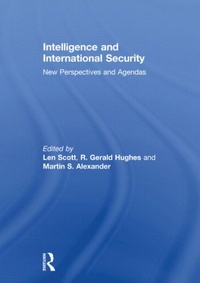
Intelligence and International Security
New Perspectives and Agendas
1st Edition
Published on 8. October 2010
Book
Hardback
182 pages
978-0-415-58387-9 (ISBN)
Description
The events of 9/11 and subsequent acts of jihadist terrorism, together with the failures of intelligence agencies over Iraq's Weapons of Mass Destruction, have arguably heralded a new age of intelligence. For some this takes the form of a crisis of legitimacy. For others the threat of cataclysmic terrorism involving chemical, biological, radiological or nuclear attack gives added poignancy to the academic contention that intelligence failure is inevitable. Many of the challenges facing intelligence appear to be both new and deeply worrying. In response, intelligence has clearly taken on new forms and new agendas. How these various developments are viewed depends upon the historical, normative and political frameworks in which they are analysed. This book addresses fundamental questions arising in this new age.
The central aim of the collection is to identify key issues and questions and subject them to interrogation from different methodological perspectives using internationally acclaimed experts in the field. A key focus in the collection is on British and North American perspectives. Recent trends and debates about the organisation and conduct of intelligence provide key themes for exploration. Underpinning several contributions is the recognition that intelligence faces a conflict of ideas as much as practices and threats.
This book was published as a special issue of Intelligence and National Security.
The central aim of the collection is to identify key issues and questions and subject them to interrogation from different methodological perspectives using internationally acclaimed experts in the field. A key focus in the collection is on British and North American perspectives. Recent trends and debates about the organisation and conduct of intelligence provide key themes for exploration. Underpinning several contributions is the recognition that intelligence faces a conflict of ideas as much as practices and threats.
This book was published as a special issue of Intelligence and National Security.
More details
Language
English
Place of publication
London
United Kingdom
Publishing group
Taylor & Francis Ltd
Target group
College/higher education
Dimensions
Height: 246 mm
Width: 174 mm
Weight
500 gr
ISBN-13
978-0-415-58387-9 (9780415583879)
Copyright in bibliographic data and cover images is held by Nielsen Book Services Limited or by the publishers or by their respective licensors: all rights reserved.
Schweitzer Classification
Other editions
Additional editions
Len Scott | R. Gerald Hughes | Martin Alexander
Intelligence and International Security
New Perspectives and Agendas
E-Book
10/2013
Routledge
€52.49
Available for download
Len Scott | R. Gerald Hughes | Martin Alexander
Intelligence and International Security
New Perspectives and Agendas
E-Book
10/2013
Routledge
€52.49
Available for download
Len Scott | R. Gerald Hughes | Martin Alexander
Intelligence and International Security
New Perspectives and Agendas
Book
04/2013
Routledge
€57.14
The article will not be published
Len Scott | R. Gerald Hughes | Martin Alexander
Intelligence and International Security
New Perspectives and Agendas
Book
09/2012
1st Edition
Routledge
€67.02
Shipment within 15-20 days
Persons
Len Scott is Professor of International Politics and Director of the Centre for Intelligence and International Security Studies at Aberystwyth University. His recent publications include, as co-editor (with R. Gerald Hughes) Intelligence, Crises and Security: Prospects and Retrospects (2008) and (with R. Gerald Hughes and Peter Jackson) Exploring Intelligence Archives: Enquiries into the Secret State (2008).
R. Gerald Hughes is Lecturer in Military History in the Department of International Politics at Aberystwyth University, an associate fellow of the Centre for Intelligence and International Security and reviews editor for Intelligence and National Security. Among his recent publications is Britain, Germany and the Cold War: The Search for a European Detente 1949-1967 (2007).
Martin S. Alexander is Professor of International Relations and was Director of the Centre for Intelligence and International Security Studies at Aberystwyth University from 2007-9. A specialist on French defence planning and civil-military relations, he has written, edited or co-edited numerous books including (with Kenneth Moure) Crisis and renewal: France 1918-1962 (Berghahn 2002); and (with John F.V. Keiger) France and the Algerian War, 1954-1962: Strategy, Operations and Diplomacy (Frank Cass, 2002). He is currently preparing a book on the performance of the French armies in 1940.
R. Gerald Hughes is Lecturer in Military History in the Department of International Politics at Aberystwyth University, an associate fellow of the Centre for Intelligence and International Security and reviews editor for Intelligence and National Security. Among his recent publications is Britain, Germany and the Cold War: The Search for a European Detente 1949-1967 (2007).
Martin S. Alexander is Professor of International Relations and was Director of the Centre for Intelligence and International Security Studies at Aberystwyth University from 2007-9. A specialist on French defence planning and civil-military relations, he has written, edited or co-edited numerous books including (with Kenneth Moure) Crisis and renewal: France 1918-1962 (Berghahn 2002); and (with John F.V. Keiger) France and the Algerian War, 1954-1962: Strategy, Operations and Diplomacy (Frank Cass, 2002). He is currently preparing a book on the performance of the French armies in 1940.
Content
1. Introduction: Journeys in Twilight Len Scott, R. Gerald Hughes and Martin S. Alexander 2. The Future of Intelligence: Seeking Perfection in an Imperfect World? Len Scott and R. Gerald Hughes 3. Global Intelligence Co-operation versus Accountability: New Facets to an Old Problem Richard J. Aldrich 4. 'The Internationalismof Islam': The British Perception of a Muslim Menace, 1840-1951 John Ferris 5. Security Intelligence and Human Rights: Illuminating the 'Heart of Darkness'? Peter Gill 6. Rise, Fall and Regeneration: From CIA to EU Rhodri Jeffreys-Jones 7. Intelligence Cooperation Meets International Studies Theory: Explaining Canadian Operations in Castro's Cuba Don Munton 8. From Saigon to Baghdad: The Vietnam Syndrome, the Iraq War and American Foreign Policy Andrew Priest