

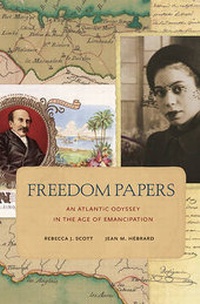
Freedom Papers
An Atlantic Odyssey in the Age of Emancipation
Published on 27. February 2012
Book
Hardback
288 pages
978-0-674-04774-7 (ISBN)
Description
Around 1785, a woman was taken from her home in Senegambia and sent to Saint-Domingue in the Caribbean. Those who enslaved her there named her Rosalie. Her later efforts to escape slavery were the beginning of a family's quest, across five generations and three continents, for lives of dignity and equality. "Freedom Papers" sets the saga of Rosalie and her descendants against the background of three great antiracist struggles of the nineteenth century: the Haitian Revolution, the French Revolution of 1848, and the Civil War and Reconstruction in the United States. Freed during the Haitian Revolution, Rosalie and her daughter Elisabeth fled to Cuba in 1803. A few years later, Elisabeth departed for New Orleans, where she married a carpenter, Jacques Tinchant. In the 1830s, with tension rising against free persons of color, they left for France. Subsequent generations of Tinchants fought in the Union Army, argued for equal rights at Louisiana's state constitutional convention, and created a transatlantic tobacco network that turned their Creole past into a commercial asset.
Yet the fragility of freedom and security became clear when, a century later, Rosalie's great-great-granddaughter Marie-Jose was arrested by Nazi forces occupying Belgium. "Freedom Papers" follows the Tinchants as each generation tries to use the power and legitimacy of documents to help secure freedom and respect. The strategies they used to overcome the constraints of slavery, war, and colonialism suggest the contours of the lives of people of color across the Atlantic world during this turbulent epoch.
Yet the fragility of freedom and security became clear when, a century later, Rosalie's great-great-granddaughter Marie-Jose was arrested by Nazi forces occupying Belgium. "Freedom Papers" follows the Tinchants as each generation tries to use the power and legitimacy of documents to help secure freedom and respect. The strategies they used to overcome the constraints of slavery, war, and colonialism suggest the contours of the lives of people of color across the Atlantic world during this turbulent epoch.
Reviews / Votes
It's a brilliant book. -- Henry Louis Gates Jr. Boston Globe 20111204 A sweeping tale of a fascinating family and the complex history of the African diaspora. -- Vanessa Bush Booklist 20120201 In this well-researched and readable family history, Scott and Hebrard recount the remarkable story of the Tinchants across generations and continents. As people of color, the Tinchants struggled, survived, and flourished--in Senegal, Cuba, New Orleans, Antwerp, and Paris; and through the Haitian Revolution, French Revolution of 1848, the Civil War and Reconstruction in the U.S., and WWII in Europe...Navigating the turbulent political and social waters of their various contexts, members of the Tinchant family often found themselves in "delicate position[s]," as in Joseph's attempt to sustain amiable contacts with the white customers of his retail store in New Orleans at the height of the Civil War. Throughout, the "family emerges as one with a tenacious commitment to claiming dignity and respect." Scott and Hebrard's rendering of the Tinchant family's story is historically enlightening and inspiring. Publishers Weekly 20120227 Scott and Hebrard impressively spin the family's web from documents culled from local/national archives in the U.S., France, Spain, Belgium, Cuba, Senegal, England, and Haiti. There are an Atlantic map, a genealogical tree, and family pictures. They persuasively argue the cross-national connections, as well as the fragility of freedom and citizenship. -- J. R. Kerr-Ritchie Choice 20120801More details
Language
English
Place of publication
Cambridge, Mass
United States
Target group
Professional and scholarly
US School Grade: College Graduate Student
Product notice
sewn/stitched
Cloth over boards
With printed dust jacket
Illustrations
17 halftones, 1 line illustration, 1 map
Dimensions
Height: 235 mm
Width: 156 mm
Thickness: 15 mm
Weight
666 gr
ISBN-13
978-0-674-04774-7 (9780674047747)
Copyright in bibliographic data and cover images is held by Nielsen Book Services Limited or by the publishers or by their respective licensors: all rights reserved.
Schweitzer Classification
Persons
Rebecca J. Scott is Charles Gibson Distinguished University Professor of History and Professor of Law at the University of Michigan. Jean M. Hebrard is a historian at the Ecole des Hautes Etudes en Sciences Sociales (Paris) and Visiting Professor at the University of Michigan.