

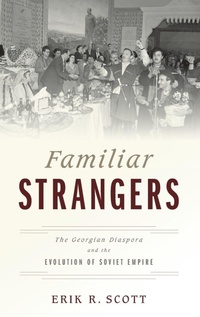
Familiar Strangers
The Georgian Diaspora and the Evolution of Soviet Empire
Published on 12. April 2016
Book
Hardback
352 pages
978-0-19-939637-5 (ISBN)
Description
Familiar Strangers tells the story of a remarkably successful group of ethnic outsiders at the heart of Soviet empire and, in so doing, reinterprets the course of modern Russian and Soviet history. While past scholars have portrayed the Soviet Union as a Russian-led empire composed of separate national republics, Erik R. Scott draws on untapped archival documents in multiple languages to make the case that it was actually an empire of diasporas, forged
through the mixing of a diverse array of nationalities. Concealed behind external Soviet borders, internal diasporas from the Soviet republics migrated throughout the socialist empire, leaving their mark on its politics, culture, and economics.
Among the Soviet Union's internal diasporas, the Georgians were arguably the most prominent group. The roles they played in the Soviet empire's evolution illuminate the opportunities as well as the limitations of the Bolshevik Revolution for ethnic minorities. Georgian revolutionaries accompanied Stalin in his rise to power and helped build the socialist state; Georgian culinary specialists contributed the dishes and rituals that defined Soviet dining habits; Georgian cultural entrepreneurs
perfected a flamboyant repertoire that spoke for a multiethnic society on stage and screen; Georgian traders thrived in the Soviet Union's burgeoning informal economy; and Georgian intellectuals explored the furthest limits of allowable expression, ultimately calling into question the legitimacy of
Soviet power.
Looking at the rise and fall of the Soviet Union from a Georgian perspective, this book moves past the typical divide between center and periphery, and colonizer and colonized, that guides most scholarship on empire. Arguing for a new theory of diaspora, it offers a new way of thinking about the experience of minorities in multiethnic states, with implications far beyond the imperial borders of Russia and Eurasia.
through the mixing of a diverse array of nationalities. Concealed behind external Soviet borders, internal diasporas from the Soviet republics migrated throughout the socialist empire, leaving their mark on its politics, culture, and economics.
Among the Soviet Union's internal diasporas, the Georgians were arguably the most prominent group. The roles they played in the Soviet empire's evolution illuminate the opportunities as well as the limitations of the Bolshevik Revolution for ethnic minorities. Georgian revolutionaries accompanied Stalin in his rise to power and helped build the socialist state; Georgian culinary specialists contributed the dishes and rituals that defined Soviet dining habits; Georgian cultural entrepreneurs
perfected a flamboyant repertoire that spoke for a multiethnic society on stage and screen; Georgian traders thrived in the Soviet Union's burgeoning informal economy; and Georgian intellectuals explored the furthest limits of allowable expression, ultimately calling into question the legitimacy of
Soviet power.
Looking at the rise and fall of the Soviet Union from a Georgian perspective, this book moves past the typical divide between center and periphery, and colonizer and colonized, that guides most scholarship on empire. Arguing for a new theory of diaspora, it offers a new way of thinking about the experience of minorities in multiethnic states, with implications far beyond the imperial borders of Russia and Eurasia.
Reviews / Votes
This is a readable book that is in no way only about Georgians, but powerfully illuminates how internal diasporas, understood implicitly as parts of cultures of circulation in which ethnicity can circulate both embodied in persons as well as things, were crucial in the formation of the peculiar multi-ethnic empire of the Soviet Union. * Paul Manning, Diasporas * Scott argues that the experience of Georgians who have made their way in Russia reveals the Soviet empire's uniquely multiethnic quality. Rather than think of the Soviet Union as a checkerboard of territorial units with Russia at its core, one could better understand it as 'an empire of mobile diasporas that ... helped construct a truly multiethnic society. * Robert Legvold, Foreign Affairs * A finely tuned study of Georgians in the Soviet landscape. Scott makes the case for how Georgians became 'familiar strangers,' the most legible among non-Russian peoples across the spectrum of Soviet life given their prominent place in politics, market stalls, on the theater stage, and perhaps most enduringly, at restaurant tables ... [an] excellent book * Bruce Grant, Slavic Review * Familiar Strangers tells us that the Soviet Union made modern Georgia in two ways. First, it gave Georgians a mass of resources to promote and protect their language, food, and culture, in ways that few other modern states would have countenanced. Second, it gave them an enormous space in which to project an identity and participate in global geopolitics. From Stalin to the Moscow restaurant table, from the folkloric stage to the black market, and from theheights of Soviet politics to the center of its break-up, Scott gives us revealing snapshots of one of the country's great internal diasporas. Those seeking a thoughtful and accessible history of Georgians and the question of nationality in the USSR will be deeply satisfied. * Yanni Kotsonis, New York University * Familiar Strangers provocatively explores how internally mobile Soviet Georgians successfully performed their otherness for a pan-Soviet audience, without sacrificing the core of their difference. In a superb study that ranges from politics to cuisine to music to market trade to film, Scott challenges conventional notions of the 'Soviet empire,' showing how the view from the periphery provides a unique yardstick to measure the rise and fall of the Soviet
project of domestic internationalism. * Diane P. Koenker, author of Club Red: Vacation Travel and the Soviet Dream * Erik Scott's fascinating and groundbreaking study upends the conventional view that the Soviet Union's multiethnic empire possessed an ethnic Russian core, and reshapes how we understand national minorities in the USSR and the nature of the Soviet empire. The book is meticulously researched and beautifully written, with rich details and surprising material. His analysis calls to mind other cases of prominent minorities in revolution, such as the Alawites in Syria and
the Sunni minority in Ba'athist Iraq. The book will be of great interest not only to students of Georgia, the Soviet Union, and Stalinism, but also to those interested in revolution and empire. * Golfo Alexopoulos, University of South Florida * This book makes an important contribution to the study of nationality in the Soviet Union ... Recommended. * CHOICE * Drawing on an impressive range of archival, periodical and secondary sources in both Russian and Georgian, as well as numerous interviews in Russia and in Georgia, Familiar Strangers is an important contribution to the study of Soviet history, political and cultural, and despite - or perhaps, because of - its focus on the concept of diaspora, it makes a strong contribution as well to recent Georgian historiography. Most importantly, in focusing on the ways in which
national identity was exploited and 'performed' beyond the boundaries of specific national territories, it brings a new approach to generalising from the study of ethnicity in the Soviet experiment, and presents a powerful case study of the ways in which a particular nationality both shaped and was
shaped by the empire of which it was a part. * Timothy K. Blauvelt, Revolutionary Russia * Illustrates how the Soviet state shaped the modern national culture of Georgia, generously providing the resources, structures, and ideological supports for a Soviet-national hybrid consisting of a rich blend of Soviet and Georgian cultures This is a welcome and innovative book; it is well written and well researched. * Stephen Jones, Russian Review *
More details
Other editions
Additional editions

Book
09/2017
Oxford University Press Inc
€60.60
Shipment within 15-20 days

E-Book
03/2016
1st Edition
OUP eBook
€27.49
Available for download

E-Book
03/2016
1st Edition
OUP eBook
€27.49
Available for download
Person
Erik R. Scott is an Assistant Professor of History at the University of Kansas and co-editor of Organized Crime and Corruption in Georgia.
Content
Acknowledgments; Note on Transliteration and Dating; Introduction; Chapter 1 - An Empire of Diasporas; Chapter 2 - Between the Caucasus and the Kremlin; Chapter 3 - Edible Ethnicity; Chapter 4 - Dances of Difference; Chapter 5 - Strangeness for Sale; Chapter 6 - Beyond the Ethnic Repertoire; Conclusion; Notes; Bibliography; Index