

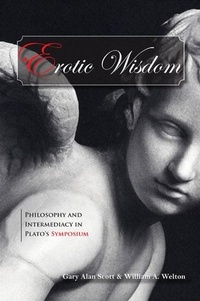
Erotic Wisdom
Philosophy and Intermediacy in Plato's Symposium
Published on 1. July 2009
Book
Paperback/Softback
297 pages
978-0-7914-7584-3 (ISBN)
Description
A lively and highly readable commentary on one of Plato's most beloved dialogues.
Erotic Wisdom provides a careful reading of one of Plato's most beloved dialogues, the Symposium, which explores the nature and scope of human desire (eros). Gary Alan Scott and William A. Welton engage all of the dialogue's major themes, devoting special attention to illuminating Plato's conception of philosophy. In the Symposium, Plato situates philosophy in an intermediate (metaxu) position-between need and resource, ignorance and knowledge-showing how the very lack of what one desires can become a guiding form of contact with the objects of human desire. The authors examine the concept of intermediacy in relation both to Platonic metaphysics and to Plato's moral psychology, arguing that philosophy, for Plato, is properly understood as a kind of "being in-between," as the love of wisdom (philosophia) rather than the possession of it.
Erotic Wisdom provides a careful reading of one of Plato's most beloved dialogues, the Symposium, which explores the nature and scope of human desire (eros). Gary Alan Scott and William A. Welton engage all of the dialogue's major themes, devoting special attention to illuminating Plato's conception of philosophy. In the Symposium, Plato situates philosophy in an intermediate (metaxu) position-between need and resource, ignorance and knowledge-showing how the very lack of what one desires can become a guiding form of contact with the objects of human desire. The authors examine the concept of intermediacy in relation both to Platonic metaphysics and to Plato's moral psychology, arguing that philosophy, for Plato, is properly understood as a kind of "being in-between," as the love of wisdom (philosophia) rather than the possession of it.
Reviews / Votes
"This is a lucid, carefully wrought study of Plato's Symposium, a dialogue whose complex narrative and multifarious themes pose unique interpretive challenges to students and professionals alike. Scott and Welton navigate these treacherous exegetical waters with grace and ease." - CHOICE"This book is a very engaging and lucid guide to Plato's Symposium. It offers a close attentive reading of the fine details of this work, paying due respect to both the dramatic staging of the different speeches and the philosophical significance of the diverse views of erotic wisdom. It combines this with an illuminating sense of the larger philosophical issues articulated in Plato's writings. I particularly liked its persuasively maintained emphasis on the centrality of the in-between nature of erotic wisdom. The authors do a really fine job in showing this centrality in its diverse ramifications, as well as very helpfully laying out different forms of intermediacy in both the Symposium and other major works of Plato." - William Desmond, author of the trilogy Being and the Between, Ethics and the Between, and God and the Between
"This is the best introduction to Plato's Symposium known to me. It offers an elegant and balanced treatment of the major themes and arguments, and deftly unites the philosophical issues with the dramatic context and characterization of the principal figures." - David Konstan, author of The Emotions of the Ancient Greeks: Studies in Aristotle and Classical Literature
More details
Series
Language
English
Place of publication
Albany, NY
United States
Target group
Professional and scholarly
US School Grade: College Graduate Student and over
Product notice
Paperback (trade)
Dimensions
Height: 226 mm
Width: 150 mm
Thickness: 23 mm
Weight
476 gr
ISBN-13
978-0-7914-7584-3 (9780791475843)
Copyright in bibliographic data and cover images is held by Nielsen Book Services Limited or by the publishers or by their respective licensors: all rights reserved.
Schweitzer Classification
Other editions
Additional editions
E-Book
12/2008
1st Edition
De Gruyter
€36.49
Available for download
Persons
At Loyola College in Maryland, Gary Alan Scott is Associate Professor of Philosophy, and William A. Welton is Visiting Affiliate Professor of Philosophy. Scott is the author of Plato's Socrates as Educator, also published by SUNY Press, and Welton is the editor of Plato's Forms: Varieties of Interpretation.
Content
Acknowledgments
Introduction
Chapter 1. Introductory Dialogue (172a-178a)
Chapter 2. Six Speeches on Love (Eros)
The Speech of Phaedrus (178a-180c) The Speech of Pausanias (180c-185e)
The Speech Eryximachus (185c-185e)
The Speech of Aristophanes (189a-193e)
The Speech of Agathon (194e-198a)
Interlude (198a-199c)
Socrates Questions Agathon (199c-201c)
Diotima Questions Socrates (201d-203b)
The Speech of Socrates (202b-212b)
Chapter 3. The Entrance and Speech of Alcibiades (212c-222c)
Chapter 4. Conclusion
Appendix: Intermediacy, Philosophy, and Recollection
Notes
Works Cited
Index
Introduction
Chapter 1. Introductory Dialogue (172a-178a)
Chapter 2. Six Speeches on Love (Eros)
The Speech of Phaedrus (178a-180c) The Speech of Pausanias (180c-185e)
The Speech Eryximachus (185c-185e)
The Speech of Aristophanes (189a-193e)
The Speech of Agathon (194e-198a)
Interlude (198a-199c)
Socrates Questions Agathon (199c-201c)
Diotima Questions Socrates (201d-203b)
The Speech of Socrates (202b-212b)
Chapter 3. The Entrance and Speech of Alcibiades (212c-222c)
Chapter 4. Conclusion
Appendix: Intermediacy, Philosophy, and Recollection
Notes
Works Cited
Index