

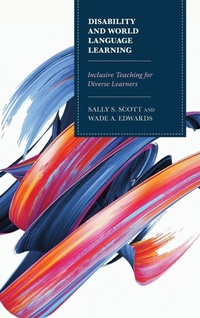
Disability and World Language Learning
Inclusive Teaching for Diverse Learners
Published on 21. December 2018
Book
Hardback
140 pages
978-1-4758-3704-9 (ISBN)
Description
The release of a report by the Modern Language Association, "Foreign Languages and Higher Education: New Structures for a Changed World," focused renewed attention on college foreign language instruction at the introductory level. Frequently, the report finds, these beginning courses are taught by part-time and untenured instructors, many of whom remain on the fringes of the department, with little access to ongoing support, pedagogical training, or faculty development. When students with sensory, cognitive or physical disabilities are introduced to this environment, the results can be frustrating for both the student (who may benefit from specific instructional strategies or accommodations) and the instructor (who may be ill-equipped to provide inclusive instruction).
Soon after the MLA report was published, the American Council on the Teaching of Foreign Languages issued "Diversity and Inclusion in Language Programs," a position statement highlighting the value of inclusive classrooms that support diverse perspectives and learning needs. That statement specifies that all students, regardless of background, should have ample access to language instruction. Meanwhile, in the wake of these two publications, the number of college students with disabilities continues to increase, as has the number of world language courses taught by graduate teaching assistants and contingent faculty.
Disability and World Language Learning begins at the intersection of these two growing concerns: for the diverse learner and for the world language instructor. Devoted to practical classroom strategies based on Universal Design for Instruction, it serves as a timely and valuable resource for all college instructors-adjunct faculty, long-time instructors, and graduate assistants alike-confronting a changing and diversifying world language classroom.
Soon after the MLA report was published, the American Council on the Teaching of Foreign Languages issued "Diversity and Inclusion in Language Programs," a position statement highlighting the value of inclusive classrooms that support diverse perspectives and learning needs. That statement specifies that all students, regardless of background, should have ample access to language instruction. Meanwhile, in the wake of these two publications, the number of college students with disabilities continues to increase, as has the number of world language courses taught by graduate teaching assistants and contingent faculty.
Disability and World Language Learning begins at the intersection of these two growing concerns: for the diverse learner and for the world language instructor. Devoted to practical classroom strategies based on Universal Design for Instruction, it serves as a timely and valuable resource for all college instructors-adjunct faculty, long-time instructors, and graduate assistants alike-confronting a changing and diversifying world language classroom.
Reviews / Votes
Scott and Edwards fill an important gap in our understanding of inclusive pedagogies for todays' diverse population of students. The integration of dual perspectives of a faculty member and a disability service provider is what makes this book unique and a must read for educators and parents alike. Today, when many are questioning the importance and ability of students with disabilities to learn a foreign language, this book guides the reader through case studies and evidence based Universal Design for Instruction practices, to answer some of these challenging queries around diverse profiles of learners and world language learning, in secondary and postsecondary institutions. -- Manju Banerjee, vice president, educational research and innovation, director, Landmark College Institute for Research and Training Finally, a true-to-form guide for understanding world language students who have to deal with barriers in language learning. Inclusive should be a mainstay in the teacher's acumen, as we all deserve the opportunity to learn, even when the learning is hard. Disability and World Language Learning meets the classroom teacher's needs by leading its users beyond just differentiated instruction. -- Dick Kuettner, romance languages and teacher education, Washington and Lee University, director, Global Discovery Laboratories In an academic area where it is often assumed that disability means inability, Disability and World Language Learning opens the door to success for both students and instructors. This rare, research-based collaboration between a French professor and a campus disability resources administrator demonstrates how a focus on the accessibility of student experience can both preserve the integrity of disciplinary teaching and promote student learning. The exploration and application of principles of Universal Design for Instruction in the teaching of world languages in this work can serve as a model for how those principles can be actualized in the teaching of other academic disciplines. -- Elizabeth Harrison, University of Dayton, director,?Office of Learning Resources, associate director, Ryan C. Harris Learning Teaching Center All students can and should learn a second (or third!) language. Inclusive teaching practices help instructors anticipate and mitigate barriers for all students, not just those with disabilities. This approach has transformed the way that I teach Spanish and educate the next generation of language teachers. -- Susan Hildebrandt, Illinois State University, professor, applied linguistics and Spanish, coordinator, teacher education, ACTFL Board of DirectorsMore details
Language
English
Place of publication
United States
Publishing group
Bloomsbury Publishing Plc
Target group
Professional and scholarly
Illustrations
4 tables; 26 textboxes
Dimensions
Height: 235 mm
Width: 157 mm
Thickness: 12 mm
Weight
367 gr
ISBN-13
978-1-4758-3704-9 (9781475837049)
Copyright in bibliographic data and cover images is held by Nielsen Book Services Limited or by the publishers or by their respective licensors: all rights reserved.
Schweitzer Classification
Other editions
Additional editions
Sally Scott | Wade Edwards
Disability and World Language Learning
Inclusive Teaching for Diverse Learners
E-Book
12/2018
1st Edition
Rowman & Littlefield Publishers
€29.49
Available for download
Sally Scott | Wade Edwards
Disability and World Language Learning
Inclusive Teaching for Diverse Learners
E-Book
12/2018
1st Edition
Rowman & Littlefield Publishers
€29.49
Available for download
Persons
Sally S. Scott is Senior Research Associate for the Association on Higher Education and Disability (AHEAD). She holds a doctorate from the University of Virginia and has over 25 years' experience working with adolescents and young adults with a wide range of disabilities.Shehas published and presented nationally and internationally on issues related to inclusive teaching, college support services, and emerging disability populations.
A former department chair and modern languages program coordinator, Wade Edwards is a professor of French and Associate Dean of the Cook-Cole College of Arts & Sciences at Longwood University in Virginia. His scholarship has appeared in?Nineteenth-Century French Studies,?Feminist Teacher, and the?NECTFL Review, among other publications. He has been teaching French to students at a variety of public?universities?for 25 years.
A former department chair and modern languages program coordinator, Wade Edwards is a professor of French and Associate Dean of the Cook-Cole College of Arts & Sciences at Longwood University in Virginia. His scholarship has appeared in?Nineteenth-Century French Studies,?Feminist Teacher, and the?NECTFL Review, among other publications. He has been teaching French to students at a variety of public?universities?for 25 years.
Content
List of Tables
Forward
Preface
Acknowledgements
Introduction
Chapter 1: Disability, Student Diversity, and Inclusive Teaching
Chapter 2: Setting the Stage for an Inclusive Language Learning Classroom
Chapter 3: In the Classroom
Chapter 4: Assessment of Student Learning
Chapter 5: Getting Started
Chapter 6: Conclusions
References
About the Authors
Forward
Preface
Acknowledgements
Introduction
Chapter 1: Disability, Student Diversity, and Inclusive Teaching
Chapter 2: Setting the Stage for an Inclusive Language Learning Classroom
Chapter 3: In the Classroom
Chapter 4: Assessment of Student Learning
Chapter 5: Getting Started
Chapter 6: Conclusions
References
About the Authors