

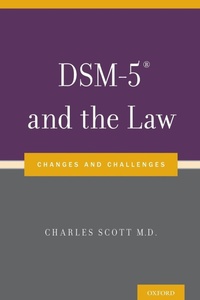
DSM-5 (R) and the Law
Changes and Challenges
Published on 9. July 2015
Book
Paperback/Softback
304 pages
978-0-19-936846-4 (ISBN)
Description
Featuring relevant diagnostic changes to each chapter topic, a wide range of civil and criminal forensic evaluations, practical vignettes and focused summary points,DSM-5r and the Law is the perfect companion text for psychiatrists and psychologists, social workers conducting forensic evaluetions, and practicing attorneys and judges. DSM-5 and the Law: Changes and Challenges Reviews the most common types of mental health evalutations that arise in the criminal justice system and in the course of civil litigation. each chapter provides an initial overview and explaination of the legal issue, how diagnostics changes impact the legal issue, practical evaluation of guidelines addressing the diagnostic changes, and clear summary points at the conclusion of each chapter.
This is the first book to apply how the DSM-5 changes will impact forensic evaluations, Dr. Charles Scott's DSM-5 and the Law: Changes and Challenges provides important, practical guidelines on how to face these new challenges posed by this new set of criteria.
This is the first book to apply how the DSM-5 changes will impact forensic evaluations, Dr. Charles Scott's DSM-5 and the Law: Changes and Challenges provides important, practical guidelines on how to face these new challenges posed by this new set of criteria.
Reviews / Votes
This book clearly explains sophisticated nuances of DSM-5 diagnoses that will protect you from making errors on the witness stand. A must-have for all forensic clinicians. * Phillip J. Resnick, M.D., Case Western Reserve University, Cleveland, OH * Dr. Scott has provided a comprehensive, scholarly, and insightful review of the process of development of the DSM-5, the American Psychiatric Association's most up-to-date psychiatric diagnostic classification system, and the implications of the changes embodied in the DSM-5 for the field of forensic psychiatry. The chapter authors, experts in their respective fields, have applied their breadth of knowledge and expertise to the analysis of the DSM-5's changes as they relate to criminal, civil, disability, and educational forensic evaluations, including? the assessment of malingering. Dr. Scott has masterfully organized this volume such that it provides both in-depth information and practical guidance that will be of invaluable assistance to forensic psychiatrists in addressing the controversies associated with the DSM-5 that may arise in the courtroom and in incorporating DSM-5's changes into their forensic practices. * Liza Gold, Georgetown University School of Medicine * This is the only work of its kind I have seen, and it provides a comfortable bridge between the functional changes associated with the DSM-5 and the effect they will have on completing forensic evaluations, both for civil and criminal matters. Chapters are well thought out and reasonably brief. The clinical vignettes help highlight the types of changes which could cause some practitioners difficulty. This is an impressive book that should prove to be a valuable resource for forensic practitioners or trainees. * Steve T. Herron M.D., Assurance Health and Wellness *More details
Language
English
Place of publication
New York
United States
Target group
College/higher education
Professional and scholarly
Dimensions
Height: 234 mm
Width: 156 mm
Thickness: 16 mm
Weight
456 gr
ISBN-13
978-0-19-936846-4 (9780199368464)
Copyright in bibliographic data and cover images is held by Nielsen Book Services Limited or by the publishers or by their respective licensors: all rights reserved.
Schweitzer Classification
Other editions
Additional editions
E-Book
05/2015
1st Edition
OUP eBook
€47.49
Available for download
E-Book
05/2015
1st Edition
OUP eBook
€47.49
Available for download
Person
Dr. Scott is a Professor of Clinical Psychiatry and Chief of the Psychiatry and the Law Division at the University of California, Davis. He is a Past-President of the American Academy of Psychiatry and the Law (AAPL) and has been a national instructor for the AAPL Annual Forensic Psychiatry Review Course for over 15 years. He serves as a consultant to the California Department of State Hospitals statewide implementation of DSM-5.
Editor
Professor of Clinical Psychiatry Chief, Division of Psychiatry and the Law,Training Director, Forensic Psychiatry Fellowship, Department of Psychiatry and Behavioral Sciences,Professor of Clinical Psychiatry Chief, Division of Psychiatry and the Law,Training Director, Forensic Psychiatry Fellowship, Department of Psychiatry and Behavioral Sciences,, University of California, Davis School of Medicine, Sacramento
Content
1. DSM-5: Development and Implementation ; Jessica Ferranti, M.D. ; 2. DSM-5 and Major Diagnostic Changes ; William Newman, M.D. and Brian Holoyda, M.D. ; 3. DSM-5: Diagnosing and Report Writing ; Charles Scott, M.D. ; 4. DSM-5 and Psychiatric Evaluations of Individuals in the Criminal Justice System ; Richard Frierson, M.D. ; 5. DSM-5: Competencies and the Criminal Justice System ; Stephen Noffsinger, M.D. and Jennifer Piel, J.D, M.D. ; 6. DSM-5 and Not Guilty by Reason of Insanity and Diminished Mens Rea Defenses ; Stephen Noffsinger, M.D. and Jennifer Piel, J.D, M.D. ; 7. DSM-5 and Civil Competencies ; Robert Weinstock, M.D, Jennifer Piel, J.D, M.D, and Gregory B. Leong, M.D. ; 8. DSM-5 and Personal Injury Litigation ; Charles Scott, M.D, Ryan Wagoner, M.D, and Mace Beckson, M.D. ; 9. DSM-5 and Disability Evaluations ; John Greene, M.D. and Charles Scott, M.D. ; 10. DSM-5 and Education Evaluations in School Aged Children ; Anne McBride, M.D. ; 11. DSM-5 and Malingering ; Barbara McDermott, Ph.D. and Charles Scott, M.D.