

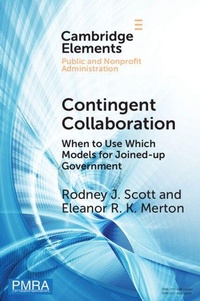
Contingent Collaboration
When to Use Which Models for Joined-up Government
Published on 14. July 2022
Book
Paperback/Softback
106 pages
978-1-009-12445-4 (ISBN)
Description
The question of how agencies can work together has been central to the field of public administration for several decades. Despite significant research, the process of collaboration can still be a fraught endeavour for practitioners. Nevertheless, agencies keep trying to work together because it is the only way to make progress on the biggest challenges facing public administrators. This Element reveals the deeply contingent nature of collaboration, rejecting the idea that collaboration can be reduced to a universal best practice. The New Zealand government has implemented such a contingent approach that maps different collaborative methods against problem settings and the degree of trade-off required from the actors' core or individual work. This Element provides a detailed case study of the New Zealand approach, and 18 embedded elements or 'model' collaborative forms for joined-up government. It explains how New Zealand public servants approach the important question: 'when to use which models?'.
More details
Series
Language
English
Place of publication
Cambridge
United Kingdom
Product notice
Paperback (trade)
Illustrations
Worked examples or Exercises
Dimensions
Height: 229 mm
Width: 152 mm
Thickness: 7 mm
Weight
167 gr
ISBN-13
978-1-009-12445-4 (9781009124454)
Copyright in bibliographic data and cover images is held by Nielsen Book Services Limited or by the publishers or by their respective licensors: all rights reserved.
Schweitzer Classification
Other editions
Additional editions
E-Book
07/2022
Cambridge University Press
€15.49
Available for download
Rodney J. Scott | Eleanor R. K. Merton
Contingent Collaboration
When to Use Which Models for Joined-up Government
E-Book
06/2022
Cambridge University Press
€15.49
Available for download
Persons
Content
1. The necessity of interagency collaboration; 2. The contingent collaboration toolkit; 3. Interagency collaboration for public policy; 4. Interagency collaboration for public administration; 5. Interagency collaboration for service delivery; 6. Conclusion.