

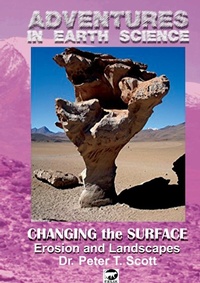
Changing the Surface
Erosion and Landscapes
Published on 16. May 2017
Book
Paperback/Softback
148 pages
978-0-9946433-0-8 (ISBN)
Description
CHANGING THE SURFACE is the third book in the Adventures in Earth Science series and deals with the topics of weathering, erosion and the landscapes which they produce. The general nature of change in minerals within rocks and how rocks are degraded by both physical and chemical means is discussed in the first chapter which also contains a section about soils and their classification.
Chapter Two looks at the unique chemical weathering of carbonate rocks such as limestone, marble and dolomite. From the landscapes of the surface of karst regions, the chapter then explores the world below the surface in limestone caves, looking at their formation and their spelaeothems or cave formations. There is also a video website link to take readers below ground into some of the author’s favourite caves.
The remaining three chapters looks at the works of erosion of water, ice and wind respectively and describes the many features of the landscapes sculptured by these three major forms of erosion. The emphasis here is that the reader should be able now to identify such landforms and understand their environment.
All chapters have a large number of photographs taken by the author in many exotic parts of the world. Including the high Andes, the Amazon basin, the Nubian Desert and Antarctica. The author is indebted to his son Matthew who provided some of the photographs taken in Bolivia. Several of the author’s videos to some of these places are provided as video website links.
CHANGING THE SURFACE is the third book in the Adventures in Earth Science series and deals with the topics of weathering, erosion and the landscapes which they produce. The general nature of change in minerals within rocks and how rocks are degraded by both physical and chemical means is discussed in the first chapter which also contains a section about soils and their classification.
Chapter Two looks at the unique chemical weathering of carbonate rocks such as limestone, marble and dolomite. From the landscapes of the surface of karst regions, the chapter then explores the world below the surface in limestone caves, looking at their formation and their spelaeothems or cave formations. There is also a video website link to take readers below ground into some of the author’s favourite caves.
The remaining three chapters looks at the works of erosion of water, ice and wind respectively and describes the many features of the landscapes sculptured by these three major forms of erosion. The emphasis here is that the reader should be able now to identify such landforms and understand their environment.
All chapters have a large number of photographs taken by the author in many exotic parts of the world. Including the high Andes, the Amazon basin, the Nubian Desert and Antarctica. The author is indebted to his son Matthew who provided some of the photographs taken in Bolivia. Several of the author’s videos to some of these places are provided as video website links.
More details
Series
Language
English
Product notice
Paperback (trade)
Unsewn / adhesive bound
Illustrations
Illustrations
Dimensions
Height: 210 mm
Width: 148 mm
Thickness: 8 mm
Weight
202 gr
ISBN-13
978-0-9946433-0-8 (9780994643308)
Copyright in bibliographic data and cover images is held by Nielsen Book Services Limited or by the publishers or by their respective licensors: all rights reserved.
Schweitzer Classification
Persons
Peter Scott was born and raised in Sydney. He has written over twenty books including non-fiction on Earth Science, the environment, survival and teaching. In the last few years, he has turned to fiction and has written in a variety of genres, mainly historical adventure and science friction. Graduating from Sydney Teachers' College as a teacher of Middle School Science at the age of nineteen, he later completed part-time studies gaining a Bachelor of Science, Masters Degrees in Science and Educational Administration and finally a Doctorate in Education. He has taught in a varieties of schools and University. During this time, he married and raised a family as well as serving as a Commissioned Officer in the Army Reserve and later an Officer/Instructor and Commanding Officer of an Australian Naval Cadet unit. With some minor sea experience with the Royal Australian Navy, he had six training cruises at sea on board 'Tall Ships', both square- and schooner-rigged. Having travelled extensively to all seven continents, including Antarctica, he has always followed his interests, so his novels often reflect his personal experiences.