

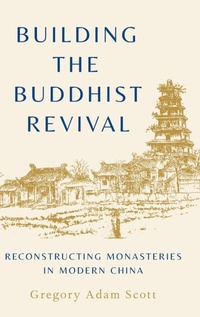
Building the Buddhist Revival
Reconstructing Monasteries in Modern China
Published on 22. April 2020
Book
Hardback
264 pages
978-0-19-093072-1 (ISBN)
Description
Between 1850 and 1966, tens of thousands of Buddhist sacred sites in China were destroyed, victims of targeted destruction, accidental damage, or simply neglect. During the same period, however, many of these sites were reconstructed, a process that involved both rebuilding material structures and reviving religious communities. The conventionally accepted narrative of Chinese Buddhism during the modern era is that it underwent a revival initiated by innovative monastics and laypersons, leaders who reinvented Buddhist traditions to meet the challenges of modernity. Gregory Adam Scott shows, however, that over time it became increasingly difficult for reconstruction leaders to resist the interests of state actors, who sought to refashion monastery sites as cultural monuments rather than as living religious communities. These sites were then intended to serve as symbols of Chinese history and cultural heritage, while their function as a frame for religious life was increasingly pushed aside. As a result, the power to determine whether and how a monastery would be reconstructed, and the types of activities that would be reinstated or newly introduced, began to shift from religious leaders and communities to state agencies that had a radically different set of motivations and values.
Building the Buddhist Revival explores the history of Chinese Buddhist monastery reconstruction from the end of the Imperial period through the first seventeen years of the People's Republic. Over this century of history, the nature and significance of reconstructing Buddhist monasteries changes drastically, mirroring broader changes in Chinese society. Yet this book argues that change has always been in the nature of religious communities such as Buddhist monasteries, and that reconstruction, rather than a return to the past, represents innovative and adaptive change. In this way, it helps us understand the broader significance of the Buddhist "revival" in China during this era, as a creative reconstruction of religion upon longstanding foundations.
Building the Buddhist Revival explores the history of Chinese Buddhist monastery reconstruction from the end of the Imperial period through the first seventeen years of the People's Republic. Over this century of history, the nature and significance of reconstructing Buddhist monasteries changes drastically, mirroring broader changes in Chinese society. Yet this book argues that change has always been in the nature of religious communities such as Buddhist monasteries, and that reconstruction, rather than a return to the past, represents innovative and adaptive change. In this way, it helps us understand the broader significance of the Buddhist "revival" in China during this era, as a creative reconstruction of religion upon longstanding foundations.
Reviews / Votes
This volume will hopefully generate deeply fruitful further discussion and research. * Joseph Chadwin, Religious Studies Review * This volume is invaluable to anyone seeking to understand contemporary Chinese Buddhism. * Joseph Chadwin, Religious Studies Review * Richly detailed... Building the Buddhist Revival will be useful for scholars of Chinese Buddhism, modern Chinese history, and monastic institutions.... Highly recommended. * CHOICE * Through its innovative perspective on the restoration of temples and monasteries, this book contributes towards a history beyond that of great men and great texts, and towards a historiography that can cope with complex developments over longer periods. * Marcus Bingenheimer, Review of Religion and Chinese Society * Building the Buddhist Revival is a fine book with exceptional detail that makes a compelling case for just how important Buddhist monasteries were in China's past politically, socially, economically, and how even today they play a significant role in Chinese Communist Party narratives about what constitutes China proper. Historians of China and scholars of Chinese Buddhist studies and religious studies will find great value in Gregory Adam Scott's work. * Journal of Chinese Religions * ...this study of Buddhist monasteries is an enjoyable and intriguing analysis of the recovery of Buddhist sites. In particular, Scott's focus on the complicated social networks surrounding the destruction and rebuilding of temples that occurred during this tumultuous period is a welcome addition to Chinese Buddhism. * Jonathan E. E. Pettit, Sociology of Religion * This book moves beyond the customary narrative of Buddhist decline in the period from 1866 to 1966, by focusing on reconstruction and change as evidence of a lively religious culture. The author describes monastic restorations as collective projects by devout local communities under the leadership of charismatic individuals. He provides a richly textured history of Buddhist institutions, as well as an unusual window into the whirlwinds of recent Chinese history. * Barend ter Haar, author of Guan Yu: The Religious Afterlife of a Failed Hero * Destroying and building are two sides of a same coin. There are studies of early Buddhists building monasteries all over China; and, more recently, of their modern destruction. Now Gregory Scott offers the first history of how Buddhists kept building and rebuilding in the age of destruction, living up to their vocation as fundraisers, planners, and architects. This is a must-read for anyone who understands that religion is largely about places and temples. * Vincent Goossaert, co-author of The Religious Question in Modern China * One of the most significant indicators of Buddhist revival is the health of its monasteries. This is the first book in English on the reconstruction of Buddhist monasteries in China between 1866 and 1966. The author discusses the motivations, resources and means to reconstruct monasteries after they had been destroyed as a result of wars and neglect. It makes major contributions to Chinese Buddhist studies and Chinese history. * Chun-fang Yu, Sheng Yen Professor Emerita of Chinese Buddhism, Columbia University *More details
Language
English
Place of publication
New York
United States
Target group
Professional and scholarly
Dimensions
Height: 240 mm
Width: 161 mm
Thickness: 19 mm
Weight
558 gr
ISBN-13
978-0-19-093072-1 (9780190930721)
Copyright in bibliographic data and cover images is held by Nielsen Book Services Limited or by the publishers or by their respective licensors: all rights reserved.
Schweitzer Classification
Other editions
Additional editions
E-Book
02/2020
OUP eBook
€48.99
Available for download
E-Book
02/2020
OUP eBook
€62.99
Available for download
Person
Gregory Adam Scott received his PhD from Columbia University, was previously a research fellow at the University of Edinburgh, and is currently lecturer at the University of Manchester. Originally from Canada, he is a historian of religion in modern China, particularly Buddhism.
Content
Introduction:Monasteries as a Frame for Buddhist Life
Chapter One: The Post-Taiping Reconstruction
Chapter Two: Reconstruction in an Era of Revolution
Chapter Three: National Salvation
Chapter Four: Cultural Relics
Conclusion
Appendices
Works Cited
Chapter One: The Post-Taiping Reconstruction
Chapter Two: Reconstruction in an Era of Revolution
Chapter Three: National Salvation
Chapter Four: Cultural Relics
Conclusion
Appendices
Works Cited