

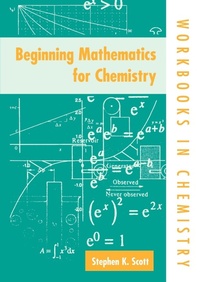
Beginning Mathematics for Chemistry
Published on 23. November 1995
Book
Paperback/Softback
136 pages
978-0-19-855930-6 (ISBN)
Description
Many first year undergraduate chemistry students are daunted by the mathematical content of their courses. Mathematics in chemistry often presents an obstacle, preventing the student from grasping the chemical concepts and real ideas that lie behind the maths. This excellent workbook will help students to overcome this problem, which cannot be solved with a textbook. It aims to be a mathematics `toolkit' rather than a formal mathematics course. This flexibility allows the student to study alone or in a group. The material covered is taken from examples of first year chemistry courses in approximately 6 x 3 hour sessions, providing a more comfortable and familiar way to learn. This workbook meets the needs of the student and is the best introduction to mathematics in chemistry available.
Reviews / Votes
The best way to develop essential mathematical skills is through practice, and Beginning Mathematics for Chemistry by Stephen Scott can help with this. If you follow the examples and try the exercises in this workbook, you should soon lose your fear of algebra, logarithms, and the like.New Scientist
More details
Language
English
Place of publication
Oxford
United Kingdom
Target group
College/higher education
Illustrations
line figures
Dimensions
Height: 297 mm
Width: 210 mm
Thickness: 8 mm
Weight
384 gr
ISBN-13
978-0-19-855930-6 (9780198559306)
Copyright in bibliographic data and cover images is held by Nielsen Book Services Limited or by the publishers or by their respective licensors: all rights reserved.
Schweitzer Classification
Person
Content
Section 1 - Algebra: Substitution and Rearrangement ; Section 2 - Powers, Exponentials and Logarithms ; Section 3 - Calculus 1: Differentiation ; Section 4 - Calculus 2: Integration ; Section 5 - Sines, Cosines and Complex Numbers ; Section 6 - Statistics: Means and Deviations