

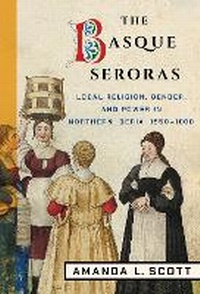
The Basque Seroras
Local Religion, Gender, and Power in Northern Iberia, 1550-1800
Published on 15. March 2020
Book
Hardback
246 pages
978-1-5017-4749-6 (ISBN)
Description
The Basque Seroras explores the intersections between local community, women's work, and religious reform in early modern northern Spain. Amanda L. Scott illuminates the lives of these uncloistered religious women, who took no vows and were free to leave the religious life if they chose. Their vocation afforded them considerably more autonomy and, in some ways, liberty, than nuns or wives.
Scott's archival work recovers the surprising ubiquity of seroras, with every Basque parish church employing at least one. Their central position in local religious life revises how we think about the social and religious limitations placed on early modern women. By situating the seroras within the social dynamics and devotional life of their communities, The Basque Seroras reconceives of female religious life and the opportunities it could provide. It also shows how these devout laywomen were instrumental in the process of negotiated reform during the Counter-Reformation.
Scott's archival work recovers the surprising ubiquity of seroras, with every Basque parish church employing at least one. Their central position in local religious life revises how we think about the social and religious limitations placed on early modern women. By situating the seroras within the social dynamics and devotional life of their communities, The Basque Seroras reconceives of female religious life and the opportunities it could provide. It also shows how these devout laywomen were instrumental in the process of negotiated reform during the Counter-Reformation.
Reviews / Votes
Scott's deep dive into three centuries of notarial and diocesan archives is truly impressive. Her writing is crisp and concise. Scott admirably succeeds in reconstructing the history of a group of exceptionally autonomous women who found purpose, esteem, and economic stability in the spaces between the religious and the secular.(Bulletin of Spanish Studies) As Amanda Scott's excellent study shows, the seroras reveal how timeless concerns coexist with and extend beyond great institutional change. In this study of seroras, Scott combines discussions pertinent to church reform, alongside institutional, social, and women's history, in order to depict habits similar to but distinct from what many scholars know. This book is an excellent contribution to all those fields, but remains, like the seroras themselves, interesting and valuable as a rare English-language study of early modern Basque life.
(Renaissance and Reformation) Through meticulous archival research, Scott crafts a compelling narrative of the lives of seroras from the sixteenth to the eighteenth century. The varied source materials-church records, criminal records, notarial documents, and legal cases-enable her to piece disparate accounts into a detailed history of how the seroras were critical to local religious life and reform
(Early Modern Women)
More details
Language
English
Place of publication
Ithaca
United States
Product notice
Paper over boards
Illustrations
10 b&w halftones, 2 maps - 10 Halftones, black and white - 2 Maps
Dimensions
Height: 229 mm
Width: 152 mm
Thickness: 24 mm
Weight
907 gr
ISBN-13
978-1-5017-4749-6 (9781501747496)
Copyright in bibliographic data and cover images is held by Nielsen Book Services Limited or by the publishers or by their respective licensors: all rights reserved.
Schweitzer Classification
Other editions
Additional editions
E-Book
03/2020
Cornell University Press
€39.99
Available for download
Person
Amanda L. Scott is Assistant Professor of Early Modern European History at Pennsylvania State University.
Content
Introduction
1. The Basque Seroras and Lay Female Religious Life in the Early Modern World
2. "Her Duty and Obligation": Selecting and Employing a Serora
3. Local Religion and Tridentine Reform in the Early Modern Basque Country
4. "Nothing More Certain Than Death": Seroras and Their Communities through Their Testaments
5. The Virgin, the Witch, and the Widow: Suspicion and Transgression in the Sixteenth and Seventeenth Centuries
6. Conflict and Community in the Seventeenth Century
7. From Seroras to Sacristans: Reforms in the Eighteenth Century
Conclusion
1. The Basque Seroras and Lay Female Religious Life in the Early Modern World
2. "Her Duty and Obligation": Selecting and Employing a Serora
3. Local Religion and Tridentine Reform in the Early Modern Basque Country
4. "Nothing More Certain Than Death": Seroras and Their Communities through Their Testaments
5. The Virgin, the Witch, and the Widow: Suspicion and Transgression in the Sixteenth and Seventeenth Centuries
6. Conflict and Community in the Seventeenth Century
7. From Seroras to Sacristans: Reforms in the Eighteenth Century
Conclusion