

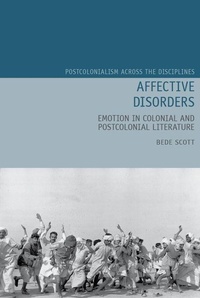
Affective Disorders
Emotion in Colonial and Postcolonial Literature
Published on 28. September 2019
Book
Hardback
200 pages
978-1-78694-170-1 (ISBN)
Description
An Open Access
edition of this book is available on the Liverpool University Press website and
through Knowledge Unlatched.
Situated at the intersection of postcolonial studies, affect studies, and narratology, Affective Disorders explores the significance of emotion in a range of colonial and postcolonial narratives. Through close readings of Naguib Mahfouz, Joaquim Maria Machado de Assis, and Upamanyu Chatterjee, among others, Bede Scott argues that literary representations of emotion need not be interpreted solely at the level of character, individual psychology, or the contingencies of plotting, but could also be related to broader sociopolitical forces. We thus find episodes of anger that serve as a collective response to the 'modernity' of wartime Cairo, feelings of jealousy that are inspired by the slave economy of imperial Brazil, and an overwhelming sense of boredom that emerges, in the late eighties, out of the bureaucratic procedures of the Indian Administrative Service. Affective Disorders also explores in some detail the formal consequences of these feelings - the way in which affective states such as anger or jealousy can often destabilize narratives, provoking crises of representation, generic ambivalence, and discursive rupture. By emphasizing the social origin of these emotions, and by analysing their influence on literary discourse, this study provides a deeper understanding of the relationship between various sociopolitical forces and the affective and aesthetic 'disorders' to which they give rise.
edition of this book is available on the Liverpool University Press website and
through Knowledge Unlatched.
Situated at the intersection of postcolonial studies, affect studies, and narratology, Affective Disorders explores the significance of emotion in a range of colonial and postcolonial narratives. Through close readings of Naguib Mahfouz, Joaquim Maria Machado de Assis, and Upamanyu Chatterjee, among others, Bede Scott argues that literary representations of emotion need not be interpreted solely at the level of character, individual psychology, or the contingencies of plotting, but could also be related to broader sociopolitical forces. We thus find episodes of anger that serve as a collective response to the 'modernity' of wartime Cairo, feelings of jealousy that are inspired by the slave economy of imperial Brazil, and an overwhelming sense of boredom that emerges, in the late eighties, out of the bureaucratic procedures of the Indian Administrative Service. Affective Disorders also explores in some detail the formal consequences of these feelings - the way in which affective states such as anger or jealousy can often destabilize narratives, provoking crises of representation, generic ambivalence, and discursive rupture. By emphasizing the social origin of these emotions, and by analysing their influence on literary discourse, this study provides a deeper understanding of the relationship between various sociopolitical forces and the affective and aesthetic 'disorders' to which they give rise.
Reviews / Votes
'Affective Disorders is a skilful, impeccably researched contribution, with much to offer to affect studies, narratology, and postcolonial work on emotion.'Alice Millington, Journal of Postcolonial Writing 'The project [is] an ambitious one given the author deals with two independent empires, three disparate centuries, and four different countries. As one proceeds through the riveting pages of the book, however, one realizes the scholarly acumen and academic rigor that Scott brings to bear on his work [...] that undoubtedly make it a pleasurable read. [...] One must acknowledge [its] nuanced, compelling, and erudite arguments. [...] The book is certainly a must-read for scholars of narratology, affect studies, and postcolonial criticism.'
Shailendra Kumar Singh, Cambridge Journal of Postcolonial Literary Inquiry
More details
Series
Language
English
Place of publication
Liverpool
United Kingdom
Target group
College/higher education
Professional and scholarly
Illustrations
2 Illustrations, black and white
Dimensions
Height: 162 mm
Width: 240 mm
Thickness: 18 mm
Weight
446 gr
ISBN-13
978-1-78694-170-1 (9781786941701)
Copyright in bibliographic data and cover images is held by Nielsen Book Services Limited or by the publishers or by their respective licensors: all rights reserved.
Schweitzer Classification
Person
Bede Scott is an Associate Professor of World Literature at Nanyang Technological University, Singapore.
Content
Acknowledgements
Introduction
1. Anger: Naguib Mahfouz's Midaq Alley
2. Reticence: Vikram Seth's A Suitable Boy
3. Jealousy: Joaquim Maria Machado de Assis' Dom Casmurro
4. Boredom: Upamanyu Chatterjee's English, August: An Indian Story
5. Fear: Michael Ondaatje's Anil's Ghost
6. Stuplimity: Vikram Chandra's Sacred Games
Works Cited
Index
Introduction
1. Anger: Naguib Mahfouz's Midaq Alley
2. Reticence: Vikram Seth's A Suitable Boy
3. Jealousy: Joaquim Maria Machado de Assis' Dom Casmurro
4. Boredom: Upamanyu Chatterjee's English, August: An Indian Story
5. Fear: Michael Ondaatje's Anil's Ghost
6. Stuplimity: Vikram Chandra's Sacred Games
Works Cited
Index