

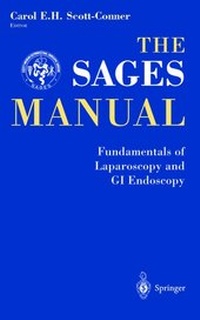
The SAGES Manual
Fundamentals of Laparoscopy, Thoracoscopy and GI Endoscopy
Published on 30. October 1998
Book
Paperback/Softback
XX, 602 pages
978-0-387-98496-4 (ISBN)
Description
A classic in the making -- a portable, concise, beautifully illustrated manual from the world's pioneering society of minimally invasive surgery. The book provides an authoritative synopsis of the major laparoscopic and endoscopic procedures in an easy-to-use, outline form. The laparoscopic section reviews the important basics of laparoscopic surgery, including equipment set-up, access to the abdomen, generating and maintaining the working space, and the principles of laparoscopic hemostasis. All the major and emerging laparoscopic general surgery procedures are included and information on indications, patient preparation and position, and the step-by-step operative technique are featured for each operation. An absolute must-have reference for the general surgery resident on call, or as a refresher before procedures.
More details
Language
English
Place of publication
NY
United States
Target group
College/higher education
Professional and scholarly
Illustrations
273
44 s/w Tabellen, 273 s/w Abbildungen
273 illustrations
Dimensions
Height: 20.3 cm
Width: 12.7 cm
Weight
620 gr
ISBN-13
978-0-387-98496-4 (9780387984964)
Schweitzer Classification
Other editions
New editions
Book
10/2005
2nd Edition
Springer
€71.64
Article exhausted; check for reprint
Content
Part One: Laparoscopy - General Principles; 1) Equipment Setup and Troubleshooting; 2) Patient Preparation; 3) Anesthesia and Monitoring;4) Access to Abdomen; 5) Generation and Maintenance of Working Space; 5.1) Pneumoperitoneum ; 5.2) Abdominal Wall Lift Devices; 5.3) Generation of Working Space: Extraperitoneal Approaches; 6) Principles of Laparoscopic Hemostasis; 7) Principles of Tissue Approximation; 8) Principles of Removal of Specimens and Solid Organs; 9) Documentation; 10) Special Problems ; 10.1) Massive Obesity ; 10.2) Laparoscopy During Pregnancy ; 10.3) Previous Abdominal Surgery ; Part Two: Diagnostic Laparoscopy and Biopsy ; 11) Emergency Laparoscopy ; 12) Elective Diagnostic Laparoscopy and Cancer Staging ; Part Three: Laparoscopic Cholecystectomy and Common Duct Exploration ; 13) Laparoscopic Cholecystectomy ; 13.1 and 13.2) Indications and Patient Preparation ; 13.3) Surgical Technique ; 13.3.1) Avoiding Complications ; 13.3.4) Cholangiography ; 13.3.3) Ultrasound and Doppler ; 14) Laparoscopic Common Duct Exploration ; 14.1) Transcystic Duct ; 14.2) VIa Laparoscopic Choledochotomy; 15) Complications ; Part Four: Hiatal Hernia Repair and Heller Myotomy ; 16) Hiatal Hernia Repair ; 17) Heller Myotomy ; Part Five: Laparoscopic Gastric Surgery ; 18) Gastrostomy ; 19) Vagotomy ; 20) Plication of Perforated Ulcer ; 21) Gastric Resections ; 22) Laparoscopic Bariatric Surgery; Part Six: Laparoscopic Procedures on the Small Intestine, Appendix and Colon ; 23) Small Bowel Resection ; 24) Placement of Jejunostomy ; 25) Laparoscopic Appendectomy ; 26) Colostomy ; 27) Laparoscopic Segmental Colectomies, Anterior Resection and Abdominoperineal Resection ; 28) Abdominoperineal Resection, Proctocolectomy, and Related Procedures ; Part Seven: Laparoscopic Approaches to the Pancreas, Spleen, and Retroperitoneum ; 29) Distal Pancreatectomy ; 30) Laparoscopic Cholecystojejunostomy ; 31) Splenectomy ; 32) Lymph Node Biopsy; Dissection, and Staging Laparotomy ; 33) Laparoscopic Adrenalectomy; Part Eight: Hernia Repair ; 34) Laparoscopic Inguinal Hernia Repair ; 35) Laparoscopic Repair of Ventral Hernia ; Part Nine: Pediatric Laparoscopy ; 36) General Complications ; 37) Specific Surgical Complications ; 38) Complications: Section II: Flexible Endoscopy; Part One: Flexible Endoscopy: General Principles ; 39) Characteristics of Flexible Endoscopes, Troubleshooting, and Equipment ; 40) Endoscope Healing ; 41) Monitoring, Sedation, and Recovery ; Part Two: Upper Gastrointestinal Endoscopy ; 42) Diagnostic Upper Gastrointestinal Endoscopy ; 43) Control of Upper Gastrointestinal Bleeding ; 43.1.1) Variceal Banding ; 43.1.2) Sclerotherapy of Variceal Bleeding ; 43.1.3) Control of Non-Variceal Upper GI Bleeding ; 43.2-5) Polypectomy ; 43.6.1-2) Percutaneous Endoscopic Feeding Tube Placement ; 44) Complications of Upper Gastrointestinal Feeding Tube Placement ; Part Three: Small Bowel Enteroscopy ; 45) Indications, Technique, and Complications ; Part Four: Endoscopic Retrograde Cholangiopancreatography ; 46) Diagnostic ERCP ; 46.1) Endoscopic Retrograde Cholangiopancreatography ; 46.2) Surgically Altered Anatomy and Special Considerations ; 47) Cannulation and Cholangiopancreatography ; 48) Therapeutic ERCP; 49) Complications of ERCP ; Part Five: Choledoschopy; 50) Diagnostic Choledochoscopy ; 51) Therapeutic Choledochoscopy and Its Complications; Part Six: Flexible Sigmoidoscopy ; 52) Flexible Sigmoidoscopy ; 53) Therapeutic Flexible Sigmoidoscopy ; Part Seven: Colonoscopy ; 54) Diagnostic Colonoscopy ; 55) Therapeutic Colonoscopy, Complications of Colonoscopy ; Part Eight: Pediatric Endoscopy ; 56) Pediatric Gastrointestinal Endoscopy; Appendices.