

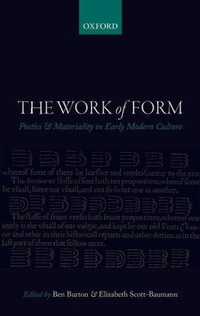
The Work of Form
Poetics and Materiality in Early Modern Culture
Published on 26. June 2014
Book
Hardback
258 pages
978-0-19-870281-8 (ISBN)
Description
The Work of Form: Poetics and Materiality in Early Modern Culture explores the resurgent interest in literary form and aesthetics in early modern english studies. Essays by leading international scholars reflect on the legacy of historicist approaches and on calls for a renewal of formalist analysis as both a tool and as a defence of our object of study as literary critics. This collection addresses the possibilities as well as the challenges of combining these critical traditions; it tests and reflects on these through practice. It also establishes new lines of enquiry by expanding definitions of form to include the material as well as theoretical implications of the term and explores the early modern roots of these connections. The period's most famous poets such as Sidney, Spenser, Shakespeare, Jonson, and Jonson appear alongside Anne Southwell, Thomas Campion, and many anonymous poets and songwriters.
The Work of Form brings together contributors from literary history, historicism, manuscript study, prosodic theory, the history of music, history of the book, as well as print and manuscript culture. It represents avowedly political historical work, alongside aesthetic and theoretical frameworks, work bridging literature and music, and cognitive poetics. In bringing together these diverse commitments, it addresses urgent questions about how we can understand and analyse literary form in a historically-rooted way, and demands rigorous discussion about the status of formal and aesthetic considerations in editing, in literary criticism, and in teaching.
The Work of Form brings together contributors from literary history, historicism, manuscript study, prosodic theory, the history of music, history of the book, as well as print and manuscript culture. It represents avowedly political historical work, alongside aesthetic and theoretical frameworks, work bridging literature and music, and cognitive poetics. In bringing together these diverse commitments, it addresses urgent questions about how we can understand and analyse literary form in a historically-rooted way, and demands rigorous discussion about the status of formal and aesthetic considerations in editing, in literary criticism, and in teaching.
Reviews / Votes
[T]his rich collection of essays ... contributes to a neo-formalism that counters the dominant literary historicism. * Arthur F. Marotti, SHARP News * The collection will not fail to please and inspire readers interested in the intersection of historicism and formalism. Each essay queries the aesthetics of verse (such as meter, punctuation, and other subtle details) as well as the verse's political, social, and religious contexts. To unpack the mysteries of Renaissance poetry, the authors immerse themselves in the cultures of their subjects. The internal stuff of the poem is anatomized along with the personal or political conditions behind the early modern author's artistic process. * Penelope Geng, Renaissance Quarterly *More details
Language
English
Place of publication
Oxford
United Kingdom
Target group
College/higher education
Product notice
sewn/stitched
Cloth over boards
With dust jacket
Illustrations
12 black-and-white illustrations
Dimensions
Height: 216 mm
Width: 145 mm
Thickness: 23 mm
Weight
454 gr
ISBN-13
978-0-19-870281-8 (9780198702818)
Copyright in bibliographic data and cover images is held by Nielsen Book Services Limited or by the publishers or by their respective licensors: all rights reserved.
Schweitzer Classification
Other editions
Additional editions
Elizabeth Scott-Baumann | Ben Burton
The Work of Form
Poetics and Materiality in Early Modern Culture
E-Book
06/2014
1st Edition
OUP eBook
€58.99
Available for download
Persons
Elizabeth Scott-Baumann is Leverhulme Early Career Fellow at King's College London. She is the author of Forms of Engagement: Women, Poetry, and Culture 1640-1680 (OUP) and co-edited The Intellectual Culture of Puritan Women (Palgrave, 2010) with Johanna Harris. She is also editing an anthology of Women Poets of the English Civil War for Manchester University Press with Sarah C. E. Ross.
Ben Burton teaches at Nottingham High School and was previously Lecturer in Early Modern English Literature at St Catherine's College, Oxford University. He has published articles on early modern devotional poetry, including an essay which won Renaissance and Reformation's Natalie Zemon Davis prize in 2007.
Ben Burton teaches at Nottingham High School and was previously Lecturer in Early Modern English Literature at St Catherine's College, Oxford University. He has published articles on early modern devotional poetry, including an essay which won Renaissance and Reformation's Natalie Zemon Davis prize in 2007.
Content
Foreword ; 1. The Work of Form: Poetics and Materiality in Early Modern Culture ; 2. 'You may be wondering why I called you all here today': Patterns of Gathering in the Early Modern Print Lyric ; 3. Allusions and Distinctions: Pentameter Couplets in Ben Jonson's Epigrams and Forest ; 4. Forms of Worship: Shakespeare's Sonnets, Ritual, and the Genealogy of formalism ; 5. Bondage and the Lyric: Philosophical and Formal, especially Renaissance ; 6. Thinking in Stanzas: Venus and Adonis and The Rape of Lucrece ; 7. A Poetics of Song ; 8. On the Reuse of Poetic Form: The Ghost in the Shell ; 9. Gender, Reception, and Form: Early Modern Women and the Making of Verse ; 10. 'I haue not time to point yr booke ... which I desire you yourselfe to doe': Editing the Form of Women's Manuscript Verse ; 11. Poetry on the Page: Visual Signalling and the Mind's Ear ; The Work of Form: Some Afterwords