

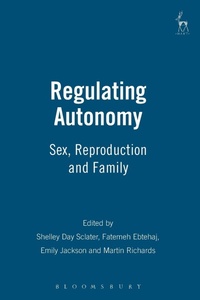
Regulating Autonomy
Sex, Reproduction and Family
Published on 4. March 2009
Book
Paperback/Softback
298 pages
978-1-84113-946-3 (ISBN)
Description
These essays explore the nature and limits of individual autonomy in law, policy and the work of regulatory agencies. Authors ask searching questions about the nature and scope of the regulation of 'private' lives, from intimacies, personal relationships and domestic lives to reproduction. They question the extent to which the law does, or should, protect individual autonomy. Recent rapid advances in the development of new technologies - particularly those concerned with human genetics and assisted reproduction - have generated new questions (practical, social, legal and ethical) about how far the state should intervene in individual decision making. Is there an inevitable tension between individual liberty and the common good? How might a workable balance between the public and the private be struck? How, indeed, should we think about 'autonomy'? The essays explore the arguments used to create and maintain the boundaries of autonomy - for example, the protection of the vulnerable, public goods of various kinds, and the maintenance of tradition and respect for cultural practices. Contributors address how those boundaries should be drawn and interventions justified.
How are contemporary ethical debates about autonomy constructed, and what principles do they embody? What happens when those principles become manifest in law?
How are contemporary ethical debates about autonomy constructed, and what principles do they embody? What happens when those principles become manifest in law?
Reviews / Votes
My overall conclusions are that there are no weak contributions here, that I learnt a lot, had my mind changed occasionally [and] was led to thinking about some - important - matters for the first time Chris Barton Child and Family Law Quarterly Volume 21, No.4, 2009 ...the book as a whole is thought-provoking and challenging, with a mastery of detail and argument that is so often lacking in public debate today...the breadth of subjects discussed and the fact that many of them are familiar from popular discussions make it a fascinating read. It provides insights into both the reach and the limitations of the law in dealing with intimate life and raises important questions about the way in which autonomy has become subject to doubt, both in its necessity and its possibility. Jan Macvarish Spiked Review of Books July 2009 Many of the individual cases are thought-provoking and useful for scholars of family law, feminist legal theory, and autonomy. They raise many provocative questions about the relationship between autonomy and regulation by challenging the assumption that these two things are necessarily opposed to one another...The chapters are accessible and could be useful in an undergraduate or graduate course on gender and law or family law. Claire E. Rasmussen Law & Politics Book Review Vol.19, No.8 August 28, 2009 The essays analyse how much intimate relationships and reproductive decision-making should be affected by the law, regulation and social policy. The collection will therefore appeal to legal scholars, social scientists, biochemists, and policy makers alike. This collection of essays engagingly discusses the intersection of autonomy and regulation in private decision making... the essays are all of high standard and ... the book makes a good contribution to its field. Malcolm Smith Bionews April 2010More details
Language
English
Place of publication
Oxford
United Kingdom
Publishing group
Bloomsbury Publishing PLC
Target group
Professional and scholarly
Dimensions
Height: 234 mm
Width: 156 mm
Thickness: 15 mm
Weight
436 gr
ISBN-13
978-1-84113-946-3 (9781841139463)
Copyright in bibliographic data and cover images is held by Nielsen Book Services Limited or by the publishers or by their respective licensors: all rights reserved.
Schweitzer Classification
Other editions
Additional editions
Shelley Day Sclater | Fatemeh Ebtehaj | Emily Jackson
Regulating Autonomy
Sex, Reproduction and Family
E-Book
03/2009
1st Edition
Hart Publishing
€88.49
Available for download
Persons
Shelley Day Sclater has been a lawyer and academic social scientist and now works as a freelance writer and researcher. She was Professor of Psychology and Law at the University of East London. Fatemeh Ebtehaj is an associate member of the Centre for Family Research, University of Cambridge. Emily Jackson is a Professor of Law at the London School of Economics and a member the Human Fertilisation and Embryology Authority, and the British Medical Association Medical Ethics Committee. Martin Richards is Emeritus Professor of Family Research at the Centre for Family Research, University of Cambridge.
Content
1. Introduction: Autonomy and Private Life Emily Jackson and Shelley Day Sclater Part 1: Intimacies and Domestic Lives 2. Exploitation: The Role of Law in Regulating Prostitution Suzanne Jenkins 3. Feminist Anti-violence Discourse as Regulation Helen Reece 4. Relational Autonomy and Rape Jonathan Herring 5. Rules for Feeding Babies Ellie Lee and Jennie Bristow 6. Legal Representation and Parental Autonomy: The Work of the English Family Bar in Contact Cases Mavis Maclean and John Eekelaar 7. Regulating Step-parenthood Jan Pryor 8. Internet Sex Offenders: Individual Autonomy, 'Folk Devils' and State Control Julia Davidson and Elena Martellozzo Part 2: Reproduction 9. Regulation of Reproductive Decision-making Theresa Glennon 10. Instruments for ART Regulation: What are the Most Appropriate Mechanisms for Achieving Smart Regulation? Martin H Johnson and Kerry Petersen 11. Which Children can we Choose? Boundaries of Reproductive Autonomy Martin Richards 12. Anonymity-or not-in the Donation of Gametes and Embryos Susan Golombok 13. Autonomy and the UK's Law on Abortion: Current Problems and Future Prospects Laura Riley and Ann Furedi