

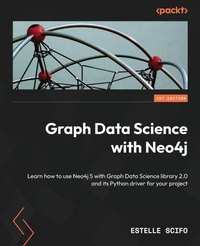
Graph Data Science with Neo4j
Learn how to use Neo4j 5 with Graph Data Science library 2.0 and its Python driver for your project
Published on 31. January 2023
Book
Paperback/Softback
288 pages
978-1-80461-274-3 (ISBN)
Description
Supercharge your data with the limitless potential of Neo4j 5, the premier graph database for cutting-edge machine learning
Purchase of the print or Kindle book includes a free PDF eBook
Key Features
Extract meaningful information from graph data with Neo4j's latest version 5
Use Graph Algorithms into a regular Machine Learning pipeline in Python
Learn the core principles of the Graph Data Science Library to make predictions and create data science pipelines.
Book DescriptionNeo4j, along with its Graph Data Science (GDS) library, is a complete solution to store, query, and analyze graph data. As graph databases are getting more popular among developers, data scientists are likely to face such databases in their career, making it an indispensable skill to work with graph algorithms for extracting context information and improving the overall model prediction performance.
Data scientists working with Python will be able to put their knowledge to work with this practical guide to Neo4j and the GDS library that offers step-by-step explanations of essential concepts and practical instructions for implementing data science techniques on graph data using the latest Neo4j version 5 and its associated libraries. You'll start by querying Neo4j with Cypher and learn how to characterize graph datasets. As you get the hang of running graph algorithms on graph data stored into Neo4j, you'll understand the new and advanced capabilities of the GDS library that enable you to make predictions and write data science pipelines. Using the newly released GDSL Python driver, you'll be able to integrate graph algorithms into your ML pipeline.
By the end of this book, you'll be able to take advantage of the relationships in your dataset to improve your current model and make other types of elaborate predictions.What you will learn
Use the Cypher query language to query graph databases such as Neo4j
Build graph datasets from your own data and public knowledge graphs
Make graph-specific predictions such as link prediction
Explore the latest version of Neo4j to build a graph data science pipeline
Run a scikit-learn prediction algorithm with graph data
Train a predictive embedding algorithm in GDS and manage the model store
Who this book is forIf you're a data scientist or data professional with a foundation in the basics of Neo4j and are now ready to understand how to build advanced analytics solutions, you'll find this graph data science book useful. Familiarity with the major components of a data science project in Python and Neo4j is necessary to follow the concepts covered in this book.
Purchase of the print or Kindle book includes a free PDF eBook
Key Features
Extract meaningful information from graph data with Neo4j's latest version 5
Use Graph Algorithms into a regular Machine Learning pipeline in Python
Learn the core principles of the Graph Data Science Library to make predictions and create data science pipelines.
Book DescriptionNeo4j, along with its Graph Data Science (GDS) library, is a complete solution to store, query, and analyze graph data. As graph databases are getting more popular among developers, data scientists are likely to face such databases in their career, making it an indispensable skill to work with graph algorithms for extracting context information and improving the overall model prediction performance.
Data scientists working with Python will be able to put their knowledge to work with this practical guide to Neo4j and the GDS library that offers step-by-step explanations of essential concepts and practical instructions for implementing data science techniques on graph data using the latest Neo4j version 5 and its associated libraries. You'll start by querying Neo4j with Cypher and learn how to characterize graph datasets. As you get the hang of running graph algorithms on graph data stored into Neo4j, you'll understand the new and advanced capabilities of the GDS library that enable you to make predictions and write data science pipelines. Using the newly released GDSL Python driver, you'll be able to integrate graph algorithms into your ML pipeline.
By the end of this book, you'll be able to take advantage of the relationships in your dataset to improve your current model and make other types of elaborate predictions.What you will learn
Use the Cypher query language to query graph databases such as Neo4j
Build graph datasets from your own data and public knowledge graphs
Make graph-specific predictions such as link prediction
Explore the latest version of Neo4j to build a graph data science pipeline
Run a scikit-learn prediction algorithm with graph data
Train a predictive embedding algorithm in GDS and manage the model store
Who this book is forIf you're a data scientist or data professional with a foundation in the basics of Neo4j and are now ready to understand how to build advanced analytics solutions, you'll find this graph data science book useful. Familiarity with the major components of a data science project in Python and Neo4j is necessary to follow the concepts covered in this book.
More details
Language
English
Place of publication
Birmingham
United Kingdom
Target group
Professional and scholarly
US School Grade: College Graduate Student
Dimensions
Height: 235 mm
Width: 191 mm
Thickness: 16 mm
Weight
543 gr
ISBN-13
978-1-80461-274-3 (9781804612743)
Copyright in bibliographic data and cover images is held by Nielsen Book Services Limited or by the publishers or by their respective licensors: all rights reserved.
Schweitzer Classification
Other editions
Additional editions
Estelle Scifo
Graph Data Science with Neo4j
Learn how to use Neo4j 5 with Graph Data Science library 2.0 and its Python driver for your project
E-Book
09/2024
Packt Publishing
from
€33.59
Available for download
Person
Estelle Scifo possesses over 7 years experience as a data scientist, after receiving her PhD from the Laboratoire de lAcclrateur Linaire, Orsay (affiliated to CERN in Geneva). As a Neo4j certified professional, she uses graph databases on a daily basis and takes full advantage of its features to build efficient machine learning models out of this data. In addition, she is also a data science mentor to guide newcomers into the field. Her domain expertise and deep insight into the perspective of the beginners needs make her an excellent teacher.
Content
Table of Contents
Introducing and Installing Neo4j
Using Existing Data to Build a Knowledge Graph
Characterizing a Graph Dataset
Using Graph Algorithms to Characterize a Graph Dataset
Visualizing Graph Data
Building a Machine Learning Model with Graph Features
Automatically Extracting Features with Graph Embeddings for Machine Learning
Building a GDS Pipeline for Node Classification Model Training
Predicting Future Edges
Writing Your Custom Graph Algorithm with the Pregel API
Introducing and Installing Neo4j
Using Existing Data to Build a Knowledge Graph
Characterizing a Graph Dataset
Using Graph Algorithms to Characterize a Graph Dataset
Visualizing Graph Data
Building a Machine Learning Model with Graph Features
Automatically Extracting Features with Graph Embeddings for Machine Learning
Building a GDS Pipeline for Node Classification Model Training
Predicting Future Edges
Writing Your Custom Graph Algorithm with the Pregel API