

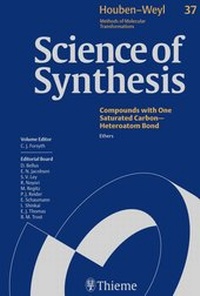
Science of Synthesis: Houben-Weyl Methods of Molecular Transformations Vol. 37
Ethers
Thieme (Publisher)
1st Edition
Published on 7. May 2008
Book
Hardback
992 pages
978-3-13-118891-5 (ISBN)
Description
Science of Synthesis: Houben-Weyl Methods of Molecular Transformations is the entirely new edition of the acclaimed reference series Houben-Weyl, the standard synthetic chemistry resource since 1909. This new edition is published in English and will comprise 48 volumes published between the years 2000 and 2008.
Science of Synthesis is a quality reference work developed by a highly esteemed editorial board to provide a comprehensive and critical selection of reliable organic and organometallic synthetic methods. This unique resource is designed to be the first point of reference when searching for a synthesis strategy.
Contains the expertise of presently 400 leading
chemists worldwide
Critically evaluates the preparative applicability
and significance of the synthetic methods
Discusses relevant background information and provides detailed experimental procedures
For full information on the Science of Synthesis series, visit the Science of Synthesis Homepage
All prices
More details
Series
Edition
1. Auflage
Language
English
Place of publication
Stuttgart
Germany
Target group
Professional and scholarly
Wissenschaftler
Edition type
New edition
Illustrations
1062 Abbildungen
- 1062 Illustrations, color - 447 Tables, color
Dimensions
Height: 24 cm
Width: 17 cm
Weight
454 gr
ISBN-13
978-3-13-118891-5 (9783131188915)
Schweitzer Classification
Persons
Content
37.1 Product Class 1: Dialkyl Ethers
37.1.1 Synthesis from Esters, Aldehydes, Ketones, and Acetals by Reduction or Alkylation
37.1.2 Synthesis by Substitution
37.1.3 Synthesis by Addition to Alkenes
37.1.4 Synthesis from Other Ethers
37.2.1 Synthesis from Alkenes by Metal-Mediated Oxidation
37.2.2 Synthesis from Alkenes with Organic Oxidants
37.2.3 Synthesis by Carbonyl Epoxidation
37.2.4 Synthesis by Ring Closure
37.3 Product Class 3: Oxetanes and Oxetan-3-ones
37.4 Product Class 4: Five-Membered and Larger-Ring
37.4.1 Synthesis by Ring-Closure Reactions, Except Ring-Closing Metathesis
37.4.2 Synthesis by Ring-Closing Metathesis
37.4.3 Synthesis from Other Cyclic Ethers
37.5 Product Class 5: Five-Membered and Larger-Ring Oxacycloalkanes
37.6 Product Class 6: Oxonium Salts
37.7 Product Class 7: Oligo- and Monosaccharide Ethers
37.8 Product Class 8: Ethers as Protecting Groups
37.1.1 Synthesis from Esters, Aldehydes, Ketones, and Acetals by Reduction or Alkylation
37.1.2 Synthesis by Substitution
37.1.3 Synthesis by Addition to Alkenes
37.1.4 Synthesis from Other Ethers
37.2.1 Synthesis from Alkenes by Metal-Mediated Oxidation
37.2.2 Synthesis from Alkenes with Organic Oxidants
37.2.3 Synthesis by Carbonyl Epoxidation
37.2.4 Synthesis by Ring Closure
37.3 Product Class 3: Oxetanes and Oxetan-3-ones
37.4 Product Class 4: Five-Membered and Larger-Ring
37.4.1 Synthesis by Ring-Closure Reactions, Except Ring-Closing Metathesis
37.4.2 Synthesis by Ring-Closing Metathesis
37.4.3 Synthesis from Other Cyclic Ethers
37.5 Product Class 5: Five-Membered and Larger-Ring Oxacycloalkanes
37.6 Product Class 6: Oxonium Salts
37.7 Product Class 7: Oligo- and Monosaccharide Ethers
37.8 Product Class 8: Ethers as Protecting Groups