

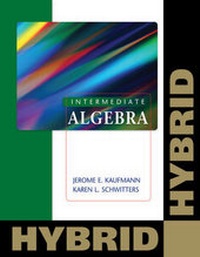
Intermediate Algebra: Hybrid
Published on 1. January 2011
Book
Mixed media product
592 pages
978-0-8400-6591-9 (ISBN)
Description
Designed for the intermediate algebra course in which an online homework system is a requirement, this text provides the content needed for the traditional, lecture-based course in a more brief and more affordable format.
Reviews / Votes
1. BASIC CONCEPTS AND PROPERTIES. Sets, Real Numbers, and Numerical Expressions. Operations with Real Numbers. Properties or Real Numbers and the Use of Exponents. Algebraic Expressions. 2. EQUATIONS, INEQUALITIES AND PROBLEM SOLVING. Solving First-Degree Equations. Equations Involving Fractional Forms. Equations Involving Decimals and Problem Solving. Formulas. Inequalities. More on Inequalities and Problem Solving. Equations and Inequalities Involving Absolute Values. 3. LINEAR EQUATIONS AND INEQUALITIES IN TWO VARIABLES. Rectangular Coordinate System and Linear Equations. Linear Inequalities in Two Variables. Distance and Slope. Determining the Equation of a Line. 4. SYSTEMS OF EQUATIONS. Systems of Two Linear Equations and Linear Inequalities in Two Variables. Substitution Method. Elimination-by-Addition Method. Systems of Three Linear Equations in Three Variables. 5. POLYNOMIALS. Polynomials: Sums and Differences. Products and Quotients of Monomials. Multiplying Polynomials. Factoring: Use of the Distributive Property. Factoring: Difference of two Squares and Sums or Difference in Two Cubes. Factoring Trinomials. Equations and Problem Solving. 6. RATIONAL EXPRESSIONS. Simplifying Rational Expressions. Multiplying and Dividing Rational Expressions. Adding and Subtracting Rational Expressions. More on Rational Expressions and Complex Fractions. Dividing Polynomials. Fractional Equations. More Rational Equations and Applications. 7. EXPONENTS AND RADICALS. Using Integers as Exponents. Roots and Radicals. Combining Radicals and Simplifying Radicals That Contain Variables. Products and Quotients Involving Radicals. Merging Exponents and Roots. Scientific Notation. 8. QUADRATIC EQUATIONS AND INEQUALITIES. Complex Numbers. Quadratic Equations. Completing the Square. Quadratic Formula. More Quadratic Equations and Applications. Quadratic and Other Nonlinear Inequalities. 9. CONIC SECTIONS. Graphing Nonlinear Equations. Graphing Parabolas. More Parabolas and Some Circles. Graphing Ellipses. Graphing Hyperbolas. Systems Involving Nonlinear Equations. 10. FUNCTIONS. Relations and Functions. Functions: Their Graphs and Applications. Graphing Made Easy Via Transformations. Composition of Functions. Inverse Functions. Direct and Inverse Variations. 11. EXPONENTIAL AND LOGARITHMIC FUCNTIONS. Exponents and Exponential Functions. Applications of Exponential Functions. Logarithms. Logarithmic Functions. Exponential Equations, Logarithmic Equations, and Problem Solving.More details
Language
English
Place of publication
Florence
United States
Target group
College/higher education
Dimensions
Height: 272 mm
Width: 213 mm
Thickness: 30 mm
Weight
1338 gr
ISBN-13
978-0-8400-6591-9 (9780840065919)
Copyright in bibliographic data and cover images is held by Nielsen Book Services Limited or by the publishers or by their respective licensors: all rights reserved.
Schweitzer Classification
Content
1. Structure and Process of Supervision. 2. Supervision Models: Psychotherapy-based Non-Psychotherapy-based. 3. Effective Supervision. 4. Supervisor. Gender and Perceived Stereotypes. Theoretical Orientation, Interaction and Learning Styles. BTI Types. Negative-Harmful Supervision. 5. Supervisee. Attachment Style. Self-presentation and Self-disclosure. Interaction and Learning Styles. Theoretical Orientation. Gender & Perceived Stereotypes. 6. Assessment of the Trainee. Knowledge and Skills. Personal Dynamics. Formal Assessment Tools. 7. Supervision Ethics. 8. Legal Aspects of Supervision in Psychotherapy. 9. Impacts of Culture and Diversity on the Supervisory Relationship and Process.