

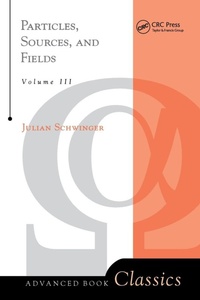
Particles, Sources, And Fields, Volume 3
1st Edition
Published on 6. November 1998
Book
Paperback/Softback
334 pages
978-0-7382-0055-2 (ISBN)
Description
An extension of Dr. Schwinger's two previous classic works, this volume contains four sections in addition to the previous sections of Electrodynamics II, which were concerned with the two-particle problem, and applications to hydrogenic atoms, positronium, and muonium.
More details
Series
Language
English
Place of publication
Oxford
United States
Publishing group
Taylor & Francis Inc
Target group
College/higher education
Professional and scholarly
Dimensions
Height: 229 mm
Width: 152 mm
Thickness: 18 mm
Weight
488 gr
ISBN-13
978-0-7382-0055-2 (9780738200552)
Copyright in bibliographic data and cover images is held by Nielsen Book Services Limited or by the publishers or by their respective licensors: all rights reserved.
Schweitzer Classification
Other editions
Additional editions
Julian Schwinger
Particles, Sources, And Fields, Volume 3
Book
06/2019
1st Edition
CRC Press
€206.30
Shipment within 15-20 days
Julian Schwinger
Particles, Sources, And Fields, Volume 3
E-Book
03/2018
CRC Press
€86.99
Available for download
Julian Schwinger
Particles, Sources, And Fields, Volume 3
E-Book
03/2018
1st Edition
CRC Press
€86.99
Available for download
Person
Julian Schwinger (1918-1994) was born in New York City. He obtained his Ph.D. in Physics from Columbia University in 1939. He also received honourary doctorates in science from Purdue, Brandeis, Harvard, and Gustavus Adolphus College. He taught at the University of California, Los Angeles, from 1972 until his death. In 1965, Dr. Schwinger received (with Richard Feynman and Sin Itiro Tomonaga) the Nobel Prize in Physics for his work in quantum electrodynamics. A National Research Foundation Fellow (1939-1940) and a Guggenheim Fellow (1970), he was the recipient of many awards, including: the First Einstein Prize Award for Physics (1964), and the American Academy of Achievement Award (1987).
Content
Electrodynamics * Two-Particle Interactions. Non-relativistic Discussion * Two-Particle Interactions. Relativistic Theory I * Two-Particle Interactions. Relativistic Theory II * Photon Propagation Function II * Positronium Muonium * Strong Magnetic Fields * Electron Magnetic Moment * Photon Propagation Function III * Photon Decay of the Pion. A Confrontation.