

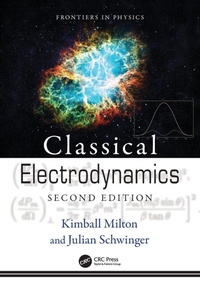
Classical Electrodynamics
2nd Edition
Published on 29. August 2025
Book
Paperback/Softback
548 pages
978-0-367-52298-8 (ISBN)
Description
Classical Electrodynamics captures Schwinger's inimitable lecturing style, in which everything flows inexorably from what has gone before. This anniversary edition offers a refreshing update while still maintaining Schwinger's voice.
The book provides the student with a thorough grounding in electrodynamics in particular, and in classical field theory in general. An essential resource for both physicists and their students, the book includes a Reader's Guide, which describes the major themes in each chapter, suggests a possible path through the book, and identifies topics for inclusion in, and exclusion from, a given course, depending on the instructor's preference.
Carefully constructed problems complement the material of the text. Classical Electrodynamics should be of great value to all physicists, from first-year graduate students to senior researchers, and to all those interested in electrodynamics, field theory, and mathematical physics.
The original text for the graduate classical electrodynamics course was left unfinished upon Julian Schwinger's death in 1994, but was completed by his former students and co-authors, who have brilliantly recreated the excitement of Schwinger's novel approach. This anniversary edition has been revised by one of those original co-authors, Kimball Milton.
The book provides the student with a thorough grounding in electrodynamics in particular, and in classical field theory in general. An essential resource for both physicists and their students, the book includes a Reader's Guide, which describes the major themes in each chapter, suggests a possible path through the book, and identifies topics for inclusion in, and exclusion from, a given course, depending on the instructor's preference.
Carefully constructed problems complement the material of the text. Classical Electrodynamics should be of great value to all physicists, from first-year graduate students to senior researchers, and to all those interested in electrodynamics, field theory, and mathematical physics.
The original text for the graduate classical electrodynamics course was left unfinished upon Julian Schwinger's death in 1994, but was completed by his former students and co-authors, who have brilliantly recreated the excitement of Schwinger's novel approach. This anniversary edition has been revised by one of those original co-authors, Kimball Milton.
More details
Series
Edition
2nd edition
Language
English
Place of publication
London
United Kingdom
Publishing group
Taylor & Francis Ltd
Target group
College/higher education
Postgraduate and Undergraduate
Illustrations
6 s/w Tabellen, 105 s/w Zeichnungen, 105 s/w Abbildungen
6 Tables, black and white; 105 Line drawings, black and white; 105 Illustrations, black and white
Dimensions
Height: 254 mm
Width: 178 mm
Thickness: 31 mm
Weight
1061 gr
ISBN-13
978-0-367-52298-8 (9780367522988)
Copyright in bibliographic data and cover images is held by Nielsen Book Services Limited or by the publishers or by their respective licensors: all rights reserved.
Schweitzer Classification
Other editions
Additional editions
Julian Schwinger | Kimball Milton
Classical Electrodynamics
E-Book
04/2024
2nd Edition
CRC Press
€69.99
Available for download
Julian Schwinger | Kimball Milton
Classical Electrodynamics
E-Book
04/2024
2nd Edition
CRC Press
€69.99
Available for download
Book
04/2024
2nd Edition
CRC Press
€126.00
Shipment within 15-20 days
Persons
The late Julian Schwinger shared the 1965 Nobel Prize for Physics with Richard Feynman and Shin'ichiro Tomonaga for their work on the theory of quantum electrodynamics. Kimball A. Milton is George Lynn Cross Research Professor of Physics, Emeritus, at the University of Oklahoma, currently residing in Memphis, Tennessee.
Content
Preface to Second Edition xv
Preface to First Edition xvii
Reader's Guide (Updated from first edition) xix
I Formulation of Electrodynamics 1
1. Maxwell's Equations......
2. Magnetic Charge I ......
3. Conservation Laws .......
4. Macroscopic Electrodynamics .....
5. Simple Model for Constitutive Relations ........
6. Dispersion Relations for the Susceptibility ......
7. Magnetic Properties of Matter ........
8. Macroscopic Energy and Momentum ......
9. Review of Action Principles ......
10. Action Principle for Electrodynamics ......
11. Einsteinian Relativity ........
12. Relativistic formulation ......
II Electrostatics .....
13. Stationary Principles for Electrostatics .....
14. Introduction to Green's Functions .......
15. Electrostatics in Free Space .......
16. Semi-Infinite Dielectric .......
17. Application of Green's Function .....
18. Bessel Functions .....
19. Parallel Conducting Plates .....
20. Modified Bessel Functions ......
21. Cylindrical Conductors .......
23. Coulomb's Potential ......
24. Multipoles ......
25. Conducting Sphere and Dielectric Ball .....
26. Dielectrics and Conductors .......
27. Modes and Variations ........
III Magnetostatics .....
28. Magnetostatics ......
29. Macroscopic Current Distributions .....
30. Magnetic Multipoles .......
31. Magnetic Scalar Potential ......
32. Steady Currents and Dissipation .......
33. Magnetic Charge II ......
IV Electromagnetic Radiation .....
34. Retarded Green's Function .....
35. Radiation-Field Point of View ........
36. Radiation-Source Point of View .....
37. Models of Antennas .....
38. Spectral Distribution of Radiation .....
Information Classification: General
39. Power Spectrum and ?Cerenkov Radiation ....
40. Constant Acceleration and Impulse ....
41. Synchrotron Radiation I .....
42. Synchrotron Radiation II-Polarization .....
43. Synchrotron Radiation III-High Energies ......
44. Propagation in a Dielectric Medium ......
45. Reflection by an Imperfect Conductor .......
46. Cylindrical Coordinates ......
47. Waveguides ......
48. Scattering by Small Obstacles ........
49. Partial-Wave Analysis of Scattering .......
50. Diffraction I .......
51. Diffraction II ......
52. Babinet's Principle ......
53. General Scattering .......
54. Charged Particle Energy Loss .....
A Units ......
Bibliography .......
Index .......
Preface to First Edition xvii
Reader's Guide (Updated from first edition) xix
I Formulation of Electrodynamics 1
1. Maxwell's Equations......
2. Magnetic Charge I ......
3. Conservation Laws .......
4. Macroscopic Electrodynamics .....
5. Simple Model for Constitutive Relations ........
6. Dispersion Relations for the Susceptibility ......
7. Magnetic Properties of Matter ........
8. Macroscopic Energy and Momentum ......
9. Review of Action Principles ......
10. Action Principle for Electrodynamics ......
11. Einsteinian Relativity ........
12. Relativistic formulation ......
II Electrostatics .....
13. Stationary Principles for Electrostatics .....
14. Introduction to Green's Functions .......
15. Electrostatics in Free Space .......
16. Semi-Infinite Dielectric .......
17. Application of Green's Function .....
18. Bessel Functions .....
19. Parallel Conducting Plates .....
20. Modified Bessel Functions ......
21. Cylindrical Conductors .......
23. Coulomb's Potential ......
24. Multipoles ......
25. Conducting Sphere and Dielectric Ball .....
26. Dielectrics and Conductors .......
27. Modes and Variations ........
III Magnetostatics .....
28. Magnetostatics ......
29. Macroscopic Current Distributions .....
30. Magnetic Multipoles .......
31. Magnetic Scalar Potential ......
32. Steady Currents and Dissipation .......
33. Magnetic Charge II ......
IV Electromagnetic Radiation .....
34. Retarded Green's Function .....
35. Radiation-Field Point of View ........
36. Radiation-Source Point of View .....
37. Models of Antennas .....
38. Spectral Distribution of Radiation .....
Information Classification: General
39. Power Spectrum and ?Cerenkov Radiation ....
40. Constant Acceleration and Impulse ....
41. Synchrotron Radiation I .....
42. Synchrotron Radiation II-Polarization .....
43. Synchrotron Radiation III-High Energies ......
44. Propagation in a Dielectric Medium ......
45. Reflection by an Imperfect Conductor .......
46. Cylindrical Coordinates ......
47. Waveguides ......
48. Scattering by Small Obstacles ........
49. Partial-Wave Analysis of Scattering .......
50. Diffraction I .......
51. Diffraction II ......
52. Babinet's Principle ......
53. General Scattering .......
54. Charged Particle Energy Loss .....
A Units ......
Bibliography .......
Index .......