

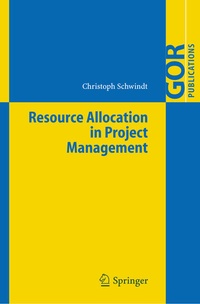
Resource Allocation in Project Management
Published on 22. October 2010
Book
Paperback/Softback
X, 194 pages
978-3-642-06481-4 (ISBN)
Description
This monograph grew out of my research in the ficld of resourcc-constraincd project scheduling conducted from 1995 to 2004 during my work as teaching assistant and assistant professor at the Institute for Economic Theory and Operations Research of thc Univcrsity of Karlsruhe. The aim of the book is to givc an introduction to quantitative concepts and methods for resource allocation in project managcmcnt with an cmphasis on an ordcr-theoretic framework allowing for a unifying treatment of various problem types. In order to make the work accessible for general readers, the basic concepts nccded arc rcviewed in introductory scctions of the book. Many pcople have contributed to the outcome of this research. First and foremost, I would like to express my deep appreciation to my supervisor P- fessor Klaus Ncumann, who introduced me to the field and the community of project schcduling. I have greatly benefited from his comprehensive sci- tific knowlcdgc and expertise, his continuous encouragement, and his support. During all these years, his departmcnt has bcen a stimulating and attractive place for doing research and teaching in Operations Rcsearch.
More details
Series
Edition
1st ed. Softcover of orig. ed. 2005
Language
English
Place of publication
Berlin
Germany
Publishing group
Springer Berlin
Target group
Professional and scholarly
Research
Illustrations
X, 194 p.
Dimensions
Height: 235 mm
Width: 155 mm
Thickness: 12 mm
Weight
318 gr
ISBN-13
978-3-642-06481-4 (9783642064814)
DOI
10.1007/3-540-27852-4
Schweitzer Classification
Other editions
Additional editions
Christoph Schwindt
Resource Allocation in Project Management
Book
06/2005
Springer
€106.99
Shipment within 7-9 days
Content
Models and Basic Concepts.- Relations, Schedules, and Objective Functions.- Relaxation-Based Algorithms.- Constructive Algorithms.- Supplements.- Applications.- Conclusions.