

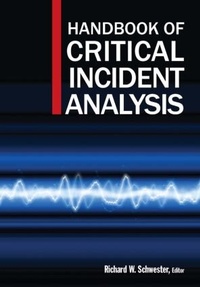
Handbook of Critical Incident Analysis
1st Edition
Published on 15. March 2012
Book
Hardback
384 pages
978-0-7656-2724-7 (ISBN)
Description
Critical incidents all too often explode onto the social conscious and challenge our sense of security. This comprehensive handbook brings together a range of experts who provide a foundation for the field of critical incident analysis by examining specific incidents9/11, the Virginia Tech massacre, the H1N1 pandemic, the BP oil spill, and more--through various methodological and disciplinary lenses.
This groundbreaking book develops a new organizational theory derived from ideas in statistics and psychometrics. The author's core premise is that errors known to occur in social science research must also occur when managers look at their data and seek to make inferences about cause and effect. Statistico-organizational theory uses methodological principles to predict when errors occur and how great they will be. Expanding on this concept, The Meta-Analytic Organization offers new theoretical propositions about organizational strategy and structure with wide application to human resource management, international business, and more.
This groundbreaking book develops a new organizational theory derived from ideas in statistics and psychometrics. The author's core premise is that errors known to occur in social science research must also occur when managers look at their data and seek to make inferences about cause and effect. Statistico-organizational theory uses methodological principles to predict when errors occur and how great they will be. Expanding on this concept, The Meta-Analytic Organization offers new theoretical propositions about organizational strategy and structure with wide application to human resource management, international business, and more.
More details
Language
English
Place of publication
London
United Kingdom
Publishing group
Taylor & Francis Ltd
Target group
Professional and scholarly
Illustrations
Illustrations
Dimensions
Height: 229 mm
Width: 152 mm
Weight
612 gr
ISBN-13
978-0-7656-2724-7 (9780765627247)
Copyright in bibliographic data and cover images is held by Nielsen Book Services Limited or by the publishers or by their respective licensors: all rights reserved.
Schweitzer Classification
Other editions
Additional editions
Richard W. Schwester
Handbook of Critical Incident Analysis
E-Book
12/2014
1st Edition
Routledge
€225.99
Available for download
Richard W. Schwester
Handbook of Critical Incident Analysis
E-Book
12/2014
1st Edition
Routledge
€225.99
Available for download
Person
Richard W. Schwester, PhD, is associate professor of Public Management at John Jay College of Criminal Justice (CUNY), where he holds a BA from Johns Hopkins University and an MA and PhD from Rutgers University. His research centers on the use of technology in government, inter-local shared services, and police and emergency service delivery models. Some of Dr. Schwester's most recent work appears in Public Budgeting and Finance, Public Performance and Management Review, Public Administration Quarterly, International Journal of Public Administration, International Review of Public Administration, and the International Journal of Organization Theory and Behavior. He is also the co-author of Public Administration: An Introduction. Dr. Schwester serves as associate director of the Academy for Critical Incident Analysis (ACIA) at John Jay.
Content
Introduction, PART I. UNDERSTANDING THE FIELD OF CRITICAL INCIDENT ANALYSIS, 1. The Emergence of Critical Incident Analysis as a Field of Study, 2. A Conceptual Model for Critical Incident Analysis, 3. Conceptualizing and Defining Critical Incidents, PART II. DISCIPLINARY AND POLICY PERSPECTIVES IN CRITICAL INCIDENT ANALYSIS, 4. Critical Incident Analysis, Biological Events, and the Case of the 2009 H1N1 Influenza A Pandemic, 5. Space, Sentiment, and Social Structure after Critical Incidents: Toward a Theory of Recovery, 6. Modeling Critical Incidents to Improve Response, 7. Predicting Critical Incidents, 8. Praxis, Applications, and Problems: Data Mining for Critical Incident Analysis, 9. Can Catastrophes Lead to Good Policy?, 10. Living with Disasters: A Planning Approach to Critical Incidents, 11. Disaster Investigations: A 9/11 Case Study, PART III. ISSUES IN CRITICAL INCIDENT ANALYSIS MANAGEMENT, 12. The Critical Role of Street-Level Bureaucrats in Disaster and Crisis Response, 13. An Earthquake Mitigation Process: A Case Study of Qinglong County's Pre-Incident Predictions, Preparation, and Mitigation Actions, 14. Jokela and Kauhajoki: Experiencing School Shootings in a Nordic Welfare Society, 15. Critical Incident Trauma Intervention: A Sense of Coherence Approach to Psychological First Aid with Student Survivors, 16. The Use of a Multi-Attribute Method to Analyze Preparedness for an Incident of Terrorism, 17. Improved Policing in an Invisible Community: A Case Study of the Gay and Lesbian Liaison Unit of Washington, DC, 18. The Dynamics of Critical Incidents in the Age of New Media: Examining the Role of the Self-Appointed or Media-Anointed Expert, 19. Ethical Challenges Inherent in Critical Incident Dynamics, About the Editor and Contributors, Name Index, Subject Index