

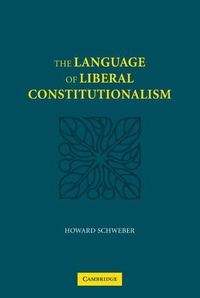
The Language of Liberal Constitutionalism
Published on 9. April 2009
Book
Paperback/Softback
396 pages
978-0-521-10833-1 (ISBN)
Description
This book explores two basic questions regarding constitutional theory. First, in view of a commitment to democratic self-rule and widespread disagreement on questions of value, how is the creation of a legitimate constitutional regime possible? Second, what must be true about a constitution if the regime that it supports is to retain its claim to legitimacy? Howard Schweber shows that the answers to these questions appear in a theory of constitutional language that combines democratic theory with constitutional philosophy. The creation of a legitimate constitutional regime depends on a shared commitment to a particular and specialized form of language. Out of this simple observation, Schweber develops arguments about the characteristics of constitutional language, the necessary differences between constitutional language and the language of ordinary law or morality, as well as the authority of officials such as judges to engage in constitutional review of laws.
More details
Language
English
Place of publication
Cambridge
United Kingdom
Target group
Professional and scholarly
Product notice
Paperback (trade)
Illustrations
Worked examples or Exercises
Dimensions
Height: 229 mm
Width: 152 mm
Thickness: 23 mm
Weight
641 gr
ISBN-13
978-0-521-10833-1 (9780521108331)
Copyright in bibliographic data and cover images is held by Nielsen Book Services Limited or by the publishers or by their respective licensors: all rights reserved.
Schweitzer Classification
Other editions
Additional editions
Howard Schweber
The Language of Liberal Constitutionalism
E-Book
09/2007
1st Edition
Cambridge University Press
€32.49
Available for download
Howard Schweber
The Language of Liberal Constitutionalism
Book
02/2007
Cambridge University Press
€138.70
Shipment within 15-20 days
Person
Howard Schweber is Associate Professor of Political Science at the University of Wisconsin, Madison. He is the author of The Creation of American Common Law, 1850-1880 and Speech, Conduct, and the First Amendment, as well as book chapters and articles in journals such as Law and History Review, Law and Society Review and Studies in American Political Development.
Content
1. The search for sovereignty: law, language, and the beginning of modern constitutionalism; 2. Consent how?: challenges to Lockean constitutionalism; 3. Constitutional language and the possibility of binding commitments; 4. Consent to what? Exclusivity and completeness in constitutional and legal language; 5. The question of substance: morality, law, and constitutional legitimacy; 6. Conclusion: the defense of constitutional language.