

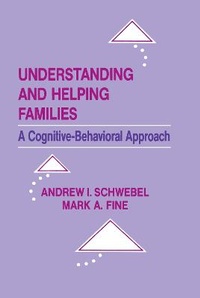
Understanding and Helping Families
A Cognitive-behavioral Approach
1st Edition
Published on 1. December 1993
Book
Hardback
226 pages
978-0-8058-1225-1 (ISBN)
Description
This book presents a new approach to understanding the family unit and how and why it functions as it does. The approach focuses on the cognitions of family members and how these, in turn, shape individuals' behavior and the functioning of the family system.
The use of the cognitive-behavioral perspective in family science has gained a quick and broad acceptance among social scientists and practitioners during the past decade. One reason for its success is that the basics of the approach are easy to learn and apply. Specifically, the approach maintains that a person who believes that he or she is a failure will -- because of this cognition -- act in certain self-defeating ways and have various self-deprecating feelings.
The wide acceptance of the cognitive-behavioral approach rests on more than its simplicity: the approach has repeatedly proven itself in the laboratory and in the clinic. The knowledge readers of this volume will gain about the cognitive-behavioral approach provides them with tools that they can use to better understand not only the family interactions, but the thoughts, feelings, and behaviors of individuals -- including themselves -- in the family setting.
The use of the cognitive-behavioral perspective in family science has gained a quick and broad acceptance among social scientists and practitioners during the past decade. One reason for its success is that the basics of the approach are easy to learn and apply. Specifically, the approach maintains that a person who believes that he or she is a failure will -- because of this cognition -- act in certain self-defeating ways and have various self-deprecating feelings.
The wide acceptance of the cognitive-behavioral approach rests on more than its simplicity: the approach has repeatedly proven itself in the laboratory and in the clinic. The knowledge readers of this volume will gain about the cognitive-behavioral approach provides them with tools that they can use to better understand not only the family interactions, but the thoughts, feelings, and behaviors of individuals -- including themselves -- in the family setting.
Reviews / Votes
"An extremely useful and timely model for applying cognitive-behavioral theory...to the family....Highly recommended."-CHOICE
"Excellent writing, conscientious documentation, and thorough discussion based on research and theory make [this] book valuable to family scientists and practitioners....a highly readable book for upper division undergraduate courses and graduate seminars. Furthermore, the book is concrete enough to be of value to many lay persons."
-Journal of Marriage and the Family
More details
Language
English
Place of publication
New York
United States
Publishing group
Taylor & Francis Inc
Target group
College/higher education
Professional and scholarly
Dimensions
Height: 229 mm
Width: 152 mm
Weight
590 gr
ISBN-13
978-0-8058-1225-1 (9780805812251)
Copyright in bibliographic data and cover images is held by Nielsen Book Services Limited or by the publishers or by their respective licensors: all rights reserved.
Schweitzer Classification
Other editions
Additional editions
Andrew I. Schwebel | Mark A. Fine | Andrew Schwebel
Understanding and Helping Families
A Cognitive-behavioral Approach
E-Book
04/2014
1st Edition
Routledge
€32.99
Available for download
Andrew I. Schwebel | Mark A. Fine | Andrew Schwebel
Understanding and Helping Families
A Cognitive-behavioral Approach
E-Book
04/2014
1st Edition
Routledge
€32.99
Available for download
Andrew I. Schwebel | Mark A. Fine | Andrew Schwebel
Understanding and Helping Families
A Cognitive-behavioral Approach
Book
11/1993
1st Edition
Routledge
€37.80
Shipment within 10-20 days
Persons
Schwebel, Andrew I.; Fine, Mark A.; Schwebel, Andrew
Content
Contents: Preface. Part I: Theoretical and Conceptual Perspectives. The Struggle to Understand the Family. The Cognitive-Behavioral Perspective. The Cognitive-Behavioral Family Model. Cognitions Within the Family Schema. Part II: Applications. Family Health. Assessment. Cognitive-Behavior Family Therapy: An Overview. Three Therapeutic Strategies. Family Life Education. Research.