

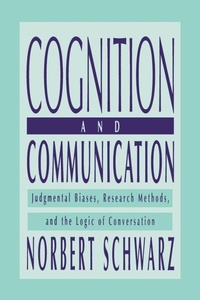
Cognition and Communication
Judgmental Biases, Research Methods, and the Logic of Conversation
1st Edition
Published on 12. August 2014
Book
Paperback/Softback
128 pages
978-1-138-00264-7 (ISBN)
Description
Psychological research into human cognition and judgment reveals a wide range of biases and shortcomings. Whether we form impressions of other people, recall episodes from memory, report our attitudes in an opinion poll, or make important decisions, we often get it wrong. The errors made are not trivial and often seem to violate common sense and basic logic. A closer look at the underlying processes, however, suggests that many of the well known fallacies do not necessarily reflect inherent shortcomings of human judgment. Rather, they partially reflect that research participants bring the tacit assumptions that govern the conduct of conversation in daily life to the research situation. According to these assumptions, communicated information comes with a guarantee of relevance and listeners are entitled to assume that the speaker tries to be informative, truthful, relevant, and clear. Moreover, listeners interpret the speakers' utterances on the assumption that they are trying to live up to these ideals.
This book introduces social science researchers to the "logic of conversation" developed by Paul Grice, a philosopher of language, who proposed the cooperative principle and a set of maxims on which conversationalists implicitly rely. The author applies this framework to a wide range of topics, including research on person perception, decision making, and the emergence of context effects in attitude measurement and public opinion research. Experimental studies reveal that the biases generally seen in such research are, in part, a function of violations of Gricean conversational norms. The author discusses implications for the design of experiments and questionnaires and addresses the socially contextualized nature of human judgment.
This book introduces social science researchers to the "logic of conversation" developed by Paul Grice, a philosopher of language, who proposed the cooperative principle and a set of maxims on which conversationalists implicitly rely. The author applies this framework to a wide range of topics, including research on person perception, decision making, and the emergence of context effects in attitude measurement and public opinion research. Experimental studies reveal that the biases generally seen in such research are, in part, a function of violations of Gricean conversational norms. The author discusses implications for the design of experiments and questionnaires and addresses the socially contextualized nature of human judgment.
Reviews / Votes
"...does a good job of summarizing complex research and theory related to language and cognition."-Studies in Second Language Acquisition
More details
Series
Language
English
Place of publication
Hove
United Kingdom
Publishing group
Taylor & Francis Ltd
Target group
Professional and scholarly
Dimensions
Height: 229 mm
Width: 152 mm
Thickness: 7 mm
Weight
195 gr
ISBN-13
978-1-138-00264-7 (9781138002647)
Copyright in bibliographic data and cover images is held by Nielsen Book Services Limited or by the publishers or by their respective licensors: all rights reserved.
Schweitzer Classification
Other editions
Additional editions
Norbert Schwarz
Cognition and Communication
Judgmental Biases, Research Methods, and the Logic of Conversation
E-Book
03/2014
1st Edition
Psychology Press Ltd
€49.99
Available for download
Norbert Schwarz
Cognition and Communication
Judgmental Biases, Research Methods, and the Logic of Conversation
E-Book
03/2014
1st Edition
Psychology Press Ltd
€49.99
Available for download
Norbert Schwarz
Cognition and Communication
Judgmental Biases, Research Methods, and the Logic of Conversation
Book
09/1996
1st Edition
Psychology Press
€139.70
Shipment within 10-20 days
Person
Norbert Schwarz
Content
Contents: Cognition, Communication, and the Fallacies of Human Judgment. Cognition and Communication: The Logic of Conversation. The Conversational Relevance of "Irrelevant" Information. Questions, Innuendos, and Assertions of the Obvious. The Conversational Relevance of Formal Features of Questionnaires. Making One's Contribution Informative: The Changing Meaning of Repeated Questions. Judgment in a Social Context: (Some) Conclusions.