

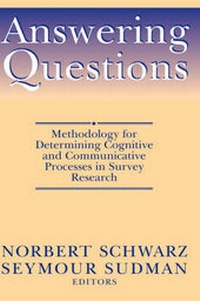
Answering Questions
Methodologu for Determining Cognitive and Communicative Process in Survey
Published on 26. September 1995
Book
Hardback
469 pages
978-0-7879-0145-5 (ISBN)
Description
This volume, edited by authorities on survey research, looks at the changing techniques used to determine and measure cognitive and communicative processes in survey response. A summary and evaluation of these ways of understanding respondents, this book presents developments that should be of use to researchers and students.
More details
Language
English
Place of publication
New York
United States
Publishing group
John Wiley & Sons Inc
Target group
College/higher education
Professional and scholarly
Dimensions
Height: 280 mm
Width: 150 mm
Thickness: 60 mm
Weight
1 gr
ISBN-13
978-0-7879-0145-5 (9780787901455)
Copyright in bibliographic data and cover images is held by Nielsen Book Services Limited or by the publishers or by their respective licensors: all rights reserved.
Schweitzer Classification
Content
Acknowledgements 1. Introduction Part One: Interactional Analysis 2. Using Behavioral Coding to Indentify Cognitive Problems with Survey Questions(Floyd Jackson Fowler Hr., and Charles F. Cannell) 3. Questionnaire Pretesting: Computer-Assisted Coding of Concurrent Protocols(Ruth N. Bolton and Tima M, Bronkhorst) 4. From Paradigm to Prototype and Back Again: Interactive Aspects of Cognitive Processing in Standardized Survey Interviews(Nora Cate Schaffer and Douglas W. Maynard) Part Two: Verbal Protocols 5. The Validity and Consequnces of Verbal Reports About Attitudes (Timothy D. Wilson, Suzanne J. LaFleur, and D. Eric Amderson) 6. Expanding and Enhancing the Use of Verbal Protocols in Survey Research(Barbara Bickart and E. Marla Felcher) 7. Integrating Questionnaire Design with a Cognitive Computational Model of Human Question Answering(Arthur C. Graesser. Sailaja Bommareddy, Shane Swamer, and Jonathon M. Golding) Part Three: Other Methods for Determining Cognitive Processes 8. Cognitive Interviewing Techniques: In the Lab and in the Field(Theresa J. DeMaio and Jennifer M. Rothgeb) 9. Cognitve Techniques in Interviewing Older People(Jared B. Jobe, Donald M. Kellerm, and Albert F. Smith) 10. An Individual Differences Perspective in Assessing Cognitive Processes(Richard E. Petty and W. Blair G. Jarvis) 11. A Coding System for Appraising Questionnaires(Judith T, Lessler and Barbara H. Forsyth) 12. Exemplar Generation: Assessing How Respondents Give Meaning to Rating Scales(Thomas M. Ostrom and Katherine M. Gannon) 13. The How and Why of Response Latency Measurement in Telephone Surveys(John N. Bassili) 14. Implicit Memory and Survey Measurement(Mahzarin R. Banji, Irene V. Blair, and Norbert Schwarz) 15. Use of Sorting Tasks to Assess Cognitive Structures(Marilynn B. Brewer and Layton N. Lui) Part Four: Conclusion 16. How Do We Know What We Think They Think Is Really What They Think?(Robert M. Groves).