

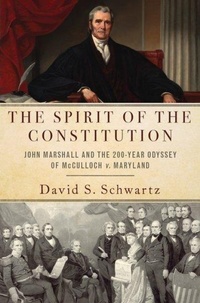
The Spirit of the Constitution
John Marshall and the 200-Year Odyssey of McCulloch v. Maryland
Published on 24. October 2019
Book
Hardback
344 pages
978-0-19-069948-2 (ISBN)
Description
2019 marks the 200th anniversary of one of the most important Supreme Court decisions in American history: McCulloch v. Maryland. The state of Maryland tried to impede the establishment of the Bank of the United States, but Chief Justice John Marshall decided that the Necessary and Proper clause of the Constitution gave the federal government implied powers that allowed it to charter the bank without hindrance. The decision expanded the power of the national government vis-a-vis the states, and it still figures in contemporary debates about the scope of national legislative power. Indeed, Chief Justice Roberts' 2012 decision upholding the Affordable Care Act relied on it.
In The Spirit of the Constitution, David S. Schwartz tells the story of the decision's long-term impact and the evolution of Justice Marshall's reputation. By tracing the rich history of McCulloch's influence from 1819 to the present, he shows that its meaning and significance for judges, political leaders, and the public varied greatly over time. The case was alternately celebrated, denounced, ignored, and reinterpreted to suit the needs of the moment. While Marshall was never reviled, he was not seen as especially influential until the late nineteenth century. Competing parties utilized McCulloch in constitutional debates over national power in the early republic; over the question of slavery in the late antebellum period; and over Congress's role in regulating the economy and civil rights in the twentieth century. Even after McCulloch's meaning seemed fixed by the mid-twentieth century, new debates about its implications have emerged in recent times. Schwartz's analysis of McCulloch's remarkable impact reaffirms the case's importance and unveils the circuitous process through which American constitutional law and ideology are made.
In The Spirit of the Constitution, David S. Schwartz tells the story of the decision's long-term impact and the evolution of Justice Marshall's reputation. By tracing the rich history of McCulloch's influence from 1819 to the present, he shows that its meaning and significance for judges, political leaders, and the public varied greatly over time. The case was alternately celebrated, denounced, ignored, and reinterpreted to suit the needs of the moment. While Marshall was never reviled, he was not seen as especially influential until the late nineteenth century. Competing parties utilized McCulloch in constitutional debates over national power in the early republic; over the question of slavery in the late antebellum period; and over Congress's role in regulating the economy and civil rights in the twentieth century. Even after McCulloch's meaning seemed fixed by the mid-twentieth century, new debates about its implications have emerged in recent times. Schwartz's analysis of McCulloch's remarkable impact reaffirms the case's importance and unveils the circuitous process through which American constitutional law and ideology are made.
Reviews / Votes
"David Schwartz has written an indispensable study of the single most important Supreme Court case in the canon. As such, he delineates not only the meaning and importance of the case in 1819, but also the use made of it over the next two centuries as it became a central myth and symbol of the very meaning of American constitutionalism."--Sanford Levinson, author of Framed: America's 51 Constitutions and the Crisis of Governance"With compelling clarity, David Schwartz uses the many re-interpretations of McCulloch v. Maryland to illuminate the whole arc of American constitutional development, and draws a surprising but vital conclusion: it is wiser to look to the precedents set by elected legislative and executive officials, as well as our current needs, to decide what our constitutional system requires to fulfill its great goals-rather than asking 'what would John Marshall
do?'"--Rogers M. Smith, Christopher H. Browne Distinguished Professor of Political Science, University of Pennsylvania and President, American Political Science Association, 2018-2019
"Professor Schwartz brilliantly shows that courts and scholars have gotten Chief Justice Marshall's famous opinion in McCulloch v Maryland wrong and misunderstood its role in the Court's history. This remarkable work of history is a must-read for anyone interested in constitutional law because Schwartz's findings should have profound consequences for Supreme Court decisionmaking in areas ranging from health care to federalism to civil rights. This is a
major contribution."--William M. Treanor, Paul Dean Professor and Dean and Executive Vice President, Georgetown University Law Center
"Professor Schwartz's book challenges the thinking of those who believe that the towering Marshall Court decision in McCulloch v. Maryland stands for legal principles that are clear and specific. It carefully explores the ambiguities in the Court's opinion and, in the process, illuminates some of the most fundamental problems-too often slighted or denied-of American constitutionalism. It is particularly valuable in its convincing demonstration of the
impact that slavery had on the development of Commerce Clause jurisprudence, especially when that influence was not immediately apparent in the cases and often neither acknowledged nor recognized by the formal
law."--Edward A. Purcell, Jr., Joseph Solomon Distinguished Professor of Law, New York Law School
More details
Language
English
Place of publication
New York
United States
Target group
College/higher education
Product notice
sewn/stitched
Cloth over boards
Dimensions
Height: 240 mm
Width: 165 mm
Thickness: 32 mm
Weight
604 gr
ISBN-13
978-0-19-069948-2 (9780190699482)
Copyright in bibliographic data and cover images is held by Nielsen Book Services Limited or by the publishers or by their respective licensors: all rights reserved.
Schweitzer Classification
Other editions
Additional editions
David S. Schwartz
The Spirit of the Constitution
John Marshall and the 200-Year Odyssey of McCulloch v. Maryland
E-Book
09/2019
OUP eBook
€12.99
Available for download
David S. Schwartz
The Spirit of the Constitution
John Marshall and the 200-Year Odyssey of McCulloch v. Maryland
E-Book
09/2019
OUP eBook
€12.99
Available for download
Person
David S. Schwartz is Professor of Law at the University of Wisconsin Law School. He teaches and writes in the areas of Constitutional Law, Evidence and Civil Procedure. His scholarship includes articles published in the Georgetown, Notre Dame, and University of Pennsylvania law reviews, and he has co-authored two casebooks: Constitutional Law: a Context and Practice Casebook (with Lori A. Ringhand) and An Analytical Approach to Evidence: Text, Problems and Cases (with Allen, Swift, Pardo & Stein).
Content
Introduction: "The Letter and Spirit of the Constitution" Part I: Defensive Nationalism
Chapter 1: "The Case Now to be Determined": the Elusive Meaning of McCulloch v. Maryland
Chapter 2: "A Question Perpetually Arising": Constitutional Politics and Law, circa 1819
Chapter 3: "Has Congress Power to Incorporate a Bank?": the McCulloch Oral Argument and Opinion
Chapter 4: "As Far as Human Prudence Could Insure": The Retreat from Implied Powers Part II: Disappearance and Revival
Chapter 5: "The Baneful Influence of this Narrow Construction": McCulloch in the Age of Jackson, 1832-1860
Chapter 6: "The Various Crises of Human Affairs": McCulloch and the Civil War Chapter 7: "The Government of All": the Rise and Fall of Reconstruction, 1865-1883 Chapter 8: "Acting Directly on the People": Neo-Whig Nationalism, 1868-1888 Chapter 9: "The Painful Duty of this Tribunal": The Emergence of Judicial Supremacy, 1884-1901 Part III: The Canonical Case
Chapter 10: "Some Choice of Means": The Lochner Era and Progressivism
Chapter 11: "Withholding the Most Appropriate Means": The New Deal and Judicial Crisis, 1932-1936
Chapter 12: "It is a Constitution We Are Expounding": the Triumph of the Capable Constitution, 1937-1968
Chapter 13: "A Splendid Bauble": McCulloch in the Long Conservative Court, 1969-2018 Conclusion: "As Long as Our System Shall Exist"
Chapter 1: "The Case Now to be Determined": the Elusive Meaning of McCulloch v. Maryland
Chapter 2: "A Question Perpetually Arising": Constitutional Politics and Law, circa 1819
Chapter 3: "Has Congress Power to Incorporate a Bank?": the McCulloch Oral Argument and Opinion
Chapter 4: "As Far as Human Prudence Could Insure": The Retreat from Implied Powers Part II: Disappearance and Revival
Chapter 5: "The Baneful Influence of this Narrow Construction": McCulloch in the Age of Jackson, 1832-1860
Chapter 6: "The Various Crises of Human Affairs": McCulloch and the Civil War Chapter 7: "The Government of All": the Rise and Fall of Reconstruction, 1865-1883 Chapter 8: "Acting Directly on the People": Neo-Whig Nationalism, 1868-1888 Chapter 9: "The Painful Duty of this Tribunal": The Emergence of Judicial Supremacy, 1884-1901 Part III: The Canonical Case
Chapter 10: "Some Choice of Means": The Lochner Era and Progressivism
Chapter 11: "Withholding the Most Appropriate Means": The New Deal and Judicial Crisis, 1932-1936
Chapter 12: "It is a Constitution We Are Expounding": the Triumph of the Capable Constitution, 1937-1968
Chapter 13: "A Splendid Bauble": McCulloch in the Long Conservative Court, 1969-2018 Conclusion: "As Long as Our System Shall Exist"