

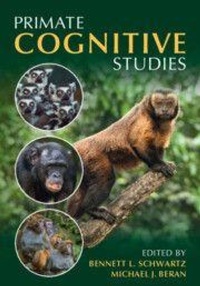
Primate Cognitive Studies
Published on 26. October 2023
Book
Paperback/Softback
712 pages
978-1-108-95819-6 (ISBN)
Description
Researchers have studied non-human primate cognition along different paths, including social cognition, planning and causal knowledge, spatial cognition and memory, and gestural communication, as well as comparative studies with humans. This volume describes how primate cognition is studied in labs, zoos, sanctuaries, and in the field, bringing together researchers examining similar issues in all of these settings and showing how each benefits from the others. Readers will discover how lab-based concepts play out in the real world of free primates. This book tackles pressing issues such as replicability, research ethics, and open science. With contributors from a broad range of comparative, cognitive, neuroscience, developmental, ecological, and ethological perspectives, the volume provides a state-of-the-art review pointing to new avenues for integrative research.
More details
Language
English
Place of publication
Cambridge
United Kingdom
Target group
Professional and scholarly
Edition type
New edition
Product notice
Paperback (trade)
Illustrations
Worked examples or Exercises
Dimensions
Height: 244 mm
Width: 170 mm
Thickness: 36 mm
Weight
1116 gr
ISBN-13
978-1-108-95819-6 (9781108958196)
Copyright in bibliographic data and cover images is held by Nielsen Book Services Limited or by the publishers or by their respective licensors: all rights reserved.
Schweitzer Classification
Other editions
Additional editions
Bennett L. Schwartz | Michael J. Beran
Primate Cognitive Studies
Book
08/2022
Cambridge University Press
€143.40
Shipment within 15-20 days
Persons
Content
1. The purpose of primate cognitive studies Bennett L. Schwartz and Michael J. Beran; 2. A history of primates studying primates David A. Washburn and Sarah G. Walters; 3. Genetic and environmental influences on Chimpanzee brain and cognition William D. Hopkins and Chet C. Sherwood; 4. The evolution of cognition in primates, including humans David A. Leavens; 5. State of the field: developmental primate cognition Eliza L. Nelson, Jacqueline Alvarez, Brenda Jimenez and Kasey Padron; 6. Current perspectives on primate perception Audrey E. Parrish and Christian Agrillo; 7. The comparative study of categorization J. David Smith, Brooke N. Jackson, Andres F. Sanchez, and Barbara A. Church; 8. Numerical cognition in non-human primates Sarah Jones and Jasmine Roman; 9. The natural history of primate spatial cognition: an organismic perspective Charles R. Menzel and Ken Sayers; 10. Progress and prospects in primate tool use and cognition Kathelijne Koops and Crickette Sanz; 11. Sequencing, artificial grammar, and recursion in primates Stephen Ferrigno; 12. The evolution of episodic cognition: the sense of time Gema Martin-Ordas; 13. Metacognition Victoria L. Templer; 14. Bridging the conceptual gap between inferential reasoning and problem solving in primates Josep Call; 15. The eyes have it: using non-invasive eye tracking to advance comparative social cognition research Lauren H. Howard and Elizabeth V. Lonsdorf; 16. Social cooperation in primates Stella R. Mayerhoff, Jhonatan M. Saldana Santisteban and Sarah F. Brosnan; 17. Primate communication: affective, intentional, or both? Rafaela Heesen, Christine Sievers, Thibaud Gruber and Zanna Clay; 18. Theory of mind in nonhuman primates Laura S. Lewis and Christopher Krupenye; 19. A requiem for ape language research: the cognitive foundations of language Lisa A. Heimbauer and Mark A. Krause; 20. Primate empathy: a flexible and multi-componential phenomenon Jake S. Brooker, Christine E. Webb and Zanna Clay; 21. Replication and reproducibility in primate cognition research Benjamin G. Farrar, Christopher Krupenye, Alba Motes-Rodrigo, Claudio Tennie, Julia Fischer, Drew M. Altschul and Ljerka Ostojic; 22. Ethical considerations in conducting primate cognition research Stephen R. Ross, Jesse G. Leinwand, and Lydia M. Hopper; 23. Collaboration and open science initiatives in primate research Drew Altschul, Manuel Bohn, Charlotte Canteloup, Sonja J. Ebel, Daniel Hanus, R. Adriana Hernandez-Aguilar, Marine Joly, Stefanie Keupp, Miquel Llorente, Cathal O'Madagain, Christopher I. Petkov, Darby Proctor, Alba Motes-Rodrigo, Kirsten Sutherland, Anna Szabelska, Derry Taylor, Christoph J. Voelter and Nicolas G. Wiggenhauser; 24. Studying primate cognition: from the wild to captivity and back Julia Fischer; 25. Do monkeys belong in the ape house? Comparing cognition across primate species Jennifer Vonk and Jared Edge.