

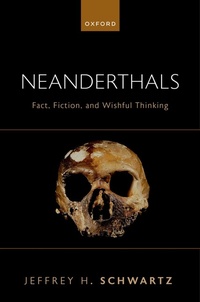
Neanderthals
Fact, Fiction, and Wishful Thinking
Will be published approx. on 22. October 2026
Book
Hardback
280 pages
978-0-19-778540-9 (ISBN)
Description
In the early 20th century, paleoanthropologists interpreted the oft-profound differences between specimens of an expanding human fossil record as reflecting taxonomic and evolutionary diversity. Why, then, in the 1940s, did geneticist Theodosius Dobzhansky reconfigure human evolution into one, profoundly morphologically variable lineage which changed slowly through time?
Neanderthals: Fact, Fiction, and Wishful Thinking exposes, for the first time, the history of how conceptions of race have configured interpretations of the first-found human fossils; how assumptions underlying human fossils were and still are interpreted as to species and their evolutionary relationships.
No matter how "different" Nazis thought living humans were, differences between Neanderthals and bigger-browed, chunkier-faced specimens and living humans trivialized the differences between living humans. In 1950, without basis, taxonomist Ernst Mayr lumped all fossil and extant humans into three transforming species of genus Homo: transvaalensis>erectus>sapiens; sapiens subsumed humans, Neanderthals, and even less morphologically sapiens-like specimens. In 1962, at a Wenner-Gren Foundation meeting, participants-mostly geneticists and behaviorists, unfamiliar with the human fossil record-voted to keep these specimens, Neanderthals, and humans in Homo sapiens.
Even when Neanderthals were returned to species neanderthalensis, the assumption remained: humans and Neanderthals interbred. When a Neanderthal nuclear DNA sequence was cobbled together and compared to human nDNA, molecular anthropologists could claim humans received "genes" identified in Neanderthal DNA via interbreeding. In its press release, the Committee that awarded Svante Paeaebo the Nobel Prize for "demonstrating" human inheritance of Neanderthal "genes" made clear that his claims were predicated on assuming Neanderthal-human interbreeding.
It's remarkable how received wisdom continues to influence paleoanthropologists and molecular anthropologists who then present as fact, to a naive public, assumptions that are biologically and evolutionarily wrong.
Neanderthals: Fact, Fiction, and Wishful Thinking exposes, for the first time, the history of how conceptions of race have configured interpretations of the first-found human fossils; how assumptions underlying human fossils were and still are interpreted as to species and their evolutionary relationships.
No matter how "different" Nazis thought living humans were, differences between Neanderthals and bigger-browed, chunkier-faced specimens and living humans trivialized the differences between living humans. In 1950, without basis, taxonomist Ernst Mayr lumped all fossil and extant humans into three transforming species of genus Homo: transvaalensis>erectus>sapiens; sapiens subsumed humans, Neanderthals, and even less morphologically sapiens-like specimens. In 1962, at a Wenner-Gren Foundation meeting, participants-mostly geneticists and behaviorists, unfamiliar with the human fossil record-voted to keep these specimens, Neanderthals, and humans in Homo sapiens.
Even when Neanderthals were returned to species neanderthalensis, the assumption remained: humans and Neanderthals interbred. When a Neanderthal nuclear DNA sequence was cobbled together and compared to human nDNA, molecular anthropologists could claim humans received "genes" identified in Neanderthal DNA via interbreeding. In its press release, the Committee that awarded Svante Paeaebo the Nobel Prize for "demonstrating" human inheritance of Neanderthal "genes" made clear that his claims were predicated on assuming Neanderthal-human interbreeding.
It's remarkable how received wisdom continues to influence paleoanthropologists and molecular anthropologists who then present as fact, to a naive public, assumptions that are biologically and evolutionarily wrong.
More details
Language
English
Place of publication
New York
United States
Illustrations
59 illustrations
Dimensions
Height: 235 mm
Width: 156 mm
ISBN-13
978-0-19-778540-9 (9780197785409)
Copyright in bibliographic data and cover images is held by Nielsen Book Services Limited or by the publishers or by their respective licensors: all rights reserved.
Schweitzer Classification
Person
Jeffrey H. Schwartz is Professor Emeritus of the Departments of Anthropology and History & Philosophy of Science, and at Resident Fellow at the Center for Philosophy of Science at the University of Pittsburgh. He is also a Research Associate at the Division of Anthropology, The American Museum of Natural History, New York. His research interests include method and theory in evolutionary and developmental biology and genetics, palaeontology, and comparative anatomy.
Author
Emeritus Professor of Anthropology, Emeritus Professor of History and Philosophy of Science, and Resident Fellow at the Center for Philosophy of ScienceEmeritus Professor of Anthropology, Emeritus Professor of History and Philosophy of Science, and Resident Fellow at the Center for Philosophy of Science, University of Pittsburgh
Content
- 1: Conceiving Humans and Their Past
- 2: Development, Genetics, and Evolutionary Thinking
- 3: Genetics and the Origin of Species: The Invention of the "Modern Evolutionary Synthesis"
- 4: Changing How Humans Evolved
- 5: The Classification That Changed Paleoanthropology
- 6: The Ongoing Impact of the Wenner-Gren Symposium on the Interpretation of Fossils, "Genes," and Human Evolution
- 7: Humans, Neanderthals, "Denisovans," and DNA