

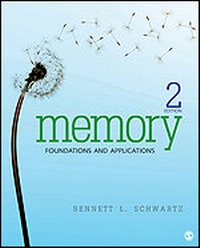
Memory
Foundations and Applications
2nd Edition
Published on 3. September 2013
Book
Paperback/Softback
480 pages
978-1-4522-5911-6 (ISBN)
Description
Designed to make memory research come to life through the use of examples that students can use in their everyday lives, Memory 2e provides an in-depth exploration into the science and the methodology of memory. Author Bennett Schwartz includes separate chapters on metamemory, biology of memory, and false memory - critical to a comprehensive understanding of memory science-to enhance the book's accessible introduction to the field. Throughout the book, coverage of cognitive psychology and neuroscience is integrated to help students make the connection between cognitive theory and research and the places in the brain where memory processes occur. Substantive changes in each chapter and 156 new references bring this new edition completely up to date with latest discoveries in the study of human memory.
Key Features
- Examples or real-life stories begin each chapter and are woven throughout to illustrate the relevance and importance of key concepts.
- Up-to-date coverage of research and theory focuses on cognitive experiments, neuroscience, patients with memory disorders, the areas of the brain involved in memory, and the cognitive theory that links this research together.
- Unique applied coverage includes how the science of memory can be applied to education, police investigations, courtrooms, memory clinics, and everyday life
- Highlighted mnemonic hints throughout the book and an entire chapter on memory improvement show students how they can apply the book's concepts to make their memories more efficient
- Invaluable in-text learning aids include interim summaries, a running glossary, and references to online resources, as well as chapter-ending key terms, summaries, and review questions.
New to the Second Edition
-A greater emphasis on the study of memory from a scientific viewpoint is present throughout the new edition, including an emphasis on the ways in which the scientific study of memory is distinct from other areas of study within psychology.
- The latest findings, studies, and techniques are covered throughout the book. Key new material includes the Addis et. al. neuroimaging study, a new discussion of the MEG neuroimaging technique, new research on involuntary memories, the latest findings on the testing effect, new work on how people control the accuracy of memories that they report, new work on direct stimulation of the brain, and much more.
- The structure of chapter thirteen has been shifted to more clearly cover memory efficiency rather than memory improvement. This chapter now contains coverage of the latest advances and strategies for studying and retaining material.
Key Features
- Examples or real-life stories begin each chapter and are woven throughout to illustrate the relevance and importance of key concepts.
- Up-to-date coverage of research and theory focuses on cognitive experiments, neuroscience, patients with memory disorders, the areas of the brain involved in memory, and the cognitive theory that links this research together.
- Unique applied coverage includes how the science of memory can be applied to education, police investigations, courtrooms, memory clinics, and everyday life
- Highlighted mnemonic hints throughout the book and an entire chapter on memory improvement show students how they can apply the book's concepts to make their memories more efficient
- Invaluable in-text learning aids include interim summaries, a running glossary, and references to online resources, as well as chapter-ending key terms, summaries, and review questions.
New to the Second Edition
-A greater emphasis on the study of memory from a scientific viewpoint is present throughout the new edition, including an emphasis on the ways in which the scientific study of memory is distinct from other areas of study within psychology.
- The latest findings, studies, and techniques are covered throughout the book. Key new material includes the Addis et. al. neuroimaging study, a new discussion of the MEG neuroimaging technique, new research on involuntary memories, the latest findings on the testing effect, new work on how people control the accuracy of memories that they report, new work on direct stimulation of the brain, and much more.
- The structure of chapter thirteen has been shifted to more clearly cover memory efficiency rather than memory improvement. This chapter now contains coverage of the latest advances and strategies for studying and retaining material.
More details
Edition
2nd Revised edition
Language
English
Place of publication
Thousand Oaks
United States
Target group
College/higher education
Professional and scholarly
Edition type
Revised edition
Dimensions
Height: 232 mm
Width: 187 mm
Weight
708 gr
ISBN-13
978-1-4522-5911-6 (9781452259116)
Copyright in bibliographic data and cover images is held by Nielsen Book Services Limited or by the publishers or by their respective licensors: all rights reserved.
Schweitzer Classification
Other editions
New editions
Book
03/2017
3rd Edition
SAGE Publications Inc
€115.32
Article exhausted; check for reprint
Previous edition
Book
09/2010
1st Edition
SAGE Publications Inc
€99.23
Article exhausted; check for reprint
Person
Bennett L. Schwartz received his PhD in 1993 from Dartmouth College in New Hampshire. Since
then he has been at Florida International University (FIU) in Miami, Florida, where he is currently professor
of psychology. He is author or editor of 10 published books as well as over 70 journal articles and
chapters. His textbook Memory: Foundations and Applications, fourth edition (SAGE), was published in
2020. He has won several teaching awards at FIU and currently teaches courses in memory, cognition,
and sensation and perception. His main research area is metacognition and memory, but he has also
conducted research in diverse areas that range from visual perception to evolutionary psychology, to
the language of thought, and to memory in nonhuman primates. Schwartz currently serves as the editor
in chief of New Ideas in Psychology.
then he has been at Florida International University (FIU) in Miami, Florida, where he is currently professor
of psychology. He is author or editor of 10 published books as well as over 70 journal articles and
chapters. His textbook Memory: Foundations and Applications, fourth edition (SAGE), was published in
2020. He has won several teaching awards at FIU and currently teaches courses in memory, cognition,
and sensation and perception. His main research area is metacognition and memory, but he has also
conducted research in diverse areas that range from visual perception to evolutionary psychology, to
the language of thought, and to memory in nonhuman primates. Schwartz currently serves as the editor
in chief of New Ideas in Psychology.
Content
1. Introduction to the Study of Memory
2. Memory and the Brain
3. Working Memory
4. Episodic Memory
5. Semantic and Lexical Memory
6. Visual Memory
7. Autobiographical Memory
8. False Memory
9. Metamemory
10. Memory Disorders
11. Memory in Childhood
12. Memory in Older Adults
13. Memory Improvement and Learning Efficiency: A User's Guide
2. Memory and the Brain
3. Working Memory
4. Episodic Memory
5. Semantic and Lexical Memory
6. Visual Memory
7. Autobiographical Memory
8. False Memory
9. Metamemory
10. Memory Disorders
11. Memory in Childhood
12. Memory in Older Adults
13. Memory Improvement and Learning Efficiency: A User's Guide