

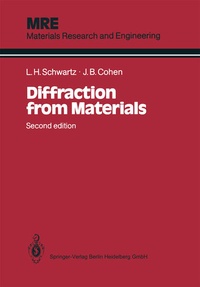
Diffraction from Materials
2nd Edition
Published on 13. July 2013
Book
Paperback/Softback
XV, 591 pages
978-3-642-82929-1 (ISBN)
Description
The atomic arrangements in condensed matter play an ever increasing role in many areas of science and technology - Materials Science and Engineering, Chemistry, Physics, Geology, Biology and Electrical, Civil, Mechanidtl and Chemical Engineering. Exciting discoveries in these fields in this century often stemmed from studies of these arrangements using diffraction: the structure and functions of DNA and other biological molecules, the configuration of polymer chains, the crystalline nature of metals and their imperfections, semiconductors and insulators, and -the links between their structures, their defects and material properties, and the interaction between materials and the environment. The broad, interdisciplinary character of diffraction studies makes them particularly exciting. With new tools such as the high-resolution electron microscope, new detectors, new techniques (such as EXAFS and glancing angle diffraction) and the new sources, the horizons of this field greatly expanded in the 1950's and 60's. Pulsed neutron sources and high intensity storage rings that came on the scene in the late 70's have opened up possibilities for new study to such vast horizons that it is hard to sit here writing this - there's so much to be done! Within the walls bounding each field of science or engineering, diffraction and structure is only one specialty. It is too easy for this topic to be developed in such a narrow way that sight is lost of the basic principles and broad possibilities.
More details
Series
Edition
Second Edition 1987
Language
English
Place of publication
Berlin
Germany
Publishing group
Springer Berlin
Target group
Professional and scholarly
Research
Illustrations
109 s/w Abbildungen
XV, 591 p. 109 illus.
Dimensions
Height: 244 mm
Width: 170 mm
Thickness: 33 mm
Weight
1040 gr
ISBN-13
978-3-642-82929-1 (9783642829291)
DOI
10.1007/978-3-642-82927-7
Schweitzer Classification
Other editions
Additional editions
Lyle H. Schwartz | Jerome B. Cohen
Diffraction from Materials
E-Book
04/2013
2nd Edition
Springer
€96.29
Available for download

Lyle H. Schwartz | Jerome B. Cohen
Diffraction from Materials
Book
08/1987
2nd Edition
Springer
€85.55
Article exhausted; check different version
Content
1. Geometry of Crystal Structures.- 2. The Nature of Diffraction.- 3. Properties of Radiation Useful for Studying the Structure of Materials.- 4. Recording the Diffraction Pattern.- 5. Crystal Symmetry and the Diffraction Pattern.- 6. Determination of Crystal Structures.- 7. What Else Can We Learn from a Diffraction Experiment Besides the Average Structure?.- 8. The Dynamical Theory of Diffraction.- Appendix A: Location of Useful Information in International Tables for Crystallography.- Appendix B: Crystallographic Classification of the 230 Space Groups.- Appendix C: Determination of the Power of the Direct Beam in X-ray Diffraction.- Method 1: Aluminum Powder.- Method 2: Polystyrene.- Method 3: Multiple Foils.- Method 4: The Ionization Chamber.- References.- Appendix D: Accuracy in Digital Counting.- D.1 Some Additional Information on Counting Electronics.- D.2 Measurement of Dead Time.- Answers to Selected Problems.