

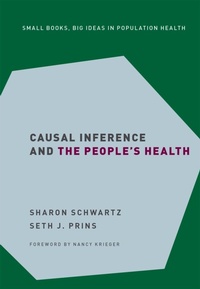
Causal Inference and the People's Health
Published on 23. April 2025
Book
Hardback
320 pages
978-0-19-752858-7 (ISBN)
Description
An essential introduction to concepts of causation and causal inference that explores how our definitions of causes in epidemiology influence how we go about finding them and estimating their effects.
A key goal of epidemiologic research is to uncover the causes of diseases and other health-related outcomes. But exactly what we mean by a "cause" and what types of phenomena qualify as causes, differ across historical periods, and is a contentious topic. The causal status of social phenomena has been, and continues to be, particularly precarious.
In Causal Inference and the People's Health, Sharon Schwartz and Seth J. Prins offer both a synthesis of the dominant school of thought around causality and propose an approach that keeps causal concepts as an organizing principle without marginalizing social phenomena. The authors examine the implications of the "Causal Revolution,"--introduced in epidemiology as the Potential Outcomes framework--which initiated a paradigm shift across the social sciences. As the authors show, this shift influences the questions we ask, the methods we use, the narratives we construct about our study results, and thus the knowledge we use to fight for the people's health. The guiding principle of the Causal Revolution is simple but profound: researchers should specify if their goal is description, prediction, or causation. In other words, researchers should declare their causal goals even for observational studies. This principle not only produced important innovations, but it also reignited debates about the definition of causation, the causal status of important social constructs like class and gender, and the role of manipulation or intervention in causal inference.
Interrogating these debates and embracing causal questions that identify and explain etiologic processes, Causal Inference and the People's Health offers a path forward that expands causal inference to include social forces as causes of the people's health, and therefore reinvigorates epidemiology's historical role in targeting systems and structures for change.
A key goal of epidemiologic research is to uncover the causes of diseases and other health-related outcomes. But exactly what we mean by a "cause" and what types of phenomena qualify as causes, differ across historical periods, and is a contentious topic. The causal status of social phenomena has been, and continues to be, particularly precarious.
In Causal Inference and the People's Health, Sharon Schwartz and Seth J. Prins offer both a synthesis of the dominant school of thought around causality and propose an approach that keeps causal concepts as an organizing principle without marginalizing social phenomena. The authors examine the implications of the "Causal Revolution,"--introduced in epidemiology as the Potential Outcomes framework--which initiated a paradigm shift across the social sciences. As the authors show, this shift influences the questions we ask, the methods we use, the narratives we construct about our study results, and thus the knowledge we use to fight for the people's health. The guiding principle of the Causal Revolution is simple but profound: researchers should specify if their goal is description, prediction, or causation. In other words, researchers should declare their causal goals even for observational studies. This principle not only produced important innovations, but it also reignited debates about the definition of causation, the causal status of important social constructs like class and gender, and the role of manipulation or intervention in causal inference.
Interrogating these debates and embracing causal questions that identify and explain etiologic processes, Causal Inference and the People's Health offers a path forward that expands causal inference to include social forces as causes of the people's health, and therefore reinvigorates epidemiology's historical role in targeting systems and structures for change.
Reviews / Votes
The Causal Revolution has greatly advanced epidemiology's understanding of causal effects, but the cost of advancement has been to narrow the scope of permissible questions. In their excellent book, Schwartz and Prins propose a solution: a theoretical framework integrating the strengths of modern causal inference with sociologic and epidemiologic theory. * Eleanor Murray, Assistant Professor of Epidemiology, Boston University School of Public Health * Insightful, intellectually honest, and a pleasure to read. Concisely unpacks recent debates on causal inference, and provides a path forward for a scientifically rigorous epidemiology that still generates knowledge about how the social world impacts health so that we as a society can decide what to do about it. * Ana V. Diez Roux, Distinguished University Professor of Epidemiology and Director of the Urban Health Collaborative, Drexel University Dornsife School of Public Health * This book is a true gem. It illuminates the most fundamental questions we face about the uses of epidemiology to improve health and expand human rights. Exceptionally profound and scholarly, yet written with extraordinary clarity, it is accessible to anyone who wants to learn about or engage with these questions. * Ezra Susser, Professor of Epidemiology and Psychiatry, Columbia University, and New York State Psychiatric Institute *More details
Series
Language
English
Place of publication
New York
United States
Target group
College/higher education
Product notice
sewn/stitched
Cloth over boards
Illustrations
15 b&w line drawings; 11 tables
Dimensions
Height: 168 mm
Width: 109 mm
Thickness: 28 mm
Weight
340 gr
ISBN-13
978-0-19-752858-7 (9780197528587)
Copyright in bibliographic data and cover images is held by Nielsen Book Services Limited or by the publishers or by their respective licensors: all rights reserved.
Schweitzer Classification
Other editions
Additional editions
Sharon Schwartz | Seth J. Prins
Causal Inference and the People's Health
E-Book
01/2025
OUP eBook
€18.49
Available for download
Sharon Schwartz | Seth J. Prins
Causal Inference and the People's Health
E-Book
01/2025
OUP eBook
€18.49
Available for download
Persons
Sharon Schwartz is a Professor of Epidemiology at Columbia University's Mailman School of Public Health. She is the training coordinator for the Psychiatric Epidemiology Training Program. Her main research interests are in the relationship between social statuses and psychiatric disorders, and how causal frameworks shape research processes.
Seth J. Prins is Assistant Professor of Epidemiology and Sociomedical Sciences at Columbia University.
He is a social and psychiatric epidemiologist whose two programs of research concern the collateral public health consequences of mass criminalization and mass incarceration, and how the division and structure of labor influence mental illness and substance use. His research integrates advanced epidemiologic methods with contemporary social theory to operationalize criminalization, punishment, and social class as dynamic relational processes rather than individual attributes.
Seth J. Prins is Assistant Professor of Epidemiology and Sociomedical Sciences at Columbia University.
He is a social and psychiatric epidemiologist whose two programs of research concern the collateral public health consequences of mass criminalization and mass incarceration, and how the division and structure of labor influence mental illness and substance use. His research integrates advanced epidemiologic methods with contemporary social theory to operationalize criminalization, punishment, and social class as dynamic relational processes rather than individual attributes.
Content
Foreword: Another World is Possible by Nancy Krieger
Introduction
Chapter 1: What is the Causal Revolution in Epidemiology and Why Should You Care?
Chapter 2: The Advance of the Causal Revolution and its Discontents
Chapter 3: Toward a More Realist Causal Revolution
Conclusion
Glossary
Notes
Index
Introduction
Chapter 1: What is the Causal Revolution in Epidemiology and Why Should You Care?
Chapter 2: The Advance of the Causal Revolution and its Discontents
Chapter 3: Toward a More Realist Causal Revolution
Conclusion
Glossary
Notes
Index