

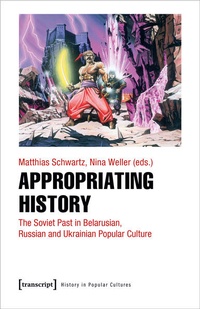
Appropriating History
The Soviet Past in Belarusian, Russian and Ukrainian Popular Culture
1st Edition
Published in September 2024
Book
Paperback/Softback
318 pages
978-3-8376-6077-7 (ISBN)
Description
Popular media play an important role in reconstructing collective imaginations of history. Dramatic events and ruptures of the 20th century provide the material for playful as well as neo-imperialist and nationalist appropriations of the past. The contributors to the volume investigate this phenomenon using case studies from Belarusian, Russian and Ukrainian popular cultures. They show how in mainstream films, TV series, novels, comics and computer games, the reference to Soviet history offers role models, action patterns and even helps to justify current political and military developments. The volume thus presents new insights into the multi-layered and explosive dynamics of popular culture in Eastern Europe.
More details
Series
Language
English
Place of publication
Bielefeld
Germany
Target group
Professional and scholarly
Product notice
Klappenbroschur
Illustrations
40
3 s/w Abbildungen, 37 farbige Abbildungen
Dispersionsbindung, 3 SW-Abbildungen, 37 Farbabbildungen
Dimensions
Height: 239 mm
Width: 153 mm
Thickness: 24 mm
Weight
558 gr
ISBN-13
978-3-8376-6077-7 (9783837660777)
Schweitzer Classification
Other editions
Additional editions
Matthias Schwartz | Nina Weller
Appropriating History
The Soviet Past in Belarusian, Russian and Ukrainian Popular Culture
E-Book
09/2024
1st Edition
transcript
€0.00
Available for download
Persons
Editor
Matthias Schwartz, Leibniz-Zentrum für Literatur- und Kulturforschung (Berlin), Deutschland
Matthias Schwartz ist Leiter des Programmbereichs Weltliteratur am ZfL Berlin.
ISNI:
Nina Weller, Leibniz-Zentrum für Literatur- und Kulturforschung (Berlin), Deutschland
Nina Weller (Dr. phil.) ist Slawistin, Literaturwissenschaftlerin und Übersetzerin. Sie ist wissenschaftliche Mitarbeiterin am Leibniz-Zentrum für Literatur- und Kulturforschung in Berlin und forscht zu Erinnerungskulturen, Populärkulturen und Gegenwartsliteraturen in Osteuropa.