

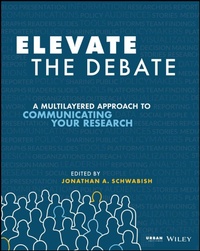
Elevate the Debate: A Multilayered Approach to Communicating Your Research
A Multilayered Approach to Communicating Your Research
1st Edition
Published on 12. February 2020
Book
Paperback/Softback
224 pages
978-1-119-62001-3 (ISBN)
Description
Learn how to make data-driven research accessible to decision makers, policymakers, and the general public
Many researchers, scholars, and analysts fail to develop communication strategies that work in today's crowded landscape of content, research, and data. To be successful, modern researchersneed to share their insights with the wider audience that lies beyond academia. Elevate the Debate helps researchers of all types more effectively communicate their work in any number of areas, from traditional news outlets to the new media platforms of the digital age. After reading this book, you will be inspired and equipped to use traditional and digital media environments to your advantage. This real-world guide helps you present your data-driven research with greater clarity, coherence, and impact.
An array of practical strategies and proven techniques enables you to make your research accessible to diverse audiences, form engaging narratives, and design and implement meaningful outreach plans. Each chapter examines a specific communications strategy, such as data visualization, presentation skills, social media, blog writing, and reporter interactions. Written by expert members of the Urban Institute's Communication department, and edited by Jonathan Schwabish, a Senior Fellow at Urban, Elevate the Debate guides you on how to use the media environment to your advantage and make a difference through policy insights and policy solutions.
This valuable book teaches you how to:
* Develop and apply data-driven and story-focused communication
* Use the "Pyramid Philosophy" of rooting accessible, engaging communications products in sophisticated research.
* Solve problems with your research by defining goals and recommending conclusions-based actions
* Identify the researchers, organizations, funders, influencers, and policymakers who are most important to your goals and precisely target their information needs
* Employ communication styles and strategies to get your work in the hands of people who can use it and act upon it.
Elevate the Debate: A Multi-layered Approach to Communicating Your Research is a must-have resource for academic researches, policy researchers, and all analysts of data-driven research.
Many researchers, scholars, and analysts fail to develop communication strategies that work in today's crowded landscape of content, research, and data. To be successful, modern researchersneed to share their insights with the wider audience that lies beyond academia. Elevate the Debate helps researchers of all types more effectively communicate their work in any number of areas, from traditional news outlets to the new media platforms of the digital age. After reading this book, you will be inspired and equipped to use traditional and digital media environments to your advantage. This real-world guide helps you present your data-driven research with greater clarity, coherence, and impact.
An array of practical strategies and proven techniques enables you to make your research accessible to diverse audiences, form engaging narratives, and design and implement meaningful outreach plans. Each chapter examines a specific communications strategy, such as data visualization, presentation skills, social media, blog writing, and reporter interactions. Written by expert members of the Urban Institute's Communication department, and edited by Jonathan Schwabish, a Senior Fellow at Urban, Elevate the Debate guides you on how to use the media environment to your advantage and make a difference through policy insights and policy solutions.
This valuable book teaches you how to:
* Develop and apply data-driven and story-focused communication
* Use the "Pyramid Philosophy" of rooting accessible, engaging communications products in sophisticated research.
* Solve problems with your research by defining goals and recommending conclusions-based actions
* Identify the researchers, organizations, funders, influencers, and policymakers who are most important to your goals and precisely target their information needs
* Employ communication styles and strategies to get your work in the hands of people who can use it and act upon it.
Elevate the Debate: A Multi-layered Approach to Communicating Your Research is a must-have resource for academic researches, policy researchers, and all analysts of data-driven research.
More details
Other editions
Additional editions
E-Book
02/2020
1st Edition
Wiley
€22.99
Available for download
E-Book
02/2020
1st Edition
Wiley-Scrivener
€22.99
Available for download
Content
Acknowledgements
Preface
1. Why Research Needs a Big Audience
Now more than ever, experts need to go further to bring their evidence-based insights to decisionmakers and influencers.
Short Story: Creating a pyramid of products
2. Developing an Audience Outreach Strategy
One audience may need a nuanced, thorough analysis of the data and methods; another may need the punch line and the most important, bottom-line numbers or facts.
Short Story: Identifying your audience and speaking to them
3. An Introduction to Visualizing Your Research
Be purposeful about what you include in your data visualizations so they best serve the needs of your reader and the message you want to convey.
Short Story: Good use of data visualization to promote research
4. Better Presentations: More Effective Speaking
A presentation is a fundamentally different form of communication than a written report.
Short Story: The power of personal stories and storytelling
5. How to Blog about Your Findings
By distilling and repackaging your message, you can make that work more appealing to and digestible for broader audiences.
Short Story: Using news hooks to write blog posts with a lot of reach
6. Working with the Media to Increase Your Impact
Make an interview more than a one-time event: use it to cultivate a relationship with the media so you can be a resource in the future.
Short Story: Leveraging elite media
7. Social Media Can Build Audiences That Matter
Social media platforms can give you the opportunity to connect and converse with new and influential audiences around your research in ways that are both intimate and public.
Short Story: Building a personal brand
8. Putting It All Together to Make a Difference
If you don't have a plan or a tangible impact in mind, then you risk your work going unnoticed by the people best positioned to act upon it.
Short Story: The Urban Institute's Communications Team's Processes and Tools
References
Preface
1. Why Research Needs a Big Audience
Now more than ever, experts need to go further to bring their evidence-based insights to decisionmakers and influencers.
Short Story: Creating a pyramid of products
2. Developing an Audience Outreach Strategy
One audience may need a nuanced, thorough analysis of the data and methods; another may need the punch line and the most important, bottom-line numbers or facts.
Short Story: Identifying your audience and speaking to them
3. An Introduction to Visualizing Your Research
Be purposeful about what you include in your data visualizations so they best serve the needs of your reader and the message you want to convey.
Short Story: Good use of data visualization to promote research
4. Better Presentations: More Effective Speaking
A presentation is a fundamentally different form of communication than a written report.
Short Story: The power of personal stories and storytelling
5. How to Blog about Your Findings
By distilling and repackaging your message, you can make that work more appealing to and digestible for broader audiences.
Short Story: Using news hooks to write blog posts with a lot of reach
6. Working with the Media to Increase Your Impact
Make an interview more than a one-time event: use it to cultivate a relationship with the media so you can be a resource in the future.
Short Story: Leveraging elite media
7. Social Media Can Build Audiences That Matter
Social media platforms can give you the opportunity to connect and converse with new and influential audiences around your research in ways that are both intimate and public.
Short Story: Building a personal brand
8. Putting It All Together to Make a Difference
If you don't have a plan or a tangible impact in mind, then you risk your work going unnoticed by the people best positioned to act upon it.
Short Story: The Urban Institute's Communications Team's Processes and Tools
References