

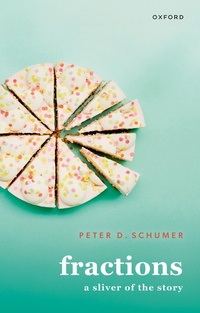
Fractions
A Sliver of the Story
Published on 13. December 2024
Book
Hardback
240 pages
978-0-19-891653-6 (ISBN)
Description
Fractions are everywhere and yet most of us learn only basic and rather dry facts about fractions in primary school. This book makes fractions come to life in a friendly, lively, and accessible way, detailing the history of fractions and their crucial role in the work of mathematicians from various cultures throughout the ages.
The book begins by outlining the importance of rational numbers and links ancient Babylonian mathematics with modern processes for determining their decimal expansions and the period length of repeating decimals, which are worked out in full. This then leads to the study of infinite sums, especially to geometric series and the notions of convergence and divergence.
The text goes on to explain the importance of the Fibonacci numbers, as well as the Cantor set and the Sierpinski carpet. Much of elementary number theory is introduced including congruence classes, the Euler phi function, the Euclidean algorithm, and some Diophantine equations.
The book also discusses many historical applications of fractions, including Christiaan Huygens's cogwheeled planetarium and Archimedes's approximation to the value of pi, as well as an extensive study of the importance of Egyptian fractions. Finally, it outlines modern applications of fractions, such as the fair apportionment of a cake, variations on slicing a pizza, probability questions involving markings on a stick, and ways to divide a bar of gold in order to pay wages for various numbers of days.
Accessible to anyone with a passion for the history of mathematics who wishes to delve deeper into the wonderful world of fractions, this book will also be of special interest to teachers of mathematics and students of all ages.
The book begins by outlining the importance of rational numbers and links ancient Babylonian mathematics with modern processes for determining their decimal expansions and the period length of repeating decimals, which are worked out in full. This then leads to the study of infinite sums, especially to geometric series and the notions of convergence and divergence.
The text goes on to explain the importance of the Fibonacci numbers, as well as the Cantor set and the Sierpinski carpet. Much of elementary number theory is introduced including congruence classes, the Euler phi function, the Euclidean algorithm, and some Diophantine equations.
The book also discusses many historical applications of fractions, including Christiaan Huygens's cogwheeled planetarium and Archimedes's approximation to the value of pi, as well as an extensive study of the importance of Egyptian fractions. Finally, it outlines modern applications of fractions, such as the fair apportionment of a cake, variations on slicing a pizza, probability questions involving markings on a stick, and ways to divide a bar of gold in order to pay wages for various numbers of days.
Accessible to anyone with a passion for the history of mathematics who wishes to delve deeper into the wonderful world of fractions, this book will also be of special interest to teachers of mathematics and students of all ages.
Reviews / Votes
This book is enjoyable mathematically and allows readers to invest as much time as needed. * J. Johnson, Choice * Accessible to anyone with a passion for the history of mathematics who wishes to delve deeper into the wonderful world of fractions, this book will also be of special interest to teachers of mathematics and students of all ages. * MathSciNet *More details
Language
English
Place of publication
Oxford
United Kingdom
Target group
Professional and scholarly
Product notice
sewn/stitched
Cloth over boards
Dimensions
Height: 217 mm
Width: 145 mm
Thickness: 19 mm
Weight
467 gr
ISBN-13
978-0-19-891653-6 (9780198916536)
Copyright in bibliographic data and cover images is held by Nielsen Book Services Limited or by the publishers or by their respective licensors: all rights reserved.
Schweitzer Classification
Other editions
Additional editions
Person
Peter D. Schumer Received BS and MS degrees from Rensselaer Polytechnic Institute and obtain his PhD from the University of Maryland. He is currently full professor and John C. Baldwin Professor of Mathematics and Natural Philosophy at Middlebury College. He has undertaken sabbaticals at Stanford, UC Berkeley, UC San Diego, Doshisha University (Kyoto), ICU (Tokyo). He has published two books and was the recipient of the Trevor Evans Award of the MAA in 2000, and the American Go Federation Teacher of the Year Award in 2021.