

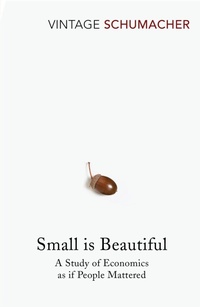
Small Is Beautiful
A Study of Economics as if People Mattered
Published on 16. September 1993
Book
Paperback/Softback
288 pages
978-0-09-922561-4 (ISBN)
Description
A humane blueprint for prosperity that serves people and planet.
First published in 1973, E. F. Schumacher's Small Is Beautiful remains a foundational text of sustainable economics and environmental thought. Rejecting the idea that "bigger is better", Schumacher argues for economies based on community, craftsmanship and ecological balance. Decades later, its message - that progress should serve people, not profits - is more urgent than ever.
Combining wisdom, practicality and visionary foresight, Small Is Beautiful continues to inspire new generations of environmentalists, policymakers and ethical business leaders seeking to build a fairer world.
'One of the 100 most influential books published since World War II' Times Literary Supplement
First published in 1973, E. F. Schumacher's Small Is Beautiful remains a foundational text of sustainable economics and environmental thought. Rejecting the idea that "bigger is better", Schumacher argues for economies based on community, craftsmanship and ecological balance. Decades later, its message - that progress should serve people, not profits - is more urgent than ever.
Combining wisdom, practicality and visionary foresight, Small Is Beautiful continues to inspire new generations of environmentalists, policymakers and ethical business leaders seeking to build a fairer world.
'One of the 100 most influential books published since World War II' Times Literary Supplement
Reviews / Votes
A book of heart and hope and downright common sense about the future. -- Peter Lewis * Daily Mail *More details
Language
English
Place of publication
London
United Kingdom
Publishing group
Vintage Publishing
Target group
Professional and scholarly
College/higher education
Product notice
Paperback (UK-B)
Dimensions
Height: 199 mm
Width: 129 mm
Thickness: 19 mm
Weight
199 gr
ISBN-13
978-0-09-922561-4 (9780099225614)
Copyright in bibliographic data and cover images is held by Nielsen Book Services Limited or by the publishers or by their respective licensors: all rights reserved.
Schweitzer Classification
Other editions
Additional editions

E-Book
05/2011
1st Edition
Vintage Digital
€10.99
Available for download
Person
Before the publication of Small is Beautiful, his bestselling reappraisal of Western economic attitudes, Dr E. F. Schumacher was already well known as an economist, journalist and progressive entrepreneur. He was Economic Adviser to the National Coal Board from 1950 to 1970, and was also the originator of the concept of Intermediate Technology for developing countries and Founder and Chairman of the Intermediate Technology Development Group Ltd. He also served as President of the Soil Association (Britains largest organic farming organisation, founded thirty years ago) and as Director of the Scott-Bader Company (pathfinders in polymer chemistry and common ownership).
Born in Germany, he first came to England in 1930 as a Rhodes Scholar to study economics at New College, Oxford. Later, at the age of twenty-two, he taught economics at New College, Oxford. Later, at the age of twenty-two, he taught economics at Columbia University, New York. As he found theorising without practical experience unsatisfying, he then went into business, farming and journalism. He resumed the academic life for a period at Oxford during the war, afterwards serving as Economic Adviser to the British Control Commission in Germany from 1946 to 1950. In later years, his advice on problems of rural development was sought by many overseas governments.
Dr Schumacher was awarded the CBE in 1974. He died in 1977.
Born in Germany, he first came to England in 1930 as a Rhodes Scholar to study economics at New College, Oxford. Later, at the age of twenty-two, he taught economics at New College, Oxford. Later, at the age of twenty-two, he taught economics at Columbia University, New York. As he found theorising without practical experience unsatisfying, he then went into business, farming and journalism. He resumed the academic life for a period at Oxford during the war, afterwards serving as Economic Adviser to the British Control Commission in Germany from 1946 to 1950. In later years, his advice on problems of rural development was sought by many overseas governments.
Dr Schumacher was awarded the CBE in 1974. He died in 1977.