

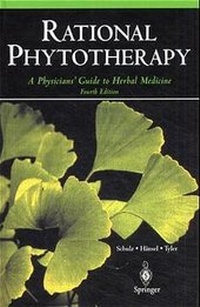
Rational Phytotherapy
A Physicians' Guide to Herbal Medicine
4th Edition
Published on 18. October 2000
Book
Hardback
XIX, 383 pages
978-3-540-67096-4 (ISBN)
Description
A practice-oriented introduction to phytotherapy. Methodically classified by organic systems and fields of application, it offers a quick insight into dosage, form of application and effects of the most important herbal remedies. Only those herbal remedies that are of pharmacological and clinical efficiency have been considered. The authors are highly experienced in the field of postgraduate medical education and, with this work, present an indispensable reference book for the medical practice.
More details
Edition
4th fully rev. and expanded ed.
Language
English
Place of publication
Heidelberg
Germany
Publishing group
Springer Berlin
Target group
College/higher education
Professional and scholarly
Edition type
Revised edition
Illustrations
90 figures, 50 tables, index
Dimensions
Height: 23.5 cm
Width: 15.5 cm
Weight
760 gr
ISBN-13
978-3-540-67096-4 (9783540670964)
DOI
10.1007/978-3-642-98093-0
Schweitzer Classification
Other editions
New editions
Volker Schulz | Rudolf Hänsel | Mark Blumenthal
Rational Phytotherapy
A Reference Guide for Physicians and Pharmacists
Book
07/2004
5th Edition
Springer
€139.09
Shipment within 10-15 days
Book
09/2003
5th Edition
Springer
€19.95
Article exhausted; check different version
Additional editions
Volker Schulz | Rudolf Hänsel | Varro E. Tyler
Rational Phytotherapy
A Physicians' Guide to Herbal Medicine
E-Book
12/2012
4th Edition
Springer
€82.38
Available for download
Previous edition
Volker Schulz | Rudolf Hänsel | Varro E. Tyler
Rational Phytotherapy
A Physicians' Guide to Herbal Medicine
Book
1998
3rd Edition
Springer
€37.20
Article exhausted; check for reprint
Persons
Content
1 Medicinal Plants, Phytomedicines, and Phytotherapy.- 1.1 Common Roots of Pharmacotherapy.- 1.2 Making Medicines Safer by Isolating and Modifying Plant Constituents.- 1.3 Pharmaceutical Preparation of Phytomedicines.- 1.3.1 What are Extracts?.- 1.3.2 Standardization of Extracts.- 1.3.2.1 Quality of the Herbal material.- 1.3.2.2 Production Methods.- 1.3.2.3 Adjustment of Quality.- 1.3.2.4 Analytical Quality Control.- 1.4 Phytomedicines.- 1.4.1 Liquid Dosage Forms.- 1.4.1.1 Tinctures, Glycerites, and Related Products.- 1.4.1.2 Syrups.- 1.4.1.3 Medicinal Oils.- 1.4.1.4 Medicinal Spirits.- 1.4.1.5 Plant Juices.- 1.4.2 Solid Dosage Forms.- 1.4.2.1 Granules.- 1.4.2.2 Uncoated Tablets.- 1.4.2.3 Coated Tablets.- 1.4.2.4 Capsules.- 1.4.2.5 Lozenges.- 1.4.3 Packaging.- 1.4.4 Herbal Combination Products.- 1.5 Phytotherapy.- 1.5.1 Pharmacologic Characteristics.- 1.5.1.1 Therapeutic Range.- 1.5.1.2 Onset of Action.- 1.5.2 Pharmacologic and Clinical Research.- 1.5.3 Indications for the Use of Phytomedicines.- 1.5.4 What Physicians Require from Phytomedicines.- 1.5.5 Hopes and Expectations of the Patients.- 1.5.6 Benefits and Risks of Phytomedicines Compared with Other Therapies.- 1.6 Medicinal Teas Today.- 1.6.1 Origin of the Word Tea. Medicinal and Nonmedicinal Teas.- 1.6.2 Medicinal Teas and Their Actions.- 1.6.3 Various Forms of Medicinal Teas.- 1.6.3.1 Mixtures of Cut and Dried Herbs.- 1.6.3.2 Tea-bag Teas.- 1.6.3.3 Soluble Teas.- 1.6.4 Standard Approval for Tea Mixtures.- 1.6.5 Teas Compounded as prescribed by a Physician.- 1.6.6 Guidelines for Tea Preparation.- 1.6.7 Teas for Infants and children.- 1.6.8 Adverse Effects and Risks.- 2 Central Nervous System.- 2.1 Ginkgo in the Treatment of Cognitive Deficiency.- 2.1.1 Introduction.- 2.1.2 Botanical Description.- 2.1.3 Crude Drug and Extract.- 2.1.4 Key Constituents, Analysis, Pharmacokinetics.- 2.1.5 Pharmacology and Toxicology.- 2.1.6 Clinical Efficacy in Patients with Cognitive Deficiency.- 2.1.7 Indications, Dosages, Risks, and Contraindications.- 2.1.8 Therapeutic Significance.- 2.1.9 Drug Products.- 2.2 ST. John's Wort as an Antidepressant.- 2.2.1 Introduction.- 2.2.2 Botanical Description.- 2.2.3 Crude Drug and Extract.- 2.2.4 Key Constituents, Analysis, Pharmacokinetics.- 2.2.5 Pharmacology.- 2.2.5.1 Biochemical Models 6l.- 2.2.5.2 Behavioral Models in Animals.- 2.2.6 Toxicology, Photosensitization.- 2.2.7 Clinical Efficacy in Depressed Patients.- 2.2.8 Indications, Dosages, Risks, and Contraindications.- 2.2.9 Therapeutic Significance.- 2.2.10 Drug Products.- 2.3 Kava as an Anxiolytic.- 2.3.1 Introduction.- 2.3.2 Botanical Description.- 2.3.3 Crude Drug and Extract.- 2.3.4 Key Constituents, Analysis, Pharmacokinetics.- 2.3.5 Pharmacology and Toxicology.- 2.3.6 Clinical Efficacy.- 2.3.7 Side Effects and Risks.- 2.3.8 Indications and Dosages.- 2.3.9 Therapeutic Significance.- 2.3.10 Drug Products.- 2.4 Restlessness and Sleep Disturbances.- 2.4.1 Valerian.- 2.4.1.1 Medicinal Plant.- 2.4.1.2 Crude Drug and Extract.- 2.4.1.3 Key Constituents, Analysis, Pharmacokinetics.- 2.4.1.4 Pharmacology and Toxicology.- 2.4.1.5 Pharmacologic Effects in Humans and Clinical Efficacy in Patients.- 2.4.1.6 Indications, Dosages, Risks, and Contraindications.- 2.4.1.7 Therapeutic Significance.- 2.4.2 Hops, Lemon Balm, Passion Flower, and Lavender.- 2.4.2.1 Hop Strobiles and Hop Glands.- 2.4.2.2 Balm Leaves.- 2.4.2.3 Passion Flower.- 2.4.2.4 Lavender.- 2.4.3 Sedative Teas.- 2.4.4 Drug Products.- 3 Cardiovascular System.- 3.1 Heart Failure and Coronary Insufficiency.- 3.1.1 Hawthorn.- 3.1.1.1 Introduction.- 3.1.1.2 Medicinal Plant.- 3.1.1.3 Crude Drug and Extract.- 3.1.1.4 Key Constituents, Analysis, Pharmacokinetics.- 3.1.1.5 Pharmacology.- 3.1.1.6 Toxicology.- 3.1.1.7 Clinical Efficacy.- 3.1.1.8 Indications. Dosages, Risks, and Contraindications.- 3.1.1.9 Therapeutic Significance.- 3.1.1.10 Drug Products.- 3.1.2 Herbs Containing Digitaloids.- 3.1.2.1 False Hellabore.- 3.1.2.2 Lily-of-the-Valley.- 3.1.2.3 Squill Powder.- 3.1.2.4 Oleander Leaves.- 3.1.2.5 Drug Products.- 3.1.3 Other Cardioactive Plant Drugs.- 3.2 Hypotension and Hypertension.- 3.2.1 Phytotherapy of Hypotension.- 3.2.1.1 Caffeine-Containing Herbs and Beverages.- 3.2.1.2 Essential Oils.- 3.2.2 Phytotherapy of Hypertension.- 3.3 Atherosclerosis and Arterial Occlusive Disease.- 3.3.1 Garlic.- 3.3.1.1 Historical Background.- 3.3.1.2 Botanical Description.- 3.3.1.3 Crude Drug.- 3.3.1.4 Key Constituents, Analysis, Pharmacokinetics.- 3.3.1.5 Experimental Pharmacology.- 3.3.1.5.1 Effects on Atherogenesis and Lipid Metabolism.- 3.3.1.5.2 Effects on Vascular Resistance, Fibrinolysis, and Platelet Aggregation.- 3.3.1.5.3 Cardioprotective and Antioxidative Effects.- 3.3.1.5.4 Other Actions.- 3.3.1.6 Toxicology.- 3.3.1.7 Clinical Studies.- 3.3.1.7.1 Reduction of Elevated Blood Lipids.- 3.3.1.7.2 Blood Pressure Reduction.- 3.3.1.7.3 Inhibiting the Progression of Atherosclerosis in Humans.- 3.3.1.7.4 Other Clinical Studies.- 3.3.1.8 Side Effects and Garlic Odor.- 3.3.1.9 Indications, Dosages, Risks, and Contraindications.- 3.3.1.10 Therapeutic Significance.- 3.3.1.11 Drug Products.- 3.3.2 Gingko Special Extract for Peripheral Arterial Occlusive Disease.- 3.3.3 Other Herbs with Antiatherosclerotic Properties.- 3.3.3.1 Red Yeast Rice.- 3.4 Chronic Venous Insufficiency.- 3.4.1 Horse Chestnut Seed Extract.- 3.4.1.1 Introduction.- 3.4.1.2 Crude Drug and Extract.- 3.4.1.3 Chemistry and Pharmacokinetics of Aescin.- 3.4.1.4 Pharmacology.- 3.4.1.5 Toxicology16l.- 3.4.1.6 Actions and Efficacy in Subjects and Patients16l.- 3.4.1.6.1 Studies in Healthy Subjects.- 3.4.1.6.2 Therapeutic Studies in Patients16l.- 3.4.1.7 Indications, Dosages, Risks, and Contraindications.- 3.4.1.8 Therapeutic Significance.- 3.4.2 Topical Venous Remedies.- 3.4.3 Drug Products.- 4 Respiratory System.- 4.1 Cold Syndrome (Flulike Infection).- 4.1.1 Risk Factors.- 4.1.2 Viruses and Host Defenses.- 4.2 General Phytotherapeutic Measures.- 4.2.1 Teas for Cold Relief.- 4.2.1.1 Elder Flowers.- 4.2.1.2 Linden Flowers.- 4.2.1.3 Meadowsweet Flowers.- 4.2.1.4 Willow Bark and Salicylates.- 4.2.1.5 Tea Formulas.- 4.2.2 Essential Oils.- 4.2.2.1 Nasal Ointments and Nosedrops.- 4.2.2.2 Inhalation Therapy.- 4.2.2.3 Lozenges, Troches and Gargles.- 4.3 Herbal Cough Remedies.- 4.3.1 Mucilaginous Herbs.- 4.3.2 Essential Oils in Cough Remedies.- 4.3.3 Ephedra.- 4.4 Herbal Expectorants.- 4.4.1 Mechanisms of Action.- 4.4.1.1 Reduction of Mucus Viscosity by Water.- 4.4.1.2 Neural Mechanism Based on the Gastropulmonary Reflex.- 4.4.1.3 Liquefaction of Secretions by Direct Action on the Bronchial Glands.- 4.4.2 Saponin-Containing Herbs.- 4.4.3 Essential Oils as Expectorants.- 4.4.3.1 Dosage Forms.- 4.4.3.2 Cineole (Eucalyptol).- 4.4.3.3 Myrtol.- 4.4.3.4 Anise Oil and Anethole.- 4.4.4 Licorice Root.- 4.4.5 Suggested Formulations.- 4.5 Phytotherapy of Sinusitis.- 4.6 Drug Products.- 5 Digestive System.- 5.1 Anorexia and Dyspepsia.- 5.1.1 Introduction.- 5.1.2 Bitter Herbs (Bitters).- 5.1.2.1 Wormwood (Absinth).- 5.1.2.2 Other Bitter Herbs.- 5.1.3 Biliary Remedies (Cholagogues).- 5.1.3.1 Artichoke Leaves.- 5.1.3.2 Other Cholagogues.- 5.1.4 Digestive Enzymes.- 5.1.5 Suggested Formulations.- 5.1.6 Drug Products.- 5.2 Bloating and Flatulence.- 5.2.1 Definition and Actions of Carminatives.- 5.2.2 Typical Carminative Herbs.- 5.2.3 Suggested Formulations.- 5.3 Gastritis and Ulcer Disease.- 5.3.1 Chamomile.- 5.3.2 Licorice Root.- 5.3.3 Drug Products.- 5.4 Irritable Bowel Syndrome.- 5.4.1 Symptoms, Epidemiology, and Approaches to Treatment.- 5.4.2 Peppermint.- 5.4.2.1 Crude Drug and Constituents.- 5.4.2.2 Peppermint Oil.- 5.4.2.3 Pharmacokinetics.- 5.4.2.4 Pharmacology.- 5.4.2.5 Therapeutic Efficacy.- 5.4.2.6 Risks and Side Effects.- 5.4.2.7 Indications, Dosages, and Contraindications.- 5.5 Acute Diarrhea.- 5.5.1 Tannin-Containing Herbs.- 5.5.1.1 Green and Black Tea.- 5.5.1.2 Other Tannin-Containing Herbs.- 5.5.1.3 Tannic Acid and Albumin Tannate.- 5.5.2 Pectins.- 5.5.3 Live Dried Yeast.- 5.5.3.1 Pharmacology and Toxicology.- 5.5.3.2 Therapeutic Efficacy.- 5.5.3.3 Indications, Dosages, Risks, and Contraindications.- 5.5.4 Other Herbal Antidiarrheals.- 5.5.5 Suggested Formulations.- 5.6 Constipation.- 5.6.1 Symptoms, Causes, General Measures.- 5.6.2 Bulk-Forming Agents.- 5.6.2.1 Mechanism of Action.- 5.6.2.2 Linseed.- 5.6.2.3 Wheat Bran.- 5.6.2.4 Psyllium Seed and Husk.- 5.6.2.5 Agar and Karaya Gum.- 5.6.3 Osmotic Agents.- 5.6.4 Anthranoid-Containing Herbs.- 5.6.4.1 Rhubarb Root.- 5.6.4.2 Buckthorn Bark.- 5.6.4.3 Senna Pods and Leaves.- 5.6.4.4 Aloe.- 5.6.5 Castor Oil.- 5.6.6 Suggested Formulations.- 5.7 Liver Diseases.- 5.7.1 Milk Thistle Fruits, Silymarin.- 5.7.1.1 Medicinal Plant and Crude Drug.- 5.7.1.2 Components and Active Constituents.- 5.7.1.3 Pharmacokinetics.- 5.7.1.4 Pharmacology and Toxicology.- 5.7.1.5 Therapeutic Efficacy in Chronic Liver Diseases.- 5.7.1.6 Use in Mushroom Poisoning.- 5.7.1.7 Indications, Dosages, Risks, and Contraindications.- 5.7.2 Soybean Phospholipids.- 5.7.3 Drug Products.- 6 Urinary Tract.- 6.1 Inflammatory Diseases of the Urinary Tract.- 6.1.1 Uva Ursi Leaves.- 6.1.2 Petasite Rhizome.- 6.2 Benign Prostatic Hyperplasia.- 6.2.1 Saw Palmetto Berries.- 6.2.2 Nettle Root.- 6.2.3 Pumpkin Seeds.- 6.2.4 Grass Pollens.- 6.2.5 Phytosterols from Hypoxis rooperi.- 6.2.6 Pygeum.- 6.3 Therapeutic Significance.- 6.4 Drug Products Other than Teas.- 6.5 Bladder and Kidney Teas.- 7. Gynecologic Indications for Herbal Remedies.- 7.1 Chasteberry.- 7.2 Black Cohosh.- 7.3 Phytoestrogens.- 7.4 Other Herbs.- 7.5 Therapeutic Significance.- 7.6 Drug Products.- 8 Skin, Trauma, Rheumatism, and Pain.- 8.1 Dosage Forms and Preparations.- 8.2 Inflammations and Injuries of the Skin.- 8.2.1 Chamomile Flowers.- 8.2.1.1 Crude Drug, Constituents, and Preparations.- 8.2.1.2 Pharmacology and Toxicology.- 8.2.1.3 Therapeutic Efficacy.- 8.2.1.4 Indications, Dosages, Side Effects, and Risks.- 8.2.2 Witch Hazel and Other Tannin-Containing Herbs.- 8.2.3 Evening Primrose Oil.- 8.2.4 Other Dermatologic Herbs.- 8.3 Post-traumatic and Postoperative Conditions.- 8.3.1 Bromelain.- 8.3.2 Comfrey.- 8.3.3 Arnica.- 8.4 Rheumatic Conditions and Degenerative Joint Diseases.- 8.4.1 Devil's Claw.- 8.4.2 Willow Bark, Ash, Aspen.- 8.4.3 Nettle Tops.- 8.4.4 Boswellia serrata.- 8.5 Treatment of Pain.- 8.5.1 Peppermint Oil and Tension Headache.- 8.5.2 Capsicum (Paprika) for Local Pain Relief.- 8.6 Formulations.- 8.7 Drug Products.- 9 Agents that Increase Resistance to Diseases.- 9.1 Adaptogens.- 9.1.1 Ginseng.- 9.1.1.1 Plant, Crude Drug, and Constituents.- 9.1.1.2 Pharmacology and Toxicology.- 9.1.1.3 Clinical Studies in Humans.- 9.1.1.4 Indications, Dosages, Risks, and Contraindications.- 9.1.2 Eleutherococcus Root.- 9.1.3 Other Adaptogenic Drugs.- 9.1.3.1 Cordyceps.- 9.1.3.2 Ashwagandha.- 9.1.3.3 Gotu Kola.- 9.1.3.4 Astragalus.- 9.1.3.5 Cat's Claw.- 9.1.3.6 Botanical Antioxidants (Grape Seed, Green Tea, Pine Bark).- 9.1.3.6.1 Pharmacology and Toxicology.- 9.1.3.6.2 Clinical and Epidemiological Studies.- 9.1.3.6.3 Indications and Dosage.- 9.2 Immune Stimulants.- 9.2.1 Coneflower (Echinacea).- 9.2.1.1 Plant, Crude Drug, and Constituents.- 9.2.1.2 Pharmacology and Toxicology.- 9.2.1.3 Studies on Therapeutic Efficacy.- 9.2.1.4 Indications, Dosages, and Risks.- 9.2.2 European Mistletoe.- 9.2.2.1 Plant, Constituents, and Actions.- 9.2.2.2 Clinical Efficacy Studies.- 9.2.2.3 Indications, Dosages, and Risks.- 9.2.3 Medicinal Yeasts.- 9.2.4 Goldenseal.- 9.3 Therapeutic Significance.- 10 Appendix The 100 Most Commonly Prescribed Herbal Medications in Germany.