

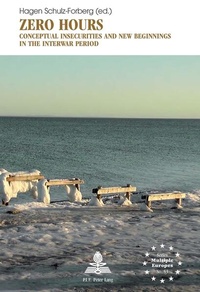
Zero Hours
Conceptual Insecurities and New Beginnings in the Interwar Period
Will be published approx. on 31. October 2013
Book
Paperback/Softback
315 pages
978-2-87574-103-5 (ISBN)
Description
To cut off time and seal away the past, to proclaim a new beginning in the present and project a better future onto tomorrow - and thus to make history - is a key signature of modern social, political and cultural discourses. In this book, this practice is represented through the metaphor of the Zero Hour, which alludes to the wish to rebuild the past in the face of a crisis-ridden present characterised by growing conceptual insecurity, hoping for a more stable future. Indeed, the ever-new construction of our past, sequenced and ordered in explanatory narratives, bears witness to a future that 'ought to be'. As the case studies in this volume show, this is a global phenomenon.
Against the backdrop of a confluence of experiences which unsettled conceptual norms after the First World War, this volume presents a novel approach to global history as it examines ways of breaking with the past and the way in which societies, as well as transnational historical actors, employ key concepts to compose arguments for a better tomorrow.
More details
Other editions
Additional editions
E-Book
11/2013
300th Edition
Peter Lang Verlag
€101.49
Available for download
Person
Hagen Schulz-Forberg is Associate Professor of Global and European History at Aarhus University, where he co-ordinates the International Studies programme. His latest monograph, co-authored with Bo Stråth, The Political History of European Integration (2010, paperback 2012), was shortlisted for the European Book Prize 2011.
Content
Contents: Hagen Schulz-Forberg: Introduction. Time and Again Toward the Future. Claims on Time as a New Approach for Global History - Andreas Steen: <<The Power of Music>>: Strengthening China in the 1920s - Maria Framke: Fascist Italy: Ideal Template for India's Economic Development? - Omar Gueye: Social Reforms in the Interwar period and the <<Revolution>> of the Popular Front in French Africa - Christoffer Kolvraa: Space and Spirit in the European Colonial Imagination after the First World War - Kenneth Weisbrode: Contours of the New Diplomacy - Volker Prott: War Aims, Wilsonian Ideas, and the 'New Diplomacy'. Reinventing the Franco-German Border of Alsace-Lorraine, 1914-1919 - Bertel Nygaard: French Revolution and Communist Future. Historical Time and Agency in European Labour Movements at the End of the First World War - James Kaye: To the Biennale, and the anti-Biennale. How the Lone Cleanser of the World Briefly Contributed to the Globalisation of Art Exhibition in Aestival Venice of 1920-22 - Niels Brimnes: 1918: International Health between Cordon Sanitaires and Rural Hygiene - Hagen Schulz-Forberg: Rejuvenating Liberalism: Economic Thought, Social Imagination, and the Invention of Neoliberalism in the 1930s.