

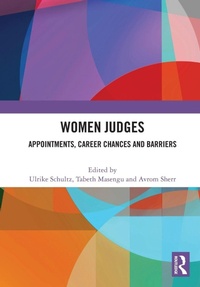
Women Judges
Appointments, Career Chances and Barriers
1st Edition
Will be published approx. on 26. December 2025
Book
Paperback/Softback
106 pages
978-1-032-73625-9 (ISBN)
Description
Do women have equal chances in the judiciary? Although women have made their way into law faculties, in many countries of the world they still face drawbacks in judicial careers. This book delves into the different aspects of women at work in the judicial environment, focusing on judicial appointments, promotions, the glass ceiling and representation in high positions of the judiciary across international settings such as Nigeria, South Africa, Philippines, Turkey, Spain, and Northern Ireland. The contributions go beyond the classical career issues by digging into several questions related to women at work in the judicial environment, such as: Are women accepted by their colleagues and by clients at court - male and female? Do they get the recognition they deserve or is there indecent behaviour and discrimination against them? What about work-life balance? And how do women judges perceive their role?
The book offers valuable insights by questioning and criticising the status quo, paving the way to a gender equal future in the judiciary. A significant new contribution to international scholarship in the field, this book was originally published as a special issue of the International Journal of the Legal Profession.
The book offers valuable insights by questioning and criticising the status quo, paving the way to a gender equal future in the judiciary. A significant new contribution to international scholarship in the field, this book was originally published as a special issue of the International Journal of the Legal Profession.
More details
Language
English
Place of publication
London
United Kingdom
Publishing group
Taylor & Francis Ltd
Target group
College/higher education
Postgraduate, Undergraduate Advanced, and Undergraduate Core
Dimensions
Height: 244 mm
Width: 170 mm
Thickness: 7 mm
Weight
216 gr
ISBN-13
978-1-032-73625-9 (9781032736259)
Copyright in bibliographic data and cover images is held by Nielsen Book Services Limited or by the publishers or by their respective licensors: all rights reserved.
Schweitzer Classification
Other editions
Additional editions
Book
06/2024
1st Edition
Routledge
€192.30
Shipment within 10-20 days
E-Book
06/2024
1st Edition
Routledge
€60.99
Available for download
E-Book
06/2024
1st Edition
Routledge
€60.99
Available for download
Persons
Ulrike Schultz is retired senior academic of FernUniversitaet in Hagen, Germany, specialised in the sociology of the legal professions, legal education, questions of gender and law. She has taken part in and organised many international socio-legal projects. She was President of the Research Committee for the Sociology of Law 2018-2023.
Tabeth Masengu is a Human Rights Lawyer and Socio-Legal Researcher. Her areas of research include the rule of law, gender and judging, governance in Africa, Constitutionalism, human rights, policy reform and intersectional discrimination.
Avrom Sherr is Emeritus Professor at the Institute of Advanced Legal Studies in the United Kingdom. He leads the quality assurance of legal aid lawyers in England and Wales. He is the founding editor of the International Journal of the Legal Profession.
Tabeth Masengu is a Human Rights Lawyer and Socio-Legal Researcher. Her areas of research include the rule of law, gender and judging, governance in Africa, Constitutionalism, human rights, policy reform and intersectional discrimination.
Avrom Sherr is Emeritus Professor at the Institute of Advanced Legal Studies in the United Kingdom. He leads the quality assurance of legal aid lawyers in England and Wales. He is the founding editor of the International Journal of the Legal Profession.
Content
Introduction: Women and judicial appointments, Ulrike Schultz and Tabeth Masengu 1. Being a woman judge in Turkish judicial culture, Seda Kalem 2. A five-year gender equality score card for the Philippine Supreme Court under its first woman Chief Justice: opportunities seized and missed, Emily Sanchez Salcedo 3. The Judicial Service Commission and the appointment of Women: more to it than meets the eye, Tabeth Masengu 4. Women in the Nigerian judiciary: considerable headway or organised progress? Enibokun Uzebu-Imarhiagbe 5. The glass ceiling at the highest levels of the Spanish judiciary, Monica Garcia Goldar 6. Problems in the pathways to judicial success: women in the legal profession in Northern Ireland, Leah Treanor