

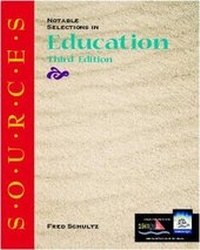
Sources: Notable Selections in Education
3rd Edition
Published on 16. June 2001
Book
Paperback/Softback
397 pages
978-0-07-241398-4 (ISBN)
Description
This volume brings together over 40 selections of enduring intellectual value--classic articles, book excerpts, and research studies--that have shaped the studyof education and our contemporary understanding of it.This title is supported by Dushkin Online (www.dushkin.com/online/), a student Web site that provides study support tools and links to links to related Web sites.
More details
Edition
3rd edition
Language
English
Place of publication
United States
Publishing group
McGraw-Hill Education - Europe
Target group
College/higher education
Dimensions
Height: 234 mm
Width: 185 mm
Thickness: 23 mm
Weight
669 gr
ISBN-13
978-0-07-241398-4 (9780072413984)
Copyright in bibliographic data and cover images is held by Nielsen Book Services Limited or by the publishers or by their respective licensors: all rights reserved.
Schweitzer Classification
Content
Part 1. Foundations of EducationCHAPTER 1. The Conservative Tradition in Educational Thought1.1. Theodore R. Sizer, from Horace's Hope: What Works for the American High School1.2. E. D. Hirsch, Jr., from Cultural Literacy: What Every American Needs to Know1.3. Diane Ravitch, from The Troubled Crusade: American Education, 1945-19801.4. Mortimer Adler, from "The Paideia Proposal: Rediscovering the Essence of Education", The American School Board JournalCHAPTER 2. Student Experience Centered--Progressive Education2.1. John Dewey, from Democracy and Education: An Introduction to the Philosophy of Education2.2. William Heard Kilpatrick, from "The Project Method", Teachers College Record2.3. Maria Montessori, from The Montessori Method2.4. C. H. Patterson, from Humanistic EducationCHAPTER 3. Some Alternative Perspectives in Educational Thought3.1. Joel Spring, from Deculturalization and the Struggle for Equality: A Brief History of the Education of Dominated Cultures in the United States3.2. Henry A. Giroux, from "Culture, Power and Transformation in the Work of Paulo Freire: Toward a Politics of Education", in Henry A. Giroux, Teachers as Intellectuals: Toward a Critical Pedagogy of Learning3.3. Paulo Freire, from Pedagogy of the Oppressed, rev. ed., trans. Myra Bergman Ramos3.4. Ivan Illich, from Deschooling SocietyPart 2. Curriculum and InstructionCHAPTER 4. Schooling4.1. Herbert R. Kohl, from The Open Classroom: A Practical Guide to a New Way of Teaching4.2. Katherine Camp Mayhew and Anna Camp Edwards, from The Dewey School: The Laboratory School of the University of Chicago, 1896-1903CHAPTER 5. Curriculum Theory and Practice5.1. Hilda Taba, from Curriculum Development: Theory and Practice5.2. Henry T. Trueba, from Raising Silent Voices: Educating the Linguistic Minorities for the Twenty-First CenturyCHAPTER 6. Curriculum Development and the Language of Educational Debate6.1. Christopher Lasch, from The Revolt of the Elites and the Betrayal of Democracy6.2. Peter McLaren, from "Multiculturalism and the Postmodern Critique: Toward a Pedagogy of Resistance and Transformation", in Henry A. Giroux and Peter McLaren, eds., Between Borders: Pedagogy and the Politics of Cultural StudiesPart 3. Schools in a Multicultural SocietyCHAPTER 7. The Struggle for Freedom in Education7.1. Cornel West, from Race Matters7.2. Booker T. Washington, from A Speech During the Atlanta Exposition, Atlanta, Georgia, September 18, 18957.3. W. E. B. Du Bois, from The Souls of Black Folk7.4. James Baldwin, from "A Talk to Teachers", Saturday ReviewCHAPTER 8. Perspectives on the Struggle for Freedom in Education8.1. Paulo Freire and Donaldo Macedo, from Literacy: Reading the Word and the World8.2. Benjamin R. Barber, from An Aristocracy of Everyone: The Politics of Education and the Future of AmericaCHAPTER 9. Women and Education9.1. Elizabeth Cady Stanton, from Eighty Years and More (1815-1897): Reminiscences of Elizabeth Cady Stanton9.2. Carmen Luke, from Feminisms and Pedagogies of Everyday LifePart 4. The American Constitutional Tradition and EducationCHAPTER 10. The Struggle for Civil Liberty in the Schools10.1. U.S. Supreme Court, from Brown v. Board of Education of Topeka, Kansas (1954)10.2. United States Commission on Civil Rights, from A Better Chance to Learn: Bilingual-Bicultural Education10.3. American Association of University Women, from How Schools Shortchange Girls: A Study of Major Findings on Girls and EducationPart 5. Perspectives From the Behavioral SciencesCHAPTER 11. Testing and the Critical Response to It11.1. B. F. Skinner, from The Technology of Teaching11.2. Benjamin S. Bloom et al., from Taxonomy of Educational Objectives, Handbook I: Cognitive Domain11.3. David R. Krathwohl, Benjamin S. Bloom, and Bertram B. Masia, from Taxonomy of Educational Objectives, Handbook II: Affective DomainCHAPTER 12. The Cognitive Revolution in Learning12.1. Ann L. Brown et al., from "Learning, Remembering, and Understanding", in Paul H. Mussen, ed., Handbook of Child Psychology, vol. 3: Cognitive Development, 4th ed.12.2. John Bransford et al., from "Teaching Thinking and Problem Solving", American Psychologist12.3. Howard Gardner and Joseph Walters, from Multiple Intelligences: The Theory in Practice12.4. John T. Bruer, from "Education and the Brain: A Bridge Too Far", Educational ResearcherPart 6. Society, Culture, and EducationCHAPTER 13. Social Change13.1. John Dewey, from "Education and Social Change", The Social Frontier13.2. I. L. Kandel, from Conflicting Theories of EducationCHAPTER 14. Culture and Education14.1. Maxine Greene, from "The Passions of Pluralism: Multiculturalism and the Expanding Community", Educational Researcher14.2. Jonathan Kozol, from Savage Inequalities: Children in America's Schools14.3. Jonathan Kozol, from Amazing Grace: The Lives of Children and the Conscience of a Nation