

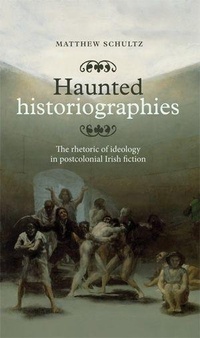
Haunted Historiographies
The Rhetoric of Ideology in Postcolonial Irish Fiction
Published on 31. August 2014
Book
Hardback
216 pages
978-0-7190-9092-9 (ISBN)
Description
The spectres of history haunt Irish fiction. In this compelling study, Matthew Schultz maps these rhetorical hauntings across a wide range of postcolonial Irish novels, and defines the spectre as a non-present presence that simultaneously symbolises and analyses an overlapping of Irish myth and Irish history.
By exploring this exchange between literary discourse and historical events, Haunted historiographies provides literary historians and cultural critics with a theory of the spectre that exposes the various complex ways in which novelists remember, represent and reinvent historical narrative. It juxtaposes canonical and non-canonical novels that complicate long-held assumptions about four definitive events in modern Irish history - the Great Famine, the Irish Revolution, the Second World War and the Northern Irish Troubles - to demonstrate how historiographical Irish fiction from James Joyce and Samuel Beckett to Roddy Doyle and Sebastian Barry is both a product of Ireland's colonial history and also the rhetorical means by which a post-colonial culture has emerged. -- .
By exploring this exchange between literary discourse and historical events, Haunted historiographies provides literary historians and cultural critics with a theory of the spectre that exposes the various complex ways in which novelists remember, represent and reinvent historical narrative. It juxtaposes canonical and non-canonical novels that complicate long-held assumptions about four definitive events in modern Irish history - the Great Famine, the Irish Revolution, the Second World War and the Northern Irish Troubles - to demonstrate how historiographical Irish fiction from James Joyce and Samuel Beckett to Roddy Doyle and Sebastian Barry is both a product of Ireland's colonial history and also the rhetorical means by which a post-colonial culture has emerged. -- .
Reviews / Votes
'This is a generally well-informed study that makes ingenious use of the spectral in relation to a range of diverse texts.'Emer Nolan, Maynooth University, James Joyce Quarterly, Volume 52, Number 1, Fall 2014
'Although it is very much a monograph (single author, single idea) rather than a survey or text book, there is a likelihood that the focus on a range of well-known texts will recommend it to teachers and learners from the Irish
Studies community around the world.'
Gerry Smyth, Liverpool John Moores University, The Canadian Journal of Irish Studies Vol. 39, No. 1 -- .
More details
Edition
UK edition
Language
English
Place of publication
Manchester
United Kingdom
Product notice
sewn/stitched
Cloth over boards
With dust jacket
Dimensions
Height: 216 mm
Width: 137 mm
Thickness: 20 mm
Weight
386 gr
ISBN-13
978-0-7190-9092-9 (9780719090929)
Copyright in bibliographic data and cover images is held by Nielsen Book Services Limited or by the publishers or by their respective licensors: all rights reserved.
Schweitzer Classification
Other editions
Additional editions
E-Book
05/2016
1st Edition
Manchester University Press
from
€189.99
Available for download
E-Book
05/2016
1st Edition
Manchester University Press
€189.99
Available for download
Person
Matthew Schultz is the Writing Center Director at Vassar College -- .
Content
Introduction: Textual spectrality and Finnegans Wake
1. The persistence of famine in postcolonial Ireland
2. The specter of famine during World War II
3. Ancient warriors, modern sexualities: Easter 1916 and the advent of post-Catholic Ireland
4. Gothic inheritance and the Troubles in contemporary Irish fiction
Conclusion: Famine and the Western Front in Samuel Beckett's Waiting for Godot
Bibliography
Index -- .
1. The persistence of famine in postcolonial Ireland
2. The specter of famine during World War II
3. Ancient warriors, modern sexualities: Easter 1916 and the advent of post-Catholic Ireland
4. Gothic inheritance and the Troubles in contemporary Irish fiction
Conclusion: Famine and the Western Front in Samuel Beckett's Waiting for Godot
Bibliography
Index -- .