

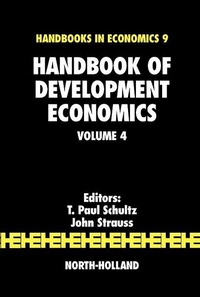
Handbook of Development Economics
Published on 4. March 2008
Book
Hardback
1054 pages
978-0-444-53100-1 (ISBN)
Description
The field of development economics has evolved since volume 3 of the Handbook of Development Economics was published more than a decade ago. Volume 4 takes stock of some of the newer trends and their implications for research in the field and our understanding of economic development.
The handbook is divided into four sections which reflect these developments, of which the first deals with agricultural and rural development. Section two is concerned with developments in the theory and evidence regarding public goods and political economy. The third section is focused on the behavior of households and individuals regarding various aspects of human capital investments, in the face of the various constraints, particularly market incentives and public goods. The final section contains papers that describe the different methods now available, both experimental and non-experimental, to conduct program evaluations, as well as describing papers that implement these methods.
The authors of the chapters are all experts in the fields they survey and extend, and this volume promises to be an invaluable addition to the Handbooks in Economics series and a useful reference to graduate students, researchers and professionals in the field of development economics.
The handbook is divided into four sections which reflect these developments, of which the first deals with agricultural and rural development. Section two is concerned with developments in the theory and evidence regarding public goods and political economy. The third section is focused on the behavior of households and individuals regarding various aspects of human capital investments, in the face of the various constraints, particularly market incentives and public goods. The final section contains papers that describe the different methods now available, both experimental and non-experimental, to conduct program evaluations, as well as describing papers that implement these methods.
The authors of the chapters are all experts in the fields they survey and extend, and this volume promises to be an invaluable addition to the Handbooks in Economics series and a useful reference to graduate students, researchers and professionals in the field of development economics.
Reviews / Votes
"This volume is a timely addition to an enormously successful and influential Handbook. The contributors, all leaders in the field, guide the reader to the frontier of knowledge on their topic. It will be an important resource for years to come." --Timothy Besley, London School of Economics"Over the past 20 years since the publication of Volume 1 of the Handbook of Development Economics, successive installments have fundamentally shaped the discipline and laid down the research agenda. Volume 4 continues this great tradition with seminal contributions which range from entirely new fields such as project evaluation and randomized evaluations, to core topics such as health and family economics and agrarian economies. This will be an indispensable tool for every scholar and student of development economics." --James Robinson, Harvard University
More details
Language
English
Place of publication
United States
Publishing group
Elsevier Science & Technology
Target group
Professional and scholarly
The Handbook is a definitive reference source suitable for use by professional researchers, advanced graduate students, or by those seeking a teaching supplement.
Product notice
sewn/stitched
Paper over boards
Dimensions
Height: 251 mm
Width: 174 mm
Thickness: 58 mm
Weight
2096 gr
ISBN-13
978-0-444-53100-1 (9780444531001)
Copyright in bibliographic data and cover images is held by Nielsen Book Services Limited or by the publishers or by their respective licensors: all rights reserved.
Schweitzer Classification
Other editions
Additional editions
T. Paul Schultz | John Strauss
Handbook of Development Economics
E-Book
03/2008
Elsevier
€131.00
Available for download
Persons
T. Paul Schultz, Malcolm K. Brachman Professor at Yale, has written and edited books, a textbook, and articles on microeconomics of individual and family behavior in development, including labor supply, fertility, marriage, production of health, investments in children, including nutrition, schooling, migration, with a focus on gender inequalities. John Strauss has over 25 years of research and survey experience in the developing world, spanning sub-Saharan Africa, Latin America and Asia. His research focus is on health and other human resource investments, their determinants and interaction with labor markets. He was a co-contributor to Volume 3A of the Handbook of Development Economics. He has been the PI of the Indonesia Family Life Survey (IFLS) for waves 3 and 4 (2000 and 2007) and is a co-PI of the China Health and Retirement Longitudinal Study (CHARLS. He is Editor in Chief of Economic Development and Cultural Change.
Content
1. Economic Development and the Decline of Agricultural Employment
2. Information Networks in Dynamic Agrarian Economies
3. Public Action for Public Goods
4. Understanding Political Corruption in Low Income Countries
5. Household Formation and Marriage Markets
6. Population Policies, Fertility, Women's Human Capital, and Child Quality
7. Health Economics for Low Income Countries
8. Health over the Life Course
9. Schooling in Developing Countries: The Roles of Supply, Demand and Government Policy
10. The Impact of Child Health and Nutrition on Education in Less Developed Countries
11. Child Labor
12. Extended Family and Kinship Networks: Economic Insights and Evolutionary Directions
13. Evaluating Anti-Poverty Programs
14. Evaluating Social Programs with Endogenous Program Placement and Selection of the Treated
15. Using Randomization in Development Economics Research: A Toolkit
16. Evaluating Conditional Schooling Health and Health Programs
2. Information Networks in Dynamic Agrarian Economies
3. Public Action for Public Goods
4. Understanding Political Corruption in Low Income Countries
5. Household Formation and Marriage Markets
6. Population Policies, Fertility, Women's Human Capital, and Child Quality
7. Health Economics for Low Income Countries
8. Health over the Life Course
9. Schooling in Developing Countries: The Roles of Supply, Demand and Government Policy
10. The Impact of Child Health and Nutrition on Education in Less Developed Countries
11. Child Labor
12. Extended Family and Kinship Networks: Economic Insights and Evolutionary Directions
13. Evaluating Anti-Poverty Programs
14. Evaluating Social Programs with Endogenous Program Placement and Selection of the Treated
15. Using Randomization in Development Economics Research: A Toolkit
16. Evaluating Conditional Schooling Health and Health Programs